


The BioCoherence Blog
BioCoherence 26.35
主要なソーシャルアップグレード:投稿とショーケース、AIヘルパーバッジ、ソーシャルメディア機能、フォローシステム。報酬、マイルストーン、デバイス間のクラウド同期を備えた新しいホームページデッキ。無料トライアル、よりスマートな招待コード、改善されたサブスクリプション管理。起動の高速化、クラウドの信頼性向上、そして多数のUX改善。 Read the newsBioCoherence 26.34
大規模コンテンツ更新:4,400の新しいガイド付き瞑想、886のTCMレシピ、そして何百もの新しい基本プログラム。自動ハーモナイザーセッション、より良い評価、カスタム推奨を備えたよりスマートな基本プログラム。すべての人により多くのアクセス:200のプログラムがアンロックされ、無料トライアルが利用可能。パフォーマンスとUXの改善:起動が速く、オンボーディングが改善され、クラウドサブスクリプションの同期... Read the newsBioCoherence 26
バージョン26が登場しました! • 新しいインターフェースと迅速なナビゲーション • クロモセラピーとリアルタイムのバイオマーカー視覚化 • 新しいハーモナイザー、更新された鍼灸マップ • 基本プログラムの大幅な拡張(個別評価付き) • カスタムAI音楽生成 • 改良されたAIヘルパー、洞察、翻訳 • 数百の最適化、安定性および画面オフの修正 • 新しい言語(ヘブライ語追加) Read the newsSummit 25 videos, Summit 26 pre-booking
Dear Friends,
BioCoherence 1.32
Read the news
BioCoherence 1.31
BioCoherence 1.30
Real-time in-app notifications, a new chord visualization on the Play homepage, and smarter alerts with a toast-style system. Exploration sync is now seamless by default, and collaboration is clearer with "last saved by" info and auto cloud-saving. Plus, numerous fixes and optimizations improve loading speed, screen layout, and overall user experience. Read the newsBioCoherence 1.29
New universal links with QR codes, in-app notifications and online preview make sharing and onboarding easier than ever. Improved cloud sync, Harmonic Boost playback, and smarter notifications for pros and users. Family billing, AI-recommended boosts, and refined visuals round out the update. Read the newsBioCoherence 1.28
New Help Center with Q&A and 650+ video answers - Precomputed Harmonic Boosts: play with screen off + media controls - New Case Report form, updated Play homepage - Better contact & program sharing, invite code options - Intro tips for new users, offline mode improvements Read the newsBioCoherence 1.27
Real-time notifications with a new notification center - Share programs & invitations via universal links - Annotate & manage screenshots in reports - Guided tooltips with the new Discovery Flow - New keystrokes, menus & contextual helps - Improved cloud collaboration and audio export Read the newsBioCoherence 1.26
New Global Coherence score (0–100) for better tracking - Enhanced curves, flowers, and timelines for progress insights - New AI Helpers for biomarkers and stimuli (Pro) - Family subscriptions now available - Redesigned Basic Program layout with embedded stimuli - Interactive body maps: zoom and cross-map navigation - Smoother navigation with new menus, tooltips, and shortcuts - 27 new psy stimuli + sound enhancements - Performance improvements and bug fixes. Read the newsIntroducing IC, the Integral Coherence score
Introducing Integral Coherence (IC): A New Milestone in BioCoherence
With version 1.26, BioCoherence takes a major leap forward with the introduction of the Integral Coherence score—IC for short. This new feature represents the very essence of what BioCoherence stands for: a unified, systemic understanding of your energy, body, and mind.
To activate it, simply go to Settings > Experimental, and enable "Show Integral Coherence score." Once activated, you'll find the IC score beautifully displayed at the center of each BioCoherence flower.
What is IC?
IC is a renormalized coherence score built on the foundation of our previous internal coherence metrics. But this time, we've made it universal—translating complex internal values into an easy-to-read scale from 0 to 100.
Behind the scenes, this transformation is powered by deep learning models trained on hundreds of thousands of data points across thousands of ECG recordings. For each biomarker, family, and type, we've computed thousands of internal coherence scores to ensure that the IC reflects a deep, data-driven understanding.
Why does it matter?
The IC score offers a powerful new way to track your overall systemic coherence. It reflects:
Internal qualities such as energy, agitation, attention, intention, and long-term vision.
External relationships like energetic exchanges with other systems, and the strength or fragility of those links.
Whether applied to a single biomarker, a family, an evaluation, or an entire exploration, IC captures the fundamental quality of coherence in the system being analyzed.
In some specific contexts—like problematic micro-organisms, negative emotional patterns, or restrictive forces—the IC may be computed using alternative algorithms or presented with a different computation, making it contextually relevant and meaningful.
A Name That Speaks Volumes
Pronounced "I see", the IC score encapsulates its purpose: to offer clear vision into your inner coherence and your ability to connect meaningfully with the world. It expresses both your inner vitality and your capacity to relate, help, and engage.
Track Progress Easily
With every new recording, the IC score can be re-evaluated and visualized over time through an intuitive progress curve. Its consistent 0–100 scale makes it easy to monitor change:
empty: Not computed (you can always recalculate a recording to compute the new IC score)
0–30 (Red flower center): Very low
30–70: Normal
70–99 (Green flower center): High — the "Resources" territory
See the Big Picture: The Global Flower
IC is also tied to the new Global Flower visualization, which presents an energy and agitation density chart. Each of the eight petals grows in proportion to the distribution of biomarkers—giving you an at-a-glance view of your system's balance and progress after each evaluation.
For each complete exploration and each of its parts (through re-evaluations), a global IC is computed that reflects the overall Integral Coherence of all biomarkers at the moment of the measurement. This gives you a clear, actionable way to track overall progress and state, with a global progress curve now added on top of the Progress section.
Integral Coherence is not just another metric—it's the heart of the BioCoherence philosophy: seeing clearly, connecting deeply, and evolving purposefully.
Ready to see your IC? Update to version 1.26 or higher (or 1.25.14 or higher on beta) and activate it in Settings.
Read moreBioCoherence 1.25
Massive Update! +300 new protocols, +1100 descriptions, +1500 biomarker matches, and the new "Structure Resonances" category for targeted balancing. AI Helpers now build and customize Basic Programs, write PDF conclusions, and remember your history. Pro onboarding is smoother with easy invite codes. Discover ATP, genes, enzymes & more in new protocols. Sneak peek: Pro Directory, Training Platform, Extensions Marketplace & Art Gallery are coming. Plus, first steps toward gamification and smarter Resources. Read the newsA Breakthrough Nature Study
The recent study titled "Acoustic modulation of mechanosensitive genes and adipocyte differentiation" published in Nature Communications Biology , presents compelling evidence that audible-range acoustic waves can directly influence gene expression and cellular behavior in mammalian cells. This research holds significant implications for the validation of BioCoherence—a concept proposing that biological systems exhibit coherent, wave-like behaviors that can be modulated or entrained by external physical stimuli.
1. Demonstrates Sound as a Biological Modulator
The study confirms that audible-range acoustic waves can induce mechanosensitive gene expression and even modulate cell fate (e.g., suppressing adipocyte differentiation). This validates one of the core principles of BioCoherence — that coherent sound or vibration can influence biological systems in precise, non-invasive ways. In the principles of BioCoherence, biological systems are thought to operate through coherent, wave-like processes that can be influenced by external physical forces. The study provides empirical evidence supporting the idea that mechanical vibrations, such as sound waves, can modulate cellular behavior in a predictable and coherent manner.
BioCoherence posits that structured, resonant inputs like sound can entrain biological rhythms and modulate cellular behavior. This paper gives molecular proof of that idea.
2. Highlights Specific Mechanisms (FAK → Ptgs2/Cox-2 → PGE₂)
This gives BioCoherence a mechanistic foothold: the modulation of the focal adhesion kinase (FAK) pathway by acoustic waves shows a tangible, intracellular route by which mechanical input becomes genetic/biochemical output.
BioCoherence can now reference Ptgs2/Cox-2 and PGE₂ signaling as concrete pathways influenced by sound, offering targets for further tuning or intervention.
3. Bridges Mechanics and Cellular Consciousness
By showing how vibrational fields (i.e., sound) directly affect cellular decision-making (e.g., whether to differentiate), the study supports the idea that cells are not just passive biochemistry labs — they respond dynamically to energetic input.
The demonstration that specific acoustic frequencies can induce targeted gene expression changes and influence cell differentiation supports the concept of BioCoherence. It implies that biological systems are not only sensitive to mechanical vibrations but also capable of translating these physical cues into coherent biological responses. This opens avenues for further research into how external physical stimuli can be harnessed to modulate biological processes, potentially leading to novel therapeutic strategies that leverage the principles of BioCoherence.
This resonates with BioCoherence's deeper suggestion that biological systems operate with inherent coherence, awareness, and responsiveness to their environment, even to subtle vibrational cues.
4. Offers Experimental Protocols
The use of C2C12 myoblasts, 3T3-L1 preadipocytes, specific sound frequencies (440 Hz, 14 kHz), and white noise, gives researchers a template to replicate or extend experiments.
Future BioCoherence studies could optimize frequency, waveform, or rhythmicity to explore specific physiological or therapeutic outcomes.
5. Supports Non-Chemical Therapeutics
BioCoherence emphasizes non-invasive, energetic interventions. This research strengthens that stance by showing that sound alone (without drugs or genetic edits) can regulate gene expression and cell behavior.
That opens doors to therapies based on acoustic vibrational patterns rather than molecules.
If you're building or advocating for BioCoherence, this paper is gold — it moves the conversation from "this sounds cool" to "this is biologically real, and here's how."
This study lays the groundwork for exploring how controlled acoustic stimulation can be used to influence cellular behavior in a coherent and predictable manner. Future research could investigate the specific pathways and mechanisms through which acoustic waves affect different cell types, the long-term effects of such stimulation, and the potential therapeutic applications of acoustic modulation in tissue engineering and regenerative medicine.
In summary, the research provides a significant step toward validating the concept of biocoherence by demonstrating that audible-range acoustic waves can serve as coherent physical stimuli, eliciting specific and measurable biological responses.
For us in the BioCoherence space, this is huge:
- Validates sound as a biological input, not just noise
- Shows precise genetic and cellular effects
- Opens the door to non-invasive, frequency-based therapeutics
Link to the paper: https://www.nature.com/articles/s42003-025-07969-1
Read moreBioCoherence 1.24, Summit 2025
The app now supports 20 languages, including Arabic with reversed layout. Audio meditations are available in 5 languages, with more coming soon. A new Journal feature allows users to track progress with entries and graphs, shared between Pro and Client. Enhanced contact management simplifies login sharing and Me Play subscriptions. Harmonic Boost & Personal Guide improvements include smoother audio and preset meditation durations. Books Update: Sing the Body Electric is now included with every Sensor order and pre-translated into 20 languages. Read the newsInstant healing testimonies: overview and possible explanations
Here are some testimonies shared in our 21th user webinar:- Vision Improvement Testimony - A user named Dan reported that after following the "10-10 Vision Program" meditation created by Christine, his eyesight showed noticeable improvement. This suggests that targeted meditation can have a positive impact on vision.
- Mother's Chronic Pain Relief - A user's mother had been suffering from severe back pain for nearly a year, trying multiple medical treatments without success. After finally agreeing to try sound frequencies, she listened to a harmonic protocol designed for her. Within 30 minutes, her pain reduced from 90% to 10%, and she was able to move freely again. She also reported having the best sleep in a long time.
- Knee Dislocation Recovery - A user named Kat experienced frequent knee dislocations, worsening to the point where it happened multiple times an hour. After running a scan and playing the harmonic boost for "joints and tendons" for just a few seconds, her knee stopped dislocating. A month later, she reported that the issue had not returned.
- Strength and Balance Improvement - A user tested their grip strength before and after listening to sound frequencies and observed a significant improvement. This real-time feedback demonstrated the immediate impact of the frequencies on physical strength and nervous system function.
- Pain and Detox Effects - Another user experienced worsening knee pain after using the frequencies, which was later identified as a detox effect. After continuing the process and adjusting their approach, they noticed structural improvements in their body, suggesting that temporary discomfort can be part of the healing process. These testimonies highlight the effectiveness of bioCoherence technology in improving physical and mental well-being through sound frequencies and guided meditations.
A possible explanation: the Piezoelectric effect
- Research suggests the piezoelectric effect may explain pain relief and other benefits from BioCoherence's audio frequencies, but the evidence is not definitive.
- It seems likely that sound-induced vibrations stimulate the body's piezoelectric materials, like bones, generating electrical signals that could reduce pain.
- The connection to specific cases, like knee pain relief, is complex and may involve indirect nervous system effects and indirect effect on tissues.
How the Piezoelectric Effect Might Work
The piezoelectric effect is when certain materials, including parts of the human body like bones, generate electrical signals under mechanical stress. When you listen to BioCoherence's audio frequencies, the sound waves may cause vibrations that stimulate these materials. This could lead to electrical signals that influence your nervous system, potentially reducing pain and improving head clarity, for instance.
Specific Case of Knee Pain
For the user with a knee problem, the audio frequencies related to knee joints might resonate with the body's tissues, possibly stimulating the piezoelectric effect in the knee area. However, if the sound is only heard through the ears, the effect might be indirect, possibly through the nervous system, rather than direct vibration at the knee. Whole body vibration is then a possible pathway.
Unexpected Detail: ECG-Based Frequencies
An interesting aspect is that BioCoherence's frequencies are selected based on ECG analysis, linking the heart, brain and body electrical activity to the selected frequencies, which might enhance the therapeutic effect by aligning with the body's natural rhythms.
Detailed Analysis of BioCoherence and the Piezoelectric Effect
This note provides a comprehensive exploration of how the piezoelectric effect might explain the observed benefits of BioCoherence's audio frequencies, including pain relief, head clarity, and problem resolution, as reported by users. It also addresses specific cases, such as the resolution of a chronic knee issue, and considers alternative explanations. The analysis is grounded in scientific research and aims to provide a professional article, offering a detailed, evidence-based perspective.
Introduction to BioCoherence and User Reports
BioCoherence plays audio frequencies in 6.73-second groups of four, selected through algorithms based on ECG analysis, and claims to provide rapid pain relief and other benefits. Users report year-long pain stopping within minutes, and one specific case involved a user with a recurring knee dislocation issue, resolved after listening to a knee-related program, with no further dislocations a month later. The question is whether the piezoelectric effect can explain these outcomes and what other mechanisms might be at play.
Understanding the Piezoelectric Effect in the Human Body
The piezoelectric effect is the generation of electrical charge in response to mechanical stress, observed in materials like quartz and, importantly, in biological tissues such as bones and collagen. Research, such as Piezoelectricity in Bone, confirms that bones exhibit this property, with mechanical stress generating electrical signals that influence bone remodeling and regeneration. This effect is due to the collagen matrix and hydroxyapatite in bones, as detailed in Piezoelectric Effect And Bone Density. Other tissues, like tendons and cartilage, also show piezoelectric properties, suggesting a broader impact across the body.
Mechanism of Sound-Induced Piezoelectric Stimulation
When users listen to BioCoherence's audio frequencies, the sound waves, within the audible range (20 Hz to 20,000 Hz), cause vibrations primarily in the auditory system, particularly the cochlea. Studies, such as Piezoelectric materials mimic the function of the cochlear sensory epithelium, indicate that the cochlea uses piezoelectricity to convert mechanical vibrations into electrical signals for hearing. These vibrations could extend to other body parts, potentially stimulating piezoelectric materials like bones, generating electrical signals that might influence cellular activity or nervous system function.
The specific timing of 6.73-second groups of four frequencies suggests a structured approach, possibly aligning with physiological cycles. If each group lasts 6.73 seconds with four frequencies, each frequency might be resonating with the body's natural frequencies. Research on resonant frequencies of the human body shows example of whole-body resonances around 9 to 16 Hz, and brain resonances at 1 to 14.3 Hz, which could overlap with lower audio frequencies and binaural beats (a kind of amplitude modulation (AM) technique that allows to transmit lower than audible frequencies acoustically), enhancing the piezoelectric effect.
Connection to Pain Relief and Other Benefits
Vibration therapy, as supported by Vibration for Chronic Pain, is known for pain relief, often through the gate control theory, where mechanoreceptors inhibit pain signals. The piezoelectric effect could contribute by generating electrical signals that modulate nerve activity, reducing pain perception. For head clarity and problem resolution, these signals might influence brain activity, possibly through resonance with neural frequencies, as suggested by studies on sound vibration effects on human health.
The ECG-based frequency selection adds complexity. ECG signals, with frequencies from 0.05 Hz to 150 Hz, might serve as selection through a multilayer non-linear analysis of audio frequency programs, potentially aligning with heart rate variability (HRV) effects, as seen in The Effect of Low Frequency Sound on Heart Rate Variability. This alignment could enhance the piezoelectric effect by synchronizing with the body's electrical rhythms, promoting relaxation and pain relief.
Specific Case Analysis: Knee Pain Resolution
The case of the user with a knee dislocation issue, resolved after listening to a knee-related program, is particularly intriguing. The knee joint includes bones and cartilage with piezoelectric properties, as noted in Piezoelectric smart biomaterials for bone and cartilage tissue engineering. However, sound heard through the ears typically doesn't directly vibrate the knee significantly. One possibility is that the audio frequencies cause whole-body vibrations, transmitted through the skeletal system, stimulating the knee's piezoelectric materials. Another is that the auditory system's piezoelectric response generates signals that, via the nervous system, reduce knee pain, possibly through endorphin release or neural modulation.
The rapid resolution (within minutes) suggests a neurological or immediate physiological effect rather than structural bone remodeling, which takes longer. This aligns with Possible Mechanisms for the Effects of Sound Vibration on Human Health, where sound vibrations improve pain tolerance, potentially through neurotransmitter activation. But this case was an instant resolution of a physical problem, not just a pain suppression.
Summary
| Tissue Type | Piezoelectric Property | Potential Role in Therapy |
| Bone | Yes, due to collagen and hydroxyapatite | Generates electrical signals for bone remodeling, potentially pain relief |
| Cartilage | Yes, observed in studies | May influence joint health, relevant for knee pain |
| Cochlea | Yes, in hair cells | Converts sound to electrical signals, possible neural pain modulation |
| Frequency Range | Potential Effect | Relevance to BioCoherence |
| 0.05–150 Hz (ECG) | Heart, brain and whole body electrical activity, basis for frequency selection | Aligns with body rhythms, enhances piezoelectric effect |
| 20–20,000 Hz (Audio) | Audible range, causes vibrations | Stimulates piezoelectric materials, potential pain relief |
The piezoelectric effect likely contributes to BioCoherence's benefits by converting sound-induced vibrations into electrical signals, influencing physiological processes like pain relief and head clarity. For specific cases like knee pain, the effect may be indirect, through nervous system modulation or whole-body vibration transmission. While research supports the piezoelectric properties of bones and vibration therapy's pain-relieving effects, the direct link to audio frequencies requires further study. The ECG-based frequency selection adds an intriguing layer, potentially enhancing resonance with the body's natural rhythms.
Another perspective: insights into how the brainstem and vestibular system interact with sound frequencies to influence physical and mental health
Jason shared some fascinating insights in our 21th user webinar:
- Brainstem's Role in Autonomic Function: The brainstem is responsible for controlling autonomic tone throughout the body. If the brainstem is not functioning well, it can lead to muscle tension, laxity, pain, or dysfunction.
- Auditory-Vestibular Connection: The auditory nerve (which processes sound) is the same as the vestibular nerve (which controls balance). Sound frequencies stimulate the vestibulospinal tract, which influences posture, movement, and pain perception.
- Pain and the Brainstem: The brainstem inhibits pain when functioning properly. If the brainstem is underactive, it can lead to chronic pain, poor balance, and nervous system dysfunction. Sound frequencies can stimulate the brainstem, improving its function and reducing pain.
- Immediate Effects of Frequencies: Jason mentioned that sound frequencies can have an immediate effect on strength, balance, and pain. He suggested using grip strength tests or balance assessments before and after listening to frequencies to measure changes in nervous system function.
- Neuroplasticity and Long-Term Effects: Repeated exposure to beneficial frequencies can rewire the brain and create new neural pathways. This can lead to lasting improvements in pain, movement, and mental health.
Jason's explanation highlights how frequencies influence the brainstem and nervous system, leading to immediate and long-term improvements in physical and mental health. The vestibular system, pain inhibition, and neuroplasticity all play a role in how sound therapy can create miraculous healing effects.
Alternative Explanations and Considerations
While the piezoelectric effect on one hand, and the nervous system reception on another hand, both offer plausible mechanisms, other explanations exist. The audio frequencies might stimulate the auditory system, activating the parasympathetic nervous system for relaxation, as seen in How Sound Affects the Brain. This could reduce pain through stress reduction, independent of piezoelectricity. The placebo effect is also possible, given the rapid and dramatic user reports, though this doesn't explain the specificity to knee-related programs. Other explanations can be found in less accepted parts of the scientific research, like the fact that Sound has Mass and thus, Gravity. This is an intriguing thought: Sound waves are mechanical vibrations that propagate through a medium, such as air or biological tissues, by causing particles to oscillate around their equilibrium positions. These waves carry energy and momentum, but they do not have mass in the traditional sense. However, in the framework of general relativity, energy and momentum can influence spacetime curvature, leading to gravitational effects. Therefore, sound waves could, in theory, generate minuscule gravitational waves due to their energy and momentum densities. You could extrapolate with the concept of resonant cavities: in the context of sound waves, certain resonance conditions in enclosed cavities—such as body organs, Helmholtz resonators, or specific chamber geometries—can create conditions where longitudinal wave interactions generate effects resembling scalar waves. When sound waves reflect and interfere within a cavity, standing wave patterns can form, potentially leading to nonlinear energy distributions. Some researchers speculate that under particular conditions, these acoustic interactions could give rise to coherent energy fields with properties akin to scalar waves, although this remains an area of debate without mainstream scientific validation.
Key Citations
- Piezoelectricity in Bone Nature article
- Vibration for Chronic Pain practical management
- Application of Piezoelectric Material in Bone Regeneration PMC
- Piezoelectric Effect And Bone Density Sciencing article
- Piezoelectric materials mimic cochlear function PMC
- Resonant frequencies of the human body PubMed
- Sound vibration effects on human health PMC
- The Effect of Low Frequency Sound on Heart Rate Variability PMC
- Piezoelectric smart biomaterials for bone and cartilage tissue engineering
- How Sound Affects the Brain iMotions article
BioCoherence 1.23
Highlight: Questionnaires & Meditations! With the theme, goal, and problem, linking to a medical questionnaire for initial and follow-up evaluations refine priorities, add specific Personal Guide meditations, and track progress. Up to three 7-day meditations can now be included in a 21-day program. The seven questionnaires bring 294 new audio meditations, plus seven functional meditations like Eye Care and Brain Care routines. A new Personal Guide intro has been added. Harmonic Boost now features improved MP3 management, looping, and control center support. The Personal Guide has also been improved.
Read the newsCode of Ethics
Charte d'Engagement Moral de BioCoherence
BioCoherence est un outil dédié au développement personnel individuel et à l'accompagnement vers une meilleure santé énergétique, physique et mentale. Grâce à une analyse innovante et à des outils de rééquilibrage uniques, nous permettons à chacun de mieux comprendre son état et d'agir en toute autonomie.
Nous nous engageons à respecter les principes fondamentaux suivants :
Aucune manipulation contre la volonté individuelle
Chaque individu est libre de son cheminement et de ses choix. Nos outils sont conçus pour guider sans influencer ni imposer.
Rendre le pouvoir d'auto-guérison à chaque individu
Nous valorisons l'autonomie et l'intelligence du corps en offrant des clés de compréhension et des outils favorisant l'équilibre et le bien-être.
Proposer des outils avancés accessibles à chacun
Nos solutions sont conçues pour être compréhensibles et utilisables par tous, indépendamment du niveau de connaissance scientifique ou technique.
Assurer un respect total de l'intégrité de chacun
Chaque individu est unique, et notre approche respecte la diversité des parcours, des ressentis et des besoins.
Garantir la confidentialité et la sécurité des données personnelles
La protection des informations est une priorité absolue. Nous mettons en place des protocoles rigoureux pour assurer la sécurité des données et la confidentialité des échanges.
Créer un espace sécurisé et rassurant
Nous favorisons un environnement bienveillant, propice à l'exploration de soi et au développement personnel en toute sérénité.
S'appuyer sur des bases scientifiques et assurer la transparence
Nos analyses reposent sur des données mesurables et des méthodologies claires. Nous communiquons de manière transparente sur les principes et les limites de nos outils.
Respecter l'autonomie et le libre arbitre
BioCoherence propose un accompagnement sans dogmatisme, permettant à chacun d'explorer librement les solutions qui lui correspondent.
Ne pas se substituer au médical
Nos outils sont un complément de bien-être et ne remplacent en aucun cas un diagnostic ou un traitement médical.
Évoluer continuellement pour améliorer nos services
Nous restons à l'écoute des avancées scientifiques et des retours de nos utilisateurs pour affiner nos méthodes et proposer des solutions toujours plus performantes.
Adopter une éthique irréprochable et une approche bienveillante
Nous nous engageons à accompagner chaque individu avec respect, sans jugement, et dans une dynamique d'écoute et d'adaptation à ses besoins.
Avec cette charte, BioCoherence affirme son engagement envers une approche responsable, respectueuse et tournée vers le bien-être et l'épanouissement de chacun.
Read moreBioCoherence 1.22
Highlight: Questionnaires for Pros! A new Questionnaires section is now available for Pros, featuring official medical questionnaires for assessments and follow-ups. Users can complete self-assessments at the end of a recording and after a 21-day program. Pros can also request client responses remotely, refining resources, priorities, and therapy evaluations. Read the newsBioCoherence 1.21
Nouvel écran de chaîne causale et amélioration de l'interface ! La section Biomarqueurs comprend désormais un écran de chaîne causale, montrant les relations entre tous les biomarqueurs et mettant en évidence les connexions clés. La navigation mobile a été améliorée avec des graphiques en plein écran, et le flux Pro/Utilisateur est maintenant plus fluide avec des codes d'invitation. Un nouveau niveau de licence Personnalisé offre un accès personnalisé aux écrans d'analyse. De plus, les programmes de base et les aides à l'IA ont été améliorés pour une meilleure navigation. Read the newsBioCoherence 1.20
Welcome, AI Helpers! Over 20 specialized AI Helpers are here to assist, offering insights tailored to their fields of expertise, with a privacy-first approach and full access to your analysis. AI Helpers can suggest biomarker insights, play harmonic boosts, create custom meditations, adjust priorities, or even build a Basic program from scratch for yourself or clients. Pros can collaborate with AI Helpers for case discussions, while users gain actionable insights. A summary is added to reports and shared with the Pro if enabled. New Features also on the Settings Page: Customize privacy levels, tweak interface options, and adjust automatic Resources and Priorities selection. Basic Programs now offer public programs accessible without registration. Revamped UI, bug fixes, and graphic updates. Read the newsIt's torus all the way down: about our Personal Guide sounds
Chers amis,Le champ corporel humain: des tores dans des tores - comme des poupées tau-rus(ses)
A l'échelle de la terre:
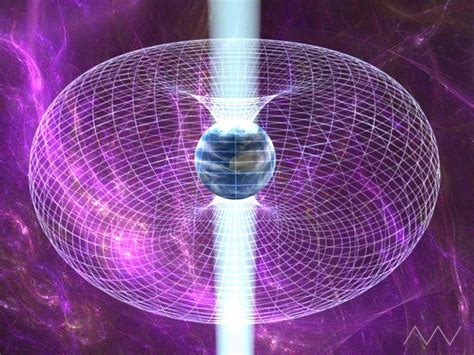
- Le champ magnétique de la terre protège des radiations venant de l'espace. Les aurores boréales sont créées par le flux magnétique entrant par les pôles qui interagit avec les particules de la haute atmosphère.
- Ce champ magnétique possède des fréquences de résonances résultant de la taille physique de l'atmosphère terrestre (les fréquences de Schumann).
A l'échelle de l'atome:
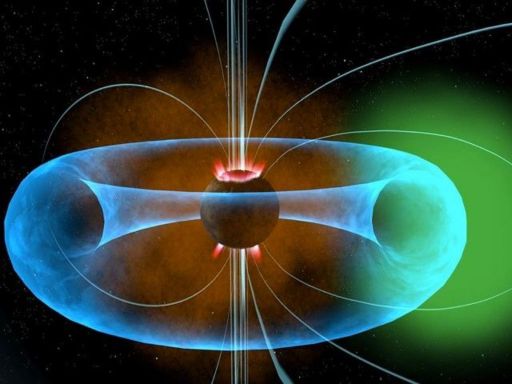
- Les champs de force atomique créent un tore à l'échelle de l'atome. Note personnelle: il est probable que ce tore ait plusieurs harmoniques (des "couches atomiques") qui correspondent aux couches atomiques autour desquelles les atomes ne peuvent prendre que des valeurs entières (c'est à dire "quantisées" d'où le terme de "physique quantique").
Entre les deux, à l'échelle du corps humain:

- Comme pour la terre,
- Protection contre les radiations extérieures. A noter que, comme pour la Terre, ces radiations devraient pouvoir circuler par le haut (7e chakra) et le bas (1er chakra). Mais elles resteraient confinées au bord extérieur et à la circulation interne verticale (Ida et Pingala, lien des chakras).
- Valeurs de résonance propre aux dimensions physique de ce champ (nos "fréquences de Schumann" personnelles).
- Comme pour l'atome,
- différentes couches correspondant à différentes harmoniques du système. Il est assez facile de ressentir ces couches avec les mains.
- Mais, comme pour un système vivant complexe, ces valeurs sont la résultante d'un nombre littéralement incalculable d'interactions des activités électro-magnétiques entre l'énergie, le corps et l'esprit. Ces valeurs peuvent donc changer de seconde en seconde. Avec un minimum d'entraînement, on peut soi-même ressentir des contractions ou expansions de ces couches en fonction des pensées, de l'environnement, ou des conditions changeantes.

Liens d'échelle
- A l'échelle terrestre: Les résonances de Schumann ont une valeur Elfie de 199, 200 et 201. La terre a une circonférence de 201 Elfie. La vitesse de la lumière a une valeur de 207 Elfie.
- A l'échelle humaine: les cellules ont des valeurs de résonance de 171, 180, 182 et 187 Elfie.
- A l'échelle atomique : l'eau sous forme de cristal liquide (dans nos cellules) a une fréquence de résonance de 135 et 140 Elfie. Les microtubules, de 130 et 132 Elfie. L'ADN, de 122 et 126 Elfie. Aux niveaux atomiques, on descend jusqu'à 116 Elfie pour l'hydrogène.
Le tore en physique:

BioCoherence et le Guide Personnel: construire son "bouclier personnel"
Le bruit blanc: le bouclier personnel
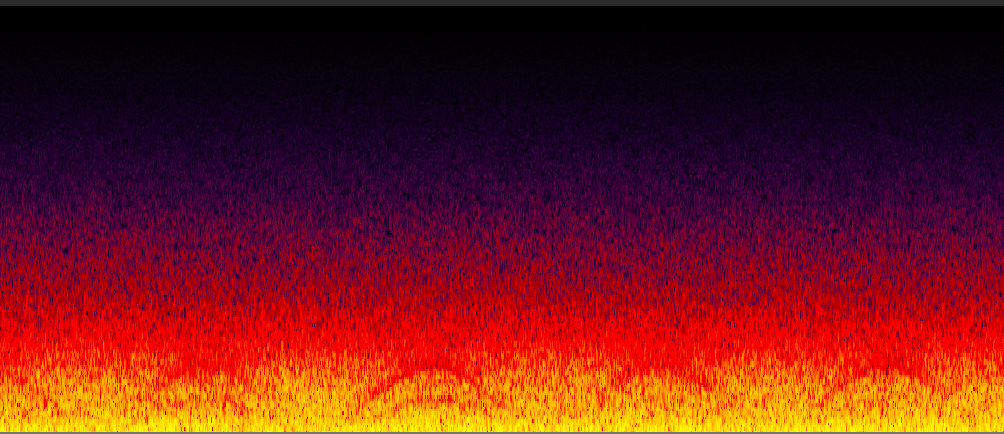
- Ces valeurs créent une rotation complexe en 3 dimensions qui ressemble à l'image B ci-dessus. Le champ est réglé autour d'un mètre autour de soi, afin de créer son propre cocon de protection durant la méditation.
- Le bruit blanc est intentionnellement fort par rapport à la voix. La voix est censée parler au mental, mais la méditation est avant tout une technique d'auto-hypnose où l'inconscient est censé prendre beaucoup plus d'importance que dans l'état normal de conscience. Ainsi, la voix doit être tout juste distinguée, à la limite de l'audition, afin d'être guidé de manière subliminale et de laisser une place prépondérante à l'inconscient.
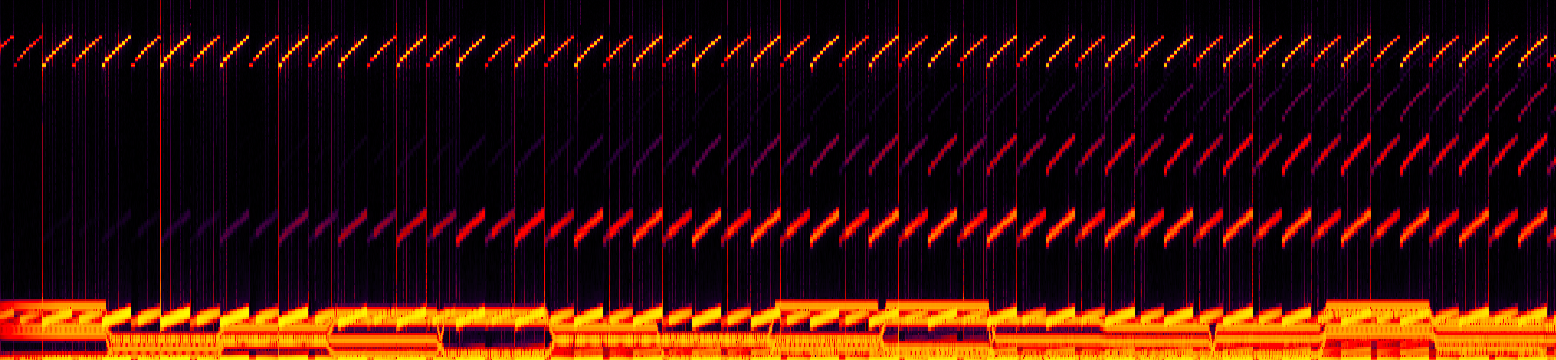
- Les fréquences audio ajoutées sont bioactives, leur volume et intentionnellement baissé car elles agissent par effet de résonance (une impulsion très faible suffit pour créer un effet, pour peu qu'elles rentrent en résonance avec un système).
Les fréquences et accords dans le guide personnel
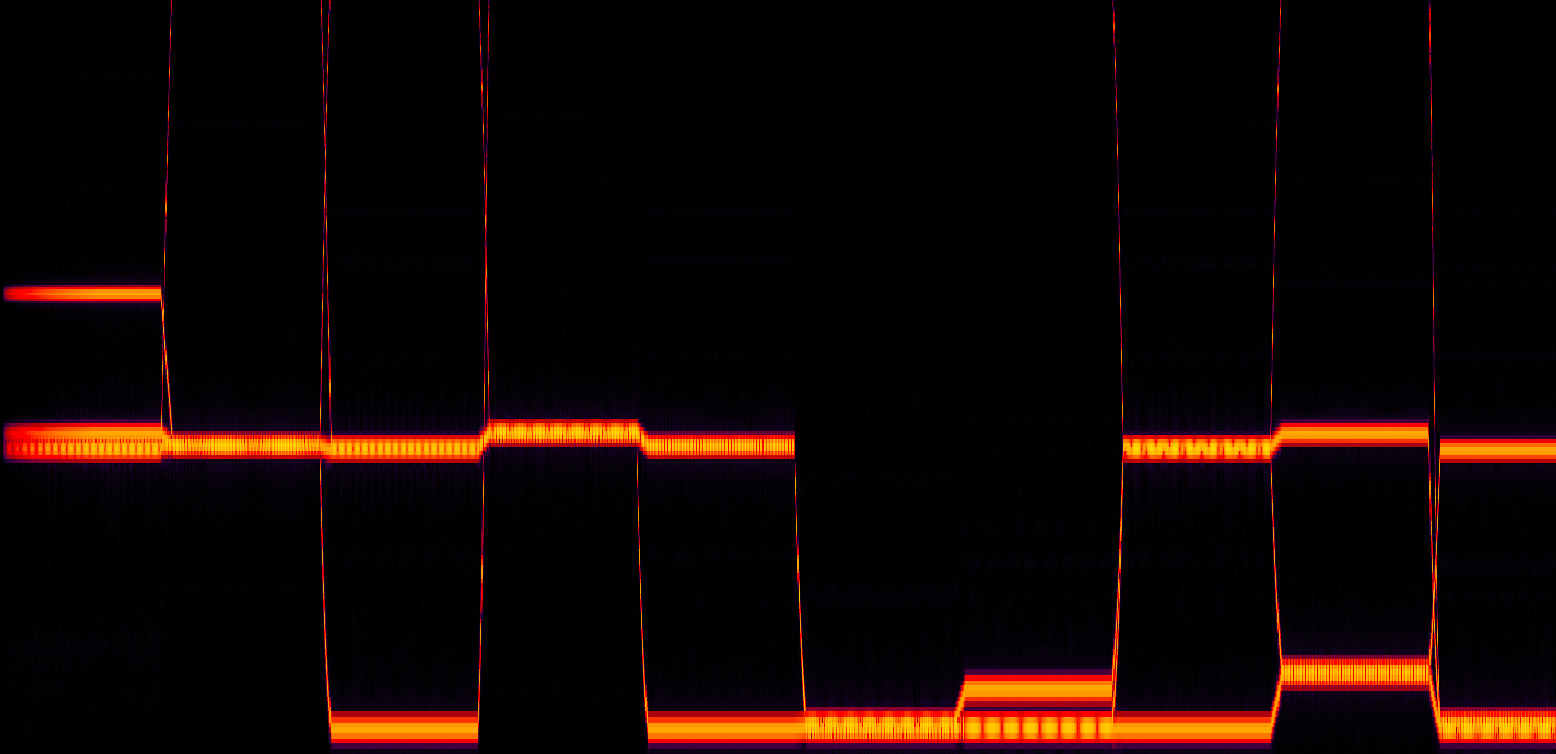
Accords de musique personnelle et respiration
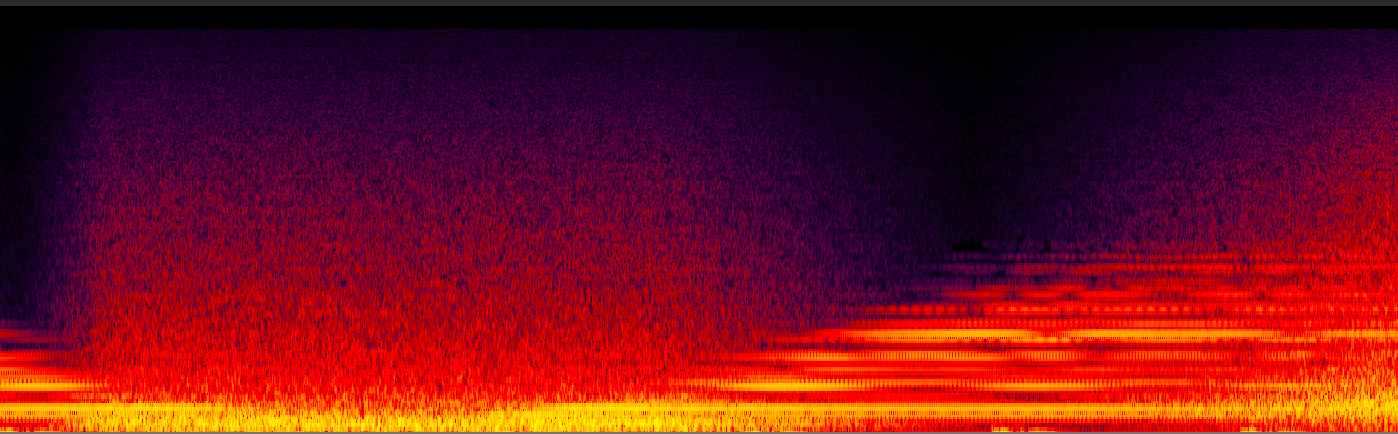
- la respiration, un fort bruit blanc
- l'accord personnel, dont les strates horizontales sont composées des harmoniques musicales de l'accord (BioCoherence détecte 432 accords personnels différents).
Fréquences bioactives (boost harmonique)
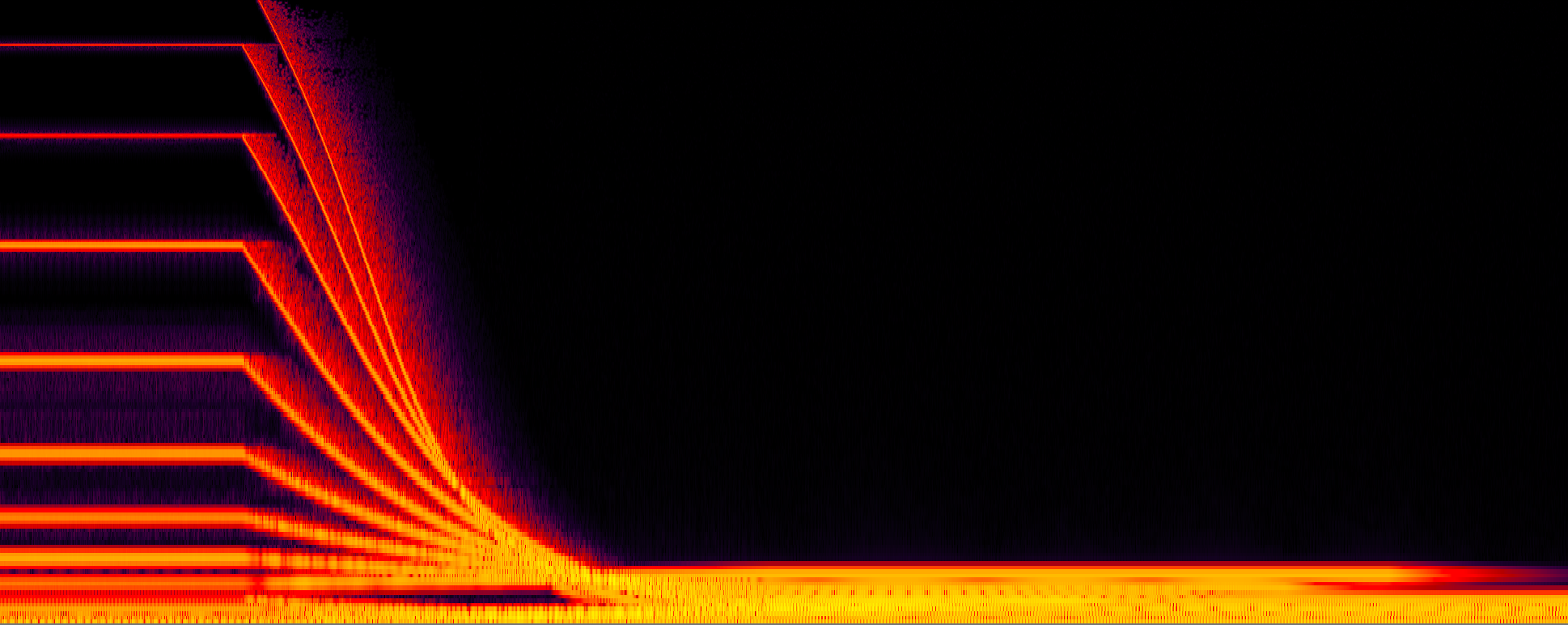
Méridiens d'acupuncture
Intro
BioCoherence 1.19
Le lecteur de méditation a été entièrement repensé pour une lecture transparente sur tous les appareils. Explorez la bibliothèque Balance, rebaptisée Sets, qui propose des outils de recherche et de personnalisation améliorés. Découvrez le nouvel écran "Courbes". De plus, profitez de synchronisations plus rapides, d'une création de MP3 améliorée et de bien d'autres choses encore. Read the newsBioCoherence 1.18
The Priorities screen gets a major upgrade with a refined automatic algorithm for precise prioritization. A new "pick a priority" tool lets you explore all biomarkers, TCM recipes, and meditation items. Introducing the Balance Library: save, share, and load priority lists for personalized or public use, including pre-set guided meditations accessible without a scan. Improved chakra visualizations, proactive Bluetooth connections, and enhanced voices (now available in English and French) round out this update. Read the newsThe 21-Day Balancing Program
The 21-Day Balancing Program is a transformative tool designed to help practitioners and clients alike achieve coherence in body, mind, and energy. Whether you're a seasoned practitioner or a curious newcomer, this presentation will provide a comprehensive overview of the program, its features, and its potential applications.What is the 21-Day Balancing Program?
The 21-Day Balancing Program is a structured, customizable protocol within the BioCoherence software that combines personalized frequency programs, guided meditations, and biomarker analysis to promote holistic well-being. Designed for both practitioners and end-users, the program offers a daily regimen of meditations and frequency-based interventions tailored to the individual's unique needs.The program is built around the principle of coherence—achieving harmony between the body, mind, and energy systems. By leveraging advanced algorithms, the software generates a personalized plan based on the user's biomarker analysis, which is conducted using the BioCoherence sensor.How Does It Work?
- Initial Scan and Analysis. The process begins with a scan using the BioCoherence sensor. This device measures various biomarkers, including energy flow, organ function, and emotional states. The data is then analyzed to identify priorities (areas that need immediate attention) and resources (strengths that can be leveraged for healing).
- Personalized Program Generation. Based on the analysis, the software generates a 21-day program that includes: - Frequency Programs: Pure sinusoidal frequencies designed to address specific biomarkers. - Guided Meditations: Spoken-word meditations tailored to the user's needs, incorporating binaural beats and other sound therapies. - Acupuncture Points and Recipes: Recommendations for Traditional Chinese Medicine (TCM) points and recipes to enhance the program's effectiveness.
- Daily Engagement. Users engage with the program daily, dedicating 30-40 minutes to the guided meditations and frequency programs. The software tracks progress, allowing for periodic re-evaluations to refine the program.
- Re-Evaluation and Updates. Practitioners can conduct re-evaluations every few days to update the program based on the user's progress. This ensures that the interventions remain aligned with the individual's evolving needs.
Key Features of the 21-Day Program
1. Guided Meditations
The guided meditations are a cornerstone of the program, combining spoken-word guidance with sound therapies like binaural beats. These meditations are designed to target specific areas identified during the initial scan, such as emotional balance, energy flow, or organ function.- Customizable Length: Users can adjust the duration of the meditation, ranging from 19 minutes to 90 minutes, depending on their schedule and needs.
- Mute Option: For those who prefer silent meditation, the software allows users to mute the spoken guidance while still benefiting from the frequencies and soundscapes.
- Daily Rotation: The meditations change daily, ensuring a dynamic and engaging experience.
2. Frequency Programs
The frequency programs are another critical component, delivering pure sinusoidal frequencies to the body. These frequencies can be played through headphones, speakers, or even specialized devices like plasma fireballs.- Transducer Technology: Users can place headphones or other transducers on specific areas of the body to target localized issues.
- Subset Selection: The software allows users to filter frequencies by categories like mind, body, or energy, enabling focused interventions.
- Export Options: Practitioners can export frequency programs as MP3 files, allowing clients to play them on loop throughout the day.
3. Biomarker Integration
The program integrates biomarker data to create a truly personalized experience. Key biomarkers include:- Energy Flow: Identifying blockages or imbalances in the body's energy systems.
- Organ Function: Highlighting areas of physical health that need attention.
- Emotional States: Addressing psychological and emotional well-being.
4. Acupuncture and TCM Integration
The software incorporates Traditional Chinese Medicine principles, recommending specific acupuncture points and recipes based on the user's analysis. These points are seamlessly integrated into the frequency and meditation programs.5. Cloud-Based Sharing and Monitoring
Practitioners can share the program with clients via the cloud, enabling remote monitoring and updates. Clients can access their reports, frequencies, and meditations through the BioCoherence app, ensuring continuity of care even from a distance.Practical Applications
For Practitioners
The 21-Day Balancing Program is a powerful tool for practitioners, offering:- Client Retention: The program encourages clients to return for periodic re-evaluations, fostering long-term relationships.
- Remote Monitoring: Practitioners can track client progress remotely, making it easier to manage multiple clients.
- Customizable Interventions: The ability to add custom meditations or frequency protocols allows for highly personalized care.
For Clients
Clients benefit from:- Convenience: The program can be accessed from home, making it ideal for those with mobility issues or busy schedules.
- Empowerment: By engaging with the program daily, clients take an active role in their healing journey.
- Holistic Care: The integration of physical, emotional, and energetic interventions ensures a comprehensive approach to well-being.
Innovations on the Horizon
The BioCoherence team is continually refining the 21-Day Balancing Program. Upcoming features include:- Custom Meditations: Practitioners will soon be able to create personalized meditations for individual clients, complete with custom scripts and audio.
- Language Expansion: The software currently supports multiple languages, with plans to add more, including Chinese.
- Pre-Loaded MP3 Players: A branded MP3 player with pre-loaded frequency programs will soon be available, allowing clients to carry their healing frequencies with them throughout the day.
BioCoherence 1.17
The Android version is now available for testing! Explore highlights like 16,000 recomputed audio guidances in four languages, revamped event editing with enhanced usability, and improved biomarker flower displays. The Frequencies feature now includes advanced filtering options, MP3 exports with album metadata, and seamless playback of your last used frequency or meditation directly from the home screen. Zoom into graph zones, enjoy revamped comments, and access intuitive priority and report features. Dive into frequency MP3 sharing and explore its profound benefits with BioCoherence! Read the newsBioCoherence 1.16
The Android app is ready for testing (v1.15 on the Play Store). A powerful device is recommended for calculations, but most decent devices can run meditations and frequencies smoothly. Highlights: • Languages: Polish, Spanish, and German added (audio guidance translations coming soon). • Prevalence Filters: Filter biomarkers by system in the prevalence screen. • Frequency Export: Faster exports with a 10-minute audio limit. • 21-Day Meditation: Direct access from the Home Screen. • Algorithm Enhancements: Improved detection of priorities and resources with updated evaluations for "low resource score" recipes. • Meditation Lists: View full descriptions for each item with a simple click. Read the newsBioCoherence 1.15
Apple Watch Import & Meditation Optimizations! Explore the new Home Screen for first-time users, featuring direct Apple Watch import and step-by-step guidance. Enjoy faster file access with delayed heavy calculations until needed in "Understand" or "Analyze" screens. Improvements: • Balance: Offline-ready daily guidances, revamped Balance screen, 21-day journey preview, and a daily progress bar. • Priorities: Enhanced algorithm for precise priority detection and bug fixes, excluding negative drives as resources. Experience streamlined functionality and optimized workflows in this update! Read the newsBioCoherence 1.14
The user webinar series continues
Update highlights: remote tests, sleep mode, progression curves...
- new option to switch between "play" (decluttered menu) and "understand" (complete menu) on the Home Screen of a report.
- new declutterred Home Screen for users that come from a Pro invitation. The Home Screen shows his reports, and the open report now proposes "Play" by default: PDF, frequencies, meditation; and record a test if needed.
- better share flow from a Pro to a user: the current report is immediately send to the cloud, and if modifications, updates needed to be sent again the cloud are now displayed on top of the screen. There is now an alert on both sides if a report is updated by the other side, prompting to sync with the cloud.
- List pre-evaluation is now immediately displayed if a scan exists.
- Ask for test is now active: a Pro can ask for a remote user to test locally the selected items. As the user opens his app, the test elements are ready to test with his sensor, anywhere in the world, using a real local ECG measurement. The results are sent back to the Pro through our Cloud. (next steps: notification sent to the user that will update the report and open it when clicked. Without notification, the Pro should send an invite to the user, and the user will open the report that will prompt him to update from the cloud).
Balance
- better insertion of protocol frequencies in the meditation.
- new screen, with buttons on the bottom and new options in the screen.
- new daily progression, with meditation changing every day.
- new graphics in Balance, with the progression of each priority in a nice curve. Display of today's curves, or all priorities curves.
- New end choice: "sleep" or "awake". For "sleep", 132 new audio guidance endings, with a long fadeout, and different evaluation of priorities.
Frequencies
- New loop player in frequencies: loop on a single block (one physiology program and its related protocols, playing again and again until you stop, to push strongly on a particular intended effect). Only available if protocols are added to a physiology program.
Report flow between Pro and User
- Usually a report is started with a scan or a test on the Pro's Sensor, and decisions are made by the Pro: resources, priorities, frequencies, protocols, comments, etc.
- The Pro then shares with the User. When clicking "share with the user", the report is immediately sent to our secure Cloud and made available this instant to the user.
- If this is a new user, the Pro sends an invite to the user. If not, the user simply starts his app. If both cases, the user logs with his email (that the Pro has entered in his account) and immediately sees the report, and can import it and open it.
- If the Pro amends the report, he will be prompted to sync it with the cloud at the end of his modifications. This will update the report on the cloud, and the User will see a hint to sync his locally saved report with the cloud.
- If the User amends the report (usually by recording a re-evaluation or performing a test prepared by the Pro), the same happens with the Pro, that sees a prompt to sync it with the cloud the next time he tries to open it.
Report started by a User
- in some cases the User can be the one that starts a report, by doing a new recording. In this case, the User has the ability to share it with his Pro (if he has no Pro, he can choose a Pro from the Pro directory first). The Pro will the receive the User in his contacts lists, and can import the report from the cloud and start working on it. When the Pro is done, he just has to click "sync with cloud" and the report is sent back to the cloud, with a prompt to sync it on the user side.
BioCoherence 1.13... and a book !
The user webinar series continues
We need your feedback: help us perfect biocoherence and receive gifts!
Now, there's a book on Biocoherence
Sing the Body Electric
Is it possible to make Sense of the Electricity in Your Body?
Empower your health and rediscover your body, your energy and your mind with the groundbreaking insights of BioCoherence: learn how every cell, organ and emotion resonates within your body's electric matrix—and take control of your health and personal progress!
Buy on Amazon (Kindle e-book or Paperback, English and French editions)
- US - English https://www.amazon.com/dp/B0DJNG7FH2
- France - English https://www.amazon.fr/dp/B0DJNG7FH2, French https://www.amazon.fr/dp/B0DJNJ9P1C
- UK, Germany, Spain, Italy, Netherlands, Poland, Sweden, Japan, Canada, Australia, India, Mexico, Brazil... see biocoherence.net/book or your amazon app.
Now, back to the week's update.
Update highlights:
- There is no zoom anymore on the top of the biomarker session evolution screen. The switch from play/pause is now controlling the zoom of this graph, along with the ones in frequency, harmony and the new one below. In 'stop' mode, all graphs display the average value for each biomarker, and the whole recording. In 'play' mode, the values are shown at the time of the play head position, and the graphs are zoomed to 50 beats. Just move the play head position to scroll through them. In 'stop' mode with several parts, the zoom also automatically adapts to the current part.
- New graph in Spectrum: "Polygraph". This screen mainly uses academic biomarkers. This is a convenient way to see in a glance e.g. the VHF, HF, LF and VHF proportions, and a linear graph of up to 7 important curves. This can be used in real time during recording, as all screens (just switch screen during a recording). All these markers come from the academic research on ECGs.
You can display up to 7 bands of your choice, in parallel or centered on the same line. - In "Bands" mode, the 7 lines are: Bpm, HRV, Mayer waves, VHF, HF, LF and VLF.
- In "Ratios" mode, the 7 lines are: SDNN (Total power), SI (Stress index), IC (Index of Centralisation), LF/HF (Power, vago-sympatethic interaction), LF/VLF (Relax), VLF/HF (Stress) and VLF+HF (Global activity).
- In "Systems" mode: CNS, Ortho, Symp, Para, IRSA, Immunity, HRV.
- In "Brainwaves": Delta, Theta, Alpha, Beta, Beta1, Beta2, Gamma.
- If you do research with this graph, it could be the basis for new insights or new biomarkers. In addition, you can analyse any biomarker in its timeline and with events on the biomarker session evolution screen.
- The photo import bug is fixed. Remember, you have to confirm a photo to actually import it.
- Meditation duration is now dynamically set according to the user's choice.
- Meditations are now dynamically changing every day. You can set as many priorities as wanted, and they will be included each one in turn in the daily meditation, as needed. Default daily duration is about 30 minutes, and can be changed by the user.
- Update on the fourth algorithm is now available: "low resource score".
- Duration of physiology program set when a protocol is added to a physiology program.
BioCoherence 1.12
- Confidentiality mode, to blur all names and photos on the screen.
- General speed enhancements on older devices. Don't expect miracles, the app is still power-hungry. As a general rule, there should be no lag in navigation; if there is, please use a better computer.
- We don't automatically save recordings anymore if they are short.
- All texts are now translatable (and translated), including previously hard-coded texts like meridian/points descriptions, MTC recipes etc. We also fixed a bug in Korean where titles were truncated.
- For your support requests, ticket answer info and management directly in the app.
- Bluetooth request is delayed until first effective use, instead of first app launch. This is because the app is only allowed to ask for your approval once. If you say no, there is no way to allow the app to request Bluetooth again, you have to go to the systems preferences and find a way to check the acceptance - or just reinstall the app... For this reason, there is a new message in the Bluetooth panel, if by mistake the initial request had been denied.
- "Read Manual" now opens in your browser. That also allows downloads of the PDF manuals.
- New "prevalence" screen, to list all biomarkers by petal state. This can help identify patterns and better understand the general image of a scan.
- Edit your own data from the home page now leads to "my account".
- Birth date and notes are now hidden by default. Click on "more infos" to show them. We don't use this info for now, it is only for your reference. We will also add height, weight and some other health data for future age-, height- and weight-related biomarkers.
- Durations are now expressed in Elfie values.
- Total export duration in .wav or .mp3 is automatically adjusted for very long programs, as a too long audio file might crash the app. Exports are limited to about 30 minutes, with an automatic adjustment of all programs to fit the available possible duration.
- Exports defaults to mp3 in one-clic. If you cancel the mp3 part by clicking "stop encoding", it will propose you to export the .wav instead. The whole process is done in background and you can use the app meanwhile, but don't reduce the app or hide it while it exports, as this will result in the app losing computing resources and the export taking ages.
- New button in the report tools to send the PDF by mail to the customer in 1 clic. The PDF is uploaded to our cloud and the mail is sent from our server, so the sender is reports@biocoherence.net, not you. If you want to be the sender, you have to use the "share" function, or save it and attach it to your regular email app.
- PDF export and save now works on Windows, Mac and Linux. Additionally, you can export as .htm, which is a modifiable format, if you want to edit it.
- The French voices are now entirely available. (the English voices will be cleaned later this month to fix the small glitches)
- Lists with type "Meditation": if you select multiple items from the same meditation list, they will be played sequentially, one per day. This shows on the report and in the meditation text. In this way, the meditation also evolves every day in a progression.
- A fourth algorithm is now available: "low resource score". When you explore priorities, this will be presented first (before "in sync"," interesting energy" and "interesting agitation"), and will show the elements with the lowest resource score (the contrary of the resources panel, so to say).
- some enhancements in these important screens:
- Personality: now shows some information texts to explain the 4 axis and the position in the scan, and also the stability or flexibility of this position.
- Momentum: restraints are now split in 2: geopathy and biology.
- Drives: the average between the positive part and the negative part of each emotion is now clearly shown. You can now clearly see the baseline between the positive and the negative part of each bar. More enhancements to come for this screen, because it might be one of the screens you end up spending the most time - it is so interesting...
- the manual will be updated with the contents of the user webinars. This will be done each week after each user seminar...
Our user webinar series starts: each thursday at 16:00 (EU time), starting tomorrow
Dear BioCoherence users,BioCoherence 1.11
- Improvements in interface, cloud loading and software. English is complete; French is almost complete and will be in approximately one week.
- Please note: this is still a preview and some texts have small glitches. We are still refining and polishing all texts.
- Improvement in certain part, like meridians and chakras (now with specific sounds), chords ...
- Add protocols directly from the frequency program page: improvements in protocol selection.
- Export in .wav or .mp3 the frequency program. Now defaults to mp3. It works better, and even, it does not crash anymore in certain circumstances, which is definitely better. Also, the export(save as) function now works on versions for Windows, Mac and Linux.
- More frequencies added and played during testing and harmonisation on biomarker and protocols.
- Print and save as now works on versions for Windows, Mac and Linux. (saves as .htm and not .pdf for now).
- Many behind-the-scene enhancements in cloud lists management (pictures, dynamic loading, invitation code for a private list...). Picture is now displayed in big during the individual test.
- On large screens (computers), lists are presented in a new multi-column view.
- Pictures are now front and big. Try the herbs, essential oils or aromas lists!
- we've tackled the various Bluetooth problems when recording and it seems much more reliable now. It even seems Bluetooth now works on Linux. But who is on Linux here, except Antoine? :)
- quickopen files are entirely recalculated in they are from a former version, to take new algorithms and biomarkers into account.
- much quicker interface on iPad, Windows, Mac and Linux versions.
- various fixes and improvements (particularly in the Bluetooth and recording section).
- various blockages and crashes fixed.
BioCoherence 1.10
- Guided meditations preview: actual audio guidance (in English only for now). almost 4000 custom-made audio guided meditations parts in each language.
- Please note: this is still a preview and a lot of texts have small glitches. We are still refining and polishing all texts and the actual correct guidances will be available later in the month.
- Includes all specific sounds, binaural beats and frequencies, chords with breath work (we have more than 450 chords in our chord detector and we play the one that has been measured in the client's energy), and some specific sounds linked to meridians, chakras, etc. (my goal is to have different ambiences for the different parts: intro, organs, chakras, meridians, drives, emotions etc.)
- You can target the desired duration of the meditation.
- Add protocols directly from the frequency program page.
- Export in .wav or .mp3 the frequency program. You can then use this audio file to balance the frequencies through any audio player, the client's smartphone, or use any kind of transducer to apply them electrically or magnetically locally from any audio jack output.
- In any case, the complete frequency program is inserted in the audio meditation, as binaural beats or frequencies.
- you can now add as many "favorites" biomarkers as needed to see them all in the progress page.
- New list type: Product. Build AI-assisted product lists: automatic product contents retrieval; automatic organ effects assessment via our AI cloud. Also, automatic preselection of suggested images. You can then pre-evaluate with the client's scan in all this product catalog, and confirm with individual tests.
- New list type: Meditation, with AI-enhanced writing and request for audio file (the meditation, if approved, will be available in the same voice as the other meditations). It will event try to find what organs might be balanced with this particular meditation. You can then pre-evaluate them, confirm them with an individual test if needed, and add them in 1 clic to the client's meditation.
- the app is now available as a preview in Korean (corrections pending). We are open to suggestions as to what new languages we should work on for the interface, please tell us!
- various fixes and improvements (particularly in the Bluetooth and recording section).
BioCoherence 1.9.23
- An infinity of custom-made audio guided meditations with more than 3800 combined parts per language and per guide
- preview of the full meditation text in the balance module
- full personalised 30-min to 1-hour meditation based on resources and priorities, with spoken words guidance, specific frequencies and personal musical elements and rhythms, as measured in the pulse. (available in 2.0)
- Physiology, emotions and energy biomarker balance: more than 10000 specific frequencies for more than 1000 different programs
- Therapeutic, pathologic and improvement protocols: more than 7000 balance-oriented therapeutic and improvement frequencies and binaural beats in 2500 specific protocols
- test of any individual balance program or protocol with immediate biofeedback answer
- remote test through our cloud (available in 2.0)
- audio frequencies player on each biomarker for immediate balancing and protocols choice with pre-evaluation
- construction of a specific frequency program with biomarkers balance and protocols attached to specific biomarkers (a protocol is played encoded on a specific biomarker balance program to direct its resonance to the part needed); play and export of frequency program (export available in 2.0)
- now includes more than 6500 new interpretation texts (description, action, emotional interpretation, biomarker quality)
- now includes the full meditation text
- new "explore" button to refine priorities
- 420 TCM points now computed with links, resources and priorities
- drives and momentum now computed as priorities and resources
- subdoshas now computed as priorities and resources
- reworked resources panel
- refined algorithm
- new filetype choice: quick open or small (defaults now to quick open, with no compute necessary on open)
- various interface improvements
BioCoherence 1.9.9 and launch promotion
- various graphic fixes
- record animation stops if measure stops
- new measure quality indicator during recording
- new recording features: auto-stop when sufficent data
- recording and live biomarkers compute optimizations
- bigger client image on home screen, now static
- technical log now sent with support ticket
- 'reports' are now 'recordings' to avoid confusion with the PDF report
- new PDF report editing tools (comments, hide sections...)
- new PDF report feature: preview from recording lists
- promo: the chakras screen is free access for all
Launch promotion
What are your questions for our upcoming BioCoherence webinar?
Submit Your Questions for the BioCoherence Q&A Webinar!
BioCoherence 1.8.8
- Reports: - much quicker processing- some biomarkers were not clickable. Now you can click on all biomarkers, including recipes, to get more info (it opens the bottom biomarker panel, that also includes direct links to the relevant scan pages)- new top menu for quick access to report sections.- possibility to share/make pdf/print only the active section as selected in the top menu. To print the whole report, just click "Whole" (the first element in the top sections list) before printing.- new report subtitles
Wow! but how?
BioCoherenceテクノロジーの仕組み
わお!でもどうやって? これは新しいユーザーが初めてスキャンした後に尋ねる主な質問です。
簡単に説明しましょう。もっと深く知りたい方は、後に詳しい説明があります。
簡単な説明
生データからインサイトへ
BioCoherenceは、医療認証されたセンサーを使用してECG(心電図)記録から始まります。主に心臓の電気活動を記録する一方で、センサーは体全体の電気活動も捉え、左手の指から右手の指までをカバーします。この包括的なデータは、心臓のリズムが支配する主要なECG記録として表示されますが、他の微細な電気活動も示します。
データ処理と分析
生データから特徴へ: 初期のECG記録には、心臓の主要なリズムと他の電気周波数が含まれています。自動フィルタリングにより、問題のあるビート(例えば、動きによる)を除外し、正確な分析を可能にします。
多層分析:
- 一次分析:
- ECGから主なデータを抽出し、特定の周波数(VLF、LF、HF)や時間ベースの間隔(HRV)を示します。
- 広範な公表された研究を使用して、学術的バイオマーカーを導出します。
- 二次分析:
- 一次データを分析して、新たな特性(調和やエントロピーなど)を明らかにします。
- 注意や意図などの特性を含む追加のバイオマーカー情報を計算します。
- 三次分析:
- 要素間のリンクや共鳴を特定し、エネルギー的な関係を示します(例:臓器間)。
- 複雑なアルゴリズムを使用して、TCMレシピや関連要素を計算します。
- 四次分析:
- リソースと優先順位を計算し、最も重要なバイオマーカーを示します。
- ユーザーの健康に関する一貫した概要に発見を統合します。
ユーザーベネフィット:
- スキャンモジュール: 詳細なバイオマーカー分析、体のマップとグラフを提供します。
- テストモジュール: リアルタイムのバイオフィードバックとオープンな作成システムを提供します。
- バランスモジュール: カスタムメディテーションとレポートを生成します。
日常の価値: リソースや優先順位などの高次の情報に焦点を当て、ユーザーに最も実用的なインサイトを提供しつつ、すべての詳細データへのアクセスも可能にします。
結論として、BioCoherenceは高度な数学的アルゴリズムを使用して、生のECGデータを価値ある健康インサイトに変換し、体の電気活動に関する包括的な情報を明らかにする多層分析を提供します。この革新的なアプローチは、ユーザーのウェルビーイングを向上させるための実行可能なデータを提供します。
詳細な説明
詳しく掘り下げてみましょう... 技術的な内容に入らず、できるだけ深く答えようとします...
最初は生の記録でした
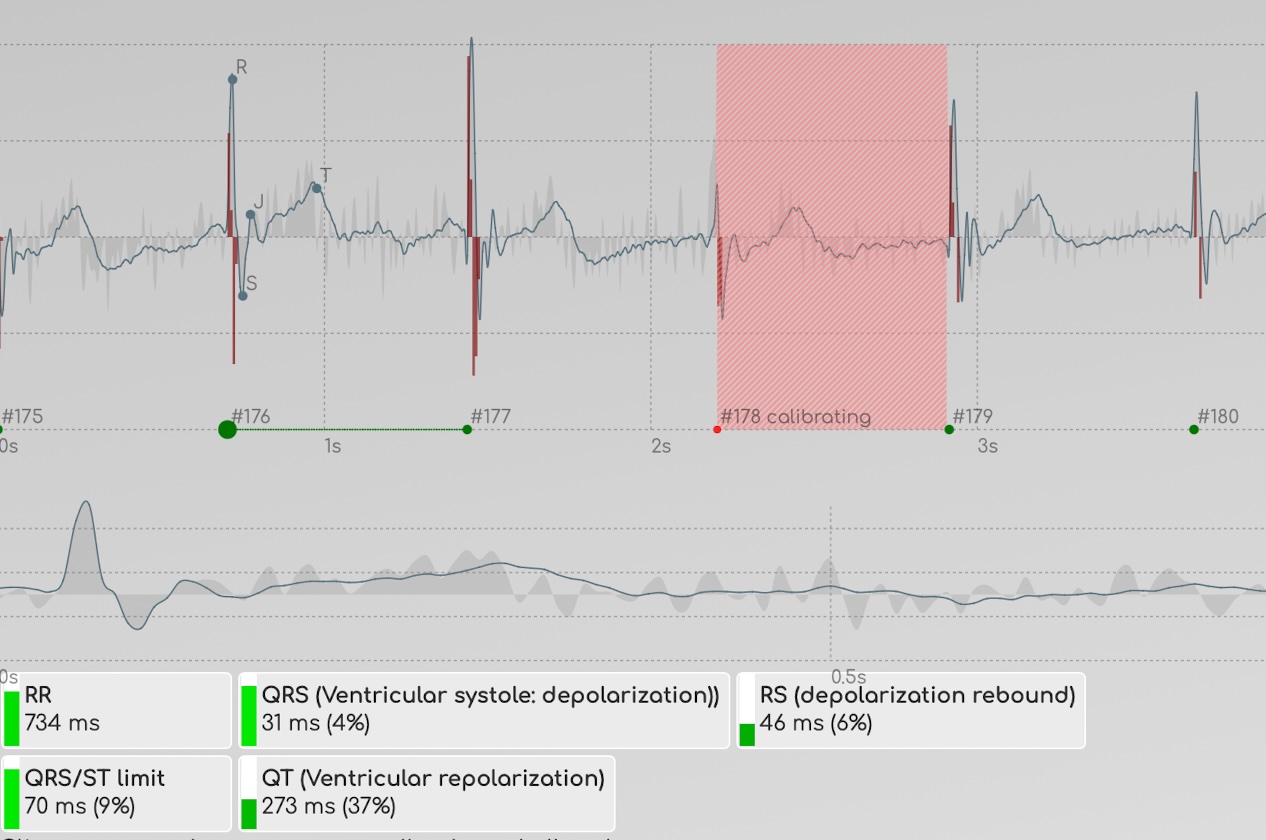 BioCoherenceはECG記録から始まります。ECGは「心電図」を意味し、心臓の電気的活動を記録するために主に使用される医療認証されたデバイス(当社のセンサー)を使用します。しかし、ここに落とし穴があります:心臓は最も強力ですが、電気的活動を持つ体の唯一の臓器ではありません。脳もそうです(EEG、脳波計に表示されます)が、実際にはすべての臓器、すべての原子、すべてのシステムには磁気的および電気的活動があります。左手の指から右手の指まで測定することで、センサーは心臓の拍動率インパルスだけでなく、全身の磁気的および電気的活動を記録します。
したがって、最初に得られるのは多くの電気情報であり、これは主なECG記録として表示されます。これは明らかに心拍の主要なリズムに支配されていますが、この主要な活動の下で多くのことが進行しており、BioCoherenceでは主波の周りで振動する灰色のラインとして表示されます。ここで、何千ものバイオマーカーの活動を再構築するためのデータを見つけることができます。
周波数ページで見ることができます:周波数グラフの下部近くには常に暗い線があり、これは最も重要な周波数(拍動率)ですが、記録内に存在する他の多くの周波数も見ることができます。この周波数グラフは、時間ベースの情報を周波数ベースのグラフに変換することによって、記録波を別の方法で見ることができるが、これは依然として同じ生の情報です。
ユーザーが動いたために電気信号が数秒間オフチャートになった場合など、問題のあるビートを除外するために自動フィルタリングを追加しました。この時点で、私たちはこの記録を分析し、特徴を抽出し始めることができます。
出現する特性
システム理論には「出現する特性」という重要な概念があります。簡単に言えば、各新しい複雑さのレベルには、下位のレベルの特性から直接導かれない新しい特性が現れることを示しています。たとえば、2つの非常に可燃性のあるガス(酸素と水素)を混ぜると、これらのガスからは予測不可能な特性を持つ安定した液体(水)が得られます。これが、私たちが多層階注文分析を行う理由であり、各レベルは前のレベルの特性を使用し、各レベルが前のレベルには存在し得なかった新しい関係を明らかにします。
これらはすべて純粋に数学によって行われます。主にランダム数生成器に基づいている他の「エネルギー評価装置」とは異なり、BioCoherenceのアルゴリズムは純粋に数学に基づいているため、録音の結果は常に正確に同じになります。実際、録音を開くたびに計算全体が再度行われます。
次に、一次分析が行われます
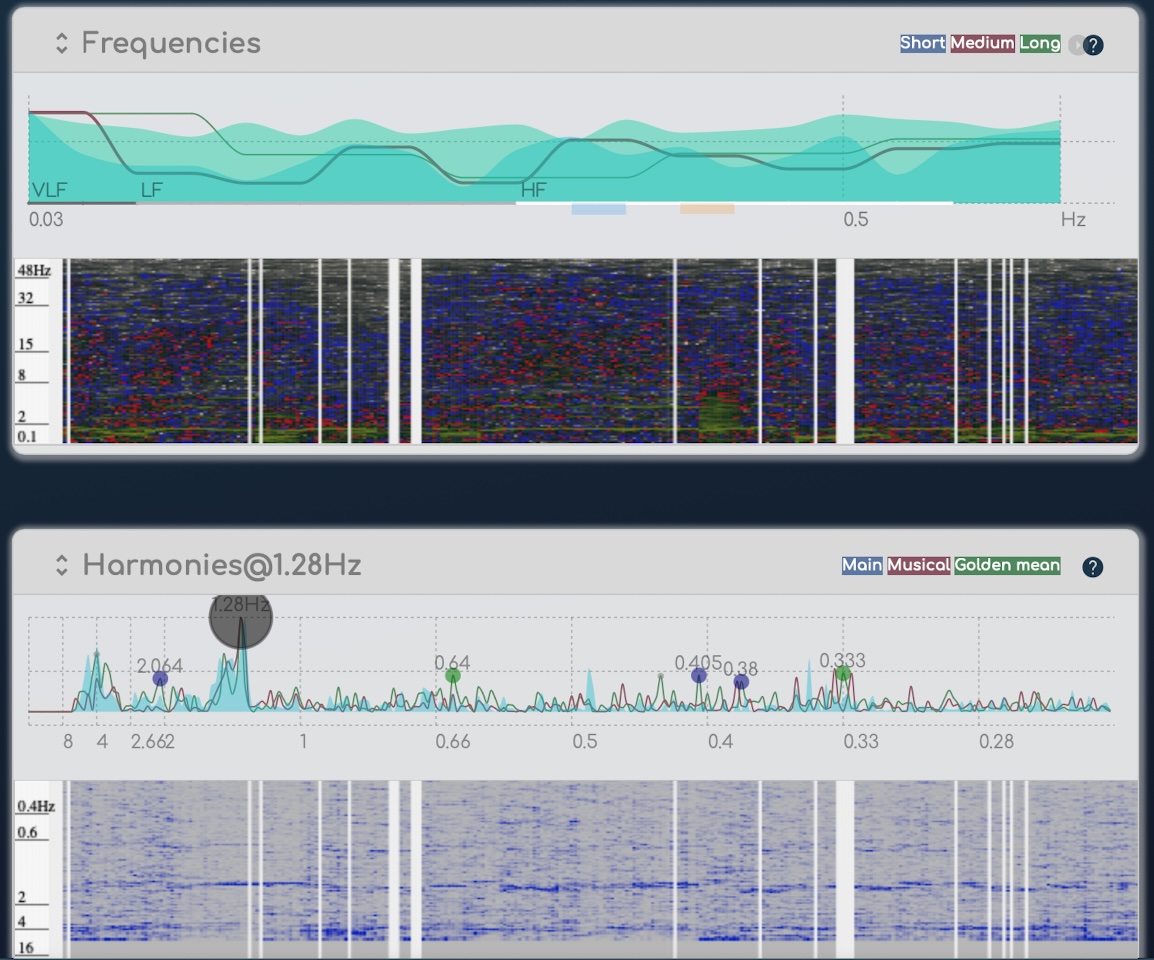 さて、私たちのアルゴリズムはこの生データに対して一次分析を行い、一次情報を抽出します。これは、特定の周波数または周波数範囲(VLF、LF、またはHFのように)や時間ベースの間隔分析(HRVのように)から得られることがあります。
私たちは、通常は一緒に話さない非常に多様なECG研究者によって発表された多くの研究を利用して、このレベルで抽出した幅広い情報のリストを作成しました。
この一次分析は、主に学術的バイオマーカーを提供します。これは、公式な研究が通常ここで止まるためです。信号処理は医療研究では通常かなり限られているからです*。一方、私は音楽信号処理を適用しており、これははるかに進んでいます。90年代以降、DSP(デジタル信号処理器)が音楽におけるアナログ処理に取って代わったため、デジタル録音を理解し、エミュレートし、処理するために多くの研究が行われてきました。音響効果やリアルタイムでデジタル音楽コンテンツを調整するためのさまざまなツールのような多くのツールが含まれます。これは基本的に、BioCoherenceで使用している同じアルゴリズムです:音楽処理において音響エンジニアが知っている高度な数学であり、医療アプリケーションでは誰も使用していません。
*: 余談として、1994年に発表された査読付き論文が、心電図の曲線下の面積(威張ってAUCと呼ばれる)を計算する非常に新しい方法を説明していると冗談を言う人が多いです。これは査読付きジャーナルに掲載されるのに十分に興味深いと見なされました。しかし、少しでも数学の訓練を受けた人なら誰でも知っているように、これは「積分」と呼ばれ、大学で学び、何世紀も前に発見されています。それにもかかわらず、ほとんどの公式研究はこのレベルの数学にとどまっています。二次分析が面白くなり始める
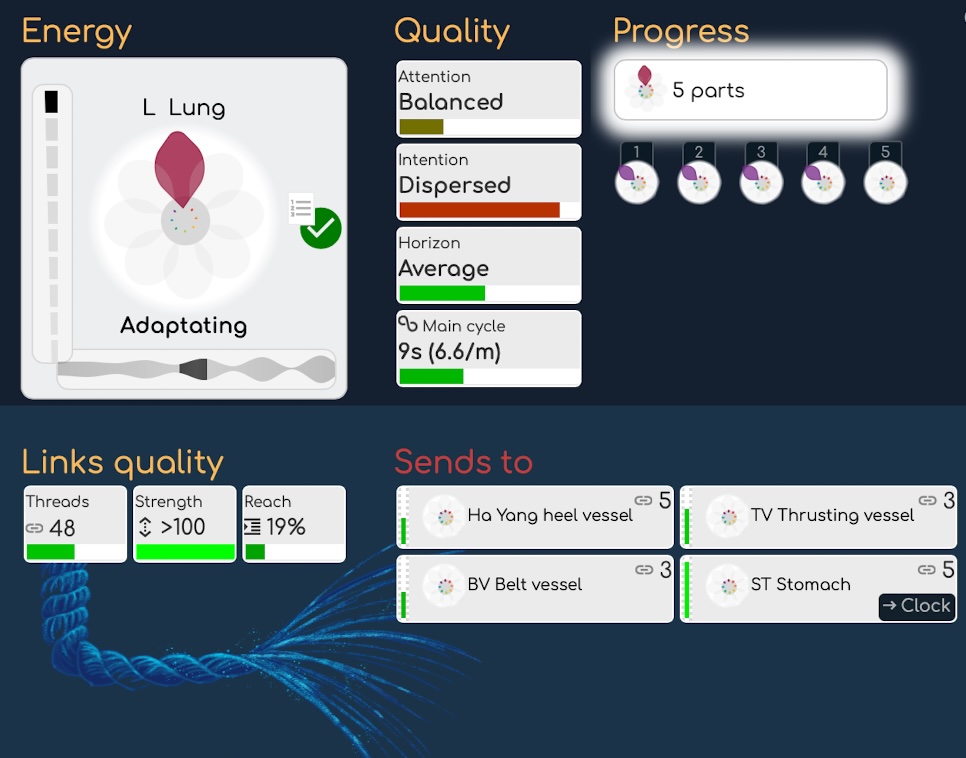 この一次データを得た後、私たちは新しい特性を得て、これらの新しい特性についていくつかの二次分析を行うことができます。例えば、一次分析としてスペクトルを計算しました:FFT(高速フーリエ変換)と呼ばれる数学的アルゴリズムのおかげで、生の記録を波ではなく周波数として表示できます。さて、二次分析では、信号の周波数ではなく、ハーモニクスを抽出することを可能にするケプストラム(2ndオーダーのFFT)を計算します:つまり、調和的に共鳴する周波数を抽出します。これらの結果を使用して、新しいバイオマーカーを得ることができます。
- 別の2ndオーダー分析の例は、各バイオマーカーのエントロピー(または「動揺」)の計算です。つまり、特定のバイオマーカーが静的であるか動揺しているかを示します。
- 2ndオーダー分析の別の例は、バイオマーカーの右側に示される特性、例えば注意、意図、地平線(音楽的特性から抽出された特性)、および主要なサイクルです。
信号に対して多くの2ndオーダー分析が行われており、多くの新しいバイオマーカー情報を得ています。しかし、ここで止まるわけにはいきません。この新しいレベルは、以前には存在しなかったいくつかの新しい興味深い特性を明らかにします。
再度、私たちは非常に多様な研究者によって発表された多くの研究を使用しました。今やECGデータではなく、アーユルヴェーダ、TCM、エネルギー評価、現代医学などの療法特有のデータに基づいています。
三次分析:リンクと共鳴
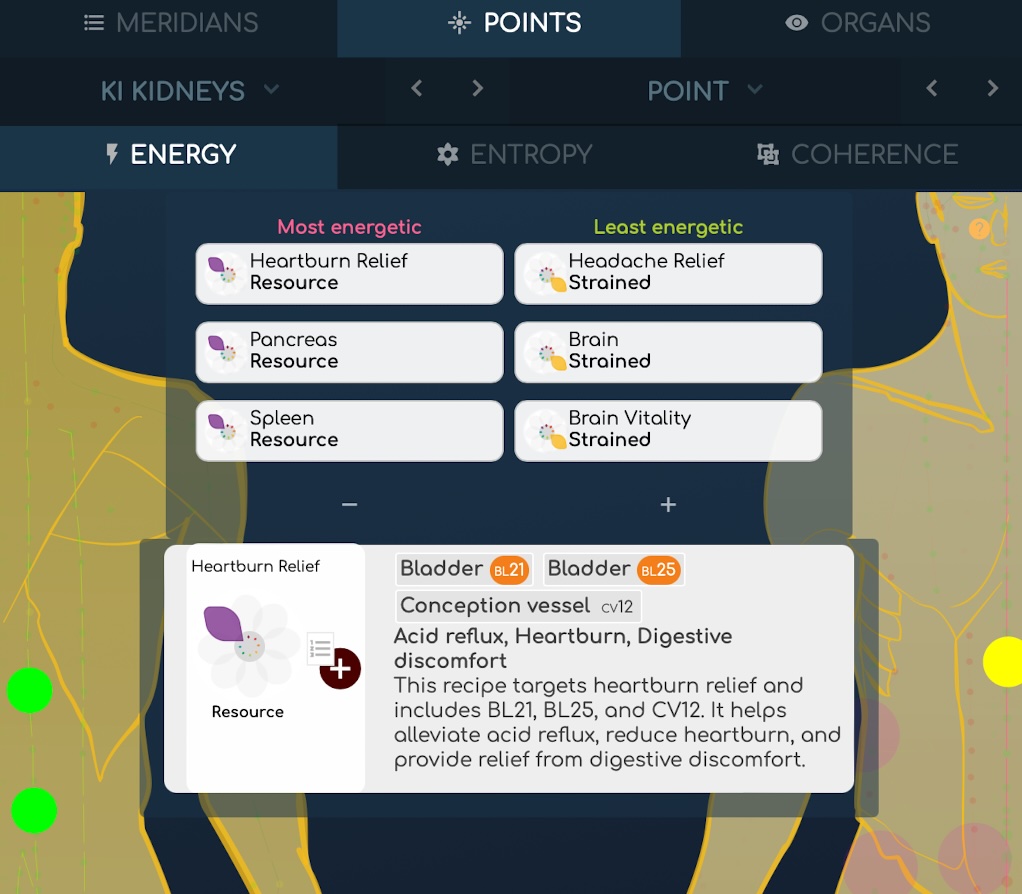 ここに新たな驚異を伴う別の複雑さのレベルが登場します。私たちが持っているすべての2ndオーダーの新しいデータを使用して、新しい特性を計算できます。例えば、要素間のリンクです。これらのリンクはアプリの至る所に表示されており、グラフや身体マップなどがあります。これにより、臓器などの主なエネルギー関係を理解することができます:ある臓器が別の臓器にリンクしている場合、エネルギーの転送が行われていることを示す可能性があり、一方が他方を助けたり、助けられたりしていることを示します。
これらのリンクは、要素間の共通の共鳴を抽出するために高度なベクトル数学を使用するかなり複雑な多次元アルゴリズムで計算されています。しかし、この複雑さを隠し、要素間の明確なリンクのみを表示するようにしました。
- プロセスの一環として、膨大なデータを計算し、それは各バイオマーカーの「リンクの質」とリンクされた要素として表れます。
- 別の三次の例は、TCMレシピの計算です。特定の症状を治療するためにいくつかの鍼灸ポイントを使用するTCMレシピの論理を逆エンジニアリングしました。それを逆にすることで、これらのポイントがこれらの三次の特性によってリンクされている場合、それは彼らのグループに関連する症状を示す可能性があります。
再び、私たちは治療特有のデータに関する公開された研究を使用しました。TCMレシピを除いて、リンクの論理は、根本原因を見つけるために因果関係を追求しようとする多くの実践者の研究から得られています。
さらに進んでみませんか?
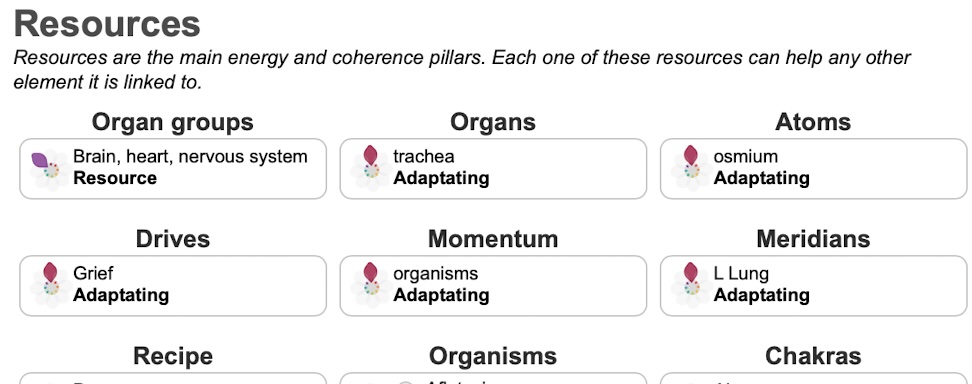 さて、これを機に、新たに現れた特性について続け、4次レベルの分析を行いましょう。これらの新しいデータポイントを用いて、リソースと優先順位を計算することができます。リソースは、下位の全てのレベルの情報を使用して単一の「リソース値」を計算する4次アルゴリズムによって算出されます。これは、リソースを変更する必要がある場合にリソースページで示されます。それは、特定のファミリー内のバイオマーカーが「寛大さのチェーンの頂点にある」ことを示しています。リソース理論はクリスティーヌ・デゴイの研究に由来し、彼女の今後の著書でより詳しく説明される予定です。
一方、優先順位はある意味でアンダードッグ、つまり「食物連鎖の底辺」に位置する部分です。これらは、特定のバイオマーカーのファミリーにおけるエネルギー、動揺、またはコヒーレンスに基づいて、3次の情報およびそれ以下から抽出されます。私たちがエネルギー、動揺、そしてコヒーレンスを計算したことにより、エネルギーが低すぎる、エネルギーが高すぎる、静的すぎる、動揺しすぎる要素、そして何かが進行中であることを示すかもしれないコヒーレントなシステムを優先順位として置くことができます。
さあ、逆に踊りましょう
私たちのH2O水の例に戻りましょう。水を初めて見たとき、あなたはその気体成分から分析することはありません。あなたはただ、飲むことができること、泳ぐことができること、他の元素と混ざることができることなど、上位の性質を見ています。通常、複雑なシステムを見るとき、私たちは外側からそれを見て、上位の性質しか見えません。そして、追加の秩序のレベルを明らかにするたびに、私たちはそれが日常のユーザーにとってどれほど便利であるかを認識しました。したがって、BioCoherenceでは、情報の重要性を逆転させ、リソース(4次の情報)、優先順位(3次の情報)、バイオマーカーの花(2次の情報)、およびバイオマーカーの特性(3次の情報)から始める傾向があります。最初のレベルの順序情報(波とスペクトル)に下ることはまだ可能ですが、日常的に最も価値があるのは上位のレベルです。
 複雑性の順序は、ホーム画面の右上の矢印を通じて示されています(それぞれのレベルで数学をやり直すためにクリックできます)が、メニューの論理(およびレポートの順序)は逆転しています:上位のレベル(バランス:リソース、優先順位、レポート)から始まります。これは通常、最初に見るべき最も重要な情報です。
これでスキャン部分は終了です。
BioCoherence 1.8.2
- Tests on home page (you can now start by a test). For instance, you can start with any test and then directly go to the Scan pages when the test is done, as the scan will be calculated anyway at the end of the recording. When you start with a test, there is no pre-evaluation as there is no recording, but there will be a post-evaluation based on the recording, once finished.
- Balance page improvements. That is only layout for now, the meditation/frequencies part is still under development.
- File duration added in list.
- Blank menu bug fixed, parts calculations for comparison fixed, and some minor bugs.
- Added 2 or 4 family accounts for Me Essential and Me. Based on a user suggestion, it seems fair to allow family members to have a distinct account even in the Me subscription. Besides, it allows Me users to test the Client management system.
- New menu entry: Open manual.
- Tutorial videos in English are all online. You can access the videos directly in-app or on ./tutorials
- Share: new "save on cloud" menu element. For now, all recordings are kept private on your device, unless you click "save on cloud"; the recordings are then sent to our own secure server and become available for your other devices or to share with a client or a Pro.
- Better test measurement visualisation. There is now a text while calibration, a countdown of test items, and some layout improvements. The record part is also now always on the bottom part of the screen.
- Better Bluetooth connect panel. Still some improvements to come.
- Better biomarker lists and links on chakras. We added some information on chakras - there are still plenty of ideas and data for future improvements.
BioCoherence 1.7
参考文献
補遺3。
参考文献
- 「プロロジー:あなたの人生プロジェクトを実現する - 書籍1:病気、癒し、変容:資源の道」 クリスティーヌ・デゴイ著
システム的アプローチを通じて健康と幸福を再考する革新的なガイドであり、あなたの存在を再定義し、人生プロジェクトのより深い理解にアクセスできるようにします。この本は、内なるコミュニケーションを育むために必要なツールを提供し、現実の認識を変革し、あなたの存在理由を完全に具現化する手助けをします。 - 「プロロジー:人生の意味を再発見する - 書籍2:身体の中の人生プロジェクト:理解し、解放し、変容する」 クリスティーヌ・デゴイ著
プロロジカルな器官のデコーディングに飛び込み、あなたの身体の各部分がどのように存在のより深い次元を反映しているかを発見します。この本は、あなたの人生経験と身体的健康の関連を探求し、エネルギー的なブロックの理解、解放、変容への鍵を提供します。内なる資源と隠された潜在能力に焦点を当てることによって、この本はあなたにホリスティックな視点を通じて人生プロジェクトを受け入れるよう招待し、身体と心を調和させた完全に満たされた人生を実現できるようにします。エネルギーと電気医学
- "ボディ・エレクトリック: 電磁気と生命の基盤" ロバート・ベッカーとゲイリー・セルデン著
この画期的な本は、人間の体の電磁場とその治癒、エネルギーの流れ、健康への深い影響を探ります。ベッカーの生体電気に関する研究は、体のエネルギーシステムの背後にある科学を理解するための重要な洞察を提供します。 - "機械の中の火花: 鍼治療の科学が西洋医学の神秘を説明する方法" ダニエル・キオウン博士著
キオウン博士の研究は、西洋医学の科学と古代の鍼治療の実践のギャップを埋め、エネルギーが体を通してどのように流れるか、そしてそれを治癒のためにどのように活用できるかを包括的に説明します。 - "エネルギー医学: 科学的基礎" ジェームズ・L・オシュマン著
この本は、エネルギー医学の背後にある科学を徹底的に探求し、電磁場、経絡、その他のエネルギーシステムが健康にどのように影響するかの証拠を示します。オシュマンは物理学と生物学から引き出して、体のエネルギーシステムを従来の治癒法と代替治療法の両方を補完する方法で説明します。 - "振動医学: 微細エネルギー療法の第一ハンドブック" リチャード・ガーバー著
ガーバーの古典的なテキストは、微細エネルギー医学の分野を理解するための重要なリソースです。エネルギー場、チャクラ、そして振動療法がどのように体と心を癒すかの詳細な概要を提供します。 - "交差電流: 電気汚染の危険性、電気医学の約束" ロバート・O・ベッカー著
ベッカーのボディ・エレクトリックの続編として、この本は現代の電気技術の健康への影響を調査し、電磁療法が治癒にどのように役立つかを探ります。 - "信念の生物学: 意識、物質、奇跡の力を解き放つ" ブルース・H・リプトン著
この本は、生物学と信念の交差点を掘り下げ、心が細胞レベルで体にどのように影響するかを示します。リプトンは、エネルギー場と意識が生物学的過程にどのように影響するかを説明します。 - "フィールド: 宇宙の秘密の力を求めて" リン・マクタガート著
マクタガートは、全ての物質を結びつける普遍的なエネルギー場であるゼロポイントフィールドに関する最先端の科学を探ります。この本は、生命のエネルギー的性質と、そのエネルギーを治癒のためにどのように活用できるかに関する洞察を提供します。 - "癒しは電圧: ハンドブック" ジェリー・テナント著
テナント博士は、特に細胞レベルでの体内の電圧が健康にとって重要であることを説明します。彼は、適切な電気的ポテンシャルを維持することが癒しと幸福の基本であるという包括的な見解を提供します。現代のスピリチュアリティ
"私の大きなTOE(全ての理論)" トーマス・キャンベル著
現実、意識、物理的と形而上学的なもののつながりを探求する包括的な三部作。物理学者で意識の研究者であるキャンベルは、科学とスピリチュアリティを融合させ、瞑想、変容した意識状態、宇宙におけるエネルギーの理解を支える存在のモデルを提示します。"照らされた心:仏教の知恵と脳科学を統合した完全な瞑想ガイド" ジョン・イェイツ(クーラダサ)著
クーラダサのガイドは、古代の仏教教えと現代の神経科学に根ざした瞑想の実践についての徹底的なステップバイステップの説明です。伝統的な瞑想技法と現代の脳に関する科学的理解とのギャップを埋めます。"変容した特性:科学が明らかにする瞑想があなたの心、脳、体をどう変えるか" ダニエル・ゴールマンとリチャード・J・デイビッドソン著
この本は、瞑想に関する科学的研究に深く掘り下げ、脳と体に対するその深遠な影響を探求します。ゴールマンとデイビッドソンは、瞑想が持続的な心理的および生理的変化をもたらす方法を説明するために数十年の研究から引き出しています。"目覚める:宗教なしのスピリチュアリティへのガイド" サム・ハリス著
神経科学者で哲学者のサム・ハリスは、科学と個人的な経験の両方に基づいたスピリチュアリティと瞑想への合理的アプローチを提示します。彼の本は、瞑想が認識と意識の理解において深遠な変化をもたらす方法に特に注目していますが、宗教的枠組みを必要としません。"今の力:精神的啓発へのガイド" エックハルト・トール著
トールの広く読まれている本は、マインドフルネスと今この瞬間にいることの重要性を強調しています。彼の教えは、より完全に、より意識的に生きる方法に関する実践的な洞察を提供し、Sing the Body Electricで議論されている健康のエネルギー的および精神的側面と一致しています。"リアルマジック:古代の知恵、現代の科学、宇宙の秘密の力へのガイド" ディーン・ラディン著
ラディンは、超心理学の分野での第一人者として、テレパシー、予知、サイコキネシスのような現象に関する科学的証拠を探求し、意識、エネルギー、現実の広範な構造との関連を描きます。この本は、物理的なものを超える他の現実を理解するための基盤を提供します。"意識の物理学:量子マインドと人生の意味" エヴァン・ハリス・ウォーカー著
この本は、量子物理学と意識との関係を掘り下げます。ウォーカーは、量子力学における観察者の役割を探求し、意識が宇宙の根本的なものであるという理論を提示し、エネルギーと存在のより広範な理解に貢献します。- "秘密の教義" H.P.ブラバツキー著
この神智学の基礎的なテキストは、宇宙、意識、精神的進化の本質を探求します。 "永遠の哲学" アルドゥス・ハクスリー著
ハクスリーは、さまざまな宗教におけるスピリチュアリティの共通の糸を探求し、普遍的な真実を強調します。"人間の運命" ピエール・ルコント・デュノイ著
この本は、科学、哲学、宗教の交差点を探求し、人間の進化は神聖な目的によって導かれているという考えを主張します。人類の精神的な可能性と、人間の意識に伴う道徳的責任について論じます。"理性への道" ピエール・ルコント・デュノイ著
この哲学的な作品では、ルコント・デュノイは宇宙を理解する上での理性と科学的思考の重要性について論じます。彼はまた、科学の進歩が道徳的および精神的発展と統合されるべきである方法について掘り下げます。"デジタル信号処理の理解" リチャード・G・ライオンズ著
この本はデジタル信号処理(DSP)への明確でアクセスしやすい入門を提供し、複雑な概念を初心者でも理解できるようにしています。フィルタリング、フーリエ解析、サンプリング理論などのトピックを実用的でわかりやすい方法で扱い、音声分析のための信号処理の基本に興味のある人に最適です。"科学者とエンジニアのためのデジタル信号処理ガイド" スティーブン・W・スミス著
実用的な例と応用を通じてDSPの概念を紹介する人気のある読みやすい本です。信号処理がどのように機能するかを段階的なガイドと実世界の例で説明する無料のオンラインリソースで、特に音声や音楽信号分析に興味のある初心者にとって非常にアクセスしやすくなっています。"デジタルオーディオ信号処理" ウド・ゾルツァー著
この本はデジタルフィルタ、オーディオエフェクト、時間-周波数解析などの分野に焦点を当て、デジタルオーディオ信号処理の原則と応用を紹介します。技術的ではありますが、DSPの基本的な知識を持つ読者にとっても親しみやすい形で資料が提供されています。"音声コンテンツ分析の入門:信号処理と音楽情報学への応用" アレクサンダー・ラーシュ著
このテキストは音声と音楽の信号処理に興味のある人に特に役立ちます。音声コンテンツ(音楽の構造、リズム、ハーモニーなど)を信号処理アルゴリズムを使用して分析するための技術を紹介します。この本は実用的で、学生や専門家の両方にとってアクセスしやすいものです。"C言語によるオーディオエフェクトプラグインの設計:デジタルオーディオ信号処理理論とともに" ウィル・パークル著
オーディオ信号処理の応用面に飛び込みたい人のために、この本はC言語を使用してオーディオエフェクトをコーディングおよび設計するためのユーザーフレンドリーな入門書です。リアルタイムのオーディオエフェクトを作成するためにDSPをどのように適用できるかを理解しようとする初心者に理想的です。ユングと無意識
- "思い出、夢、反省" カール・G・ユング著
半自伝的な作品であるこの本は、ユングの人生と重要なアイデアを扱っており、集合的無意識、アーキタイプ、シャドウなどの概念の発展を含んでいます。彼の心理学的理論に対する個人的な洞察を提供します。 - "アーキタイプと集合的無意識" カール・G・ユング著
この本はユング心理学の中心的なテキストで、彼は無意識の心に関する理論、特に集合的無意識とそのアーキタイプのイメージを概説しています。ユングの人格や心理についての考えを理解するための基本的な読み物です。 - "心理的タイプ" カール・G・ユング著
この作品でユングは心理的タイプの理論を紹介し、後にマイヤーズ・ブリッグス・タイプ指標(MBTI)の発展に影響を与えました。彼は内向性と外向性の二分法や、人格を形成する他の心理的機能について議論しています。 - "人間とその象徴" カール・G・ユング著
ユング思想へのアクセスしやすい紹介として書かれたこの本は、夢や芸術における象徴の使用を無意識のプロセスの表現として掘り下げています。幅広い読者を対象としており、人間の心理に関する洞察を提供します。 - "発見されていない自己" カール・G・ユング著
ユングは、個人の成長の必要性と現代社会の圧力との間の対立を探求します。無意識や人格のシャドウの側面をナビゲートする上での自己認識の重要性を強調しています。 - "自分のシャドウを受け入れる: 心理の暗い側面を理解する" ロバート・A・ジョンソン著
ユングのシャドウの概念を理解するための実用ガイドで、この本は心理的バランスと個人的成長のためにシャドウセルフを認識し統合する方法を説明しています。 - "ユングの魂の地図: はじめに" マレー・スタイン著
この本は、影、無意識、個性化についてのユングの人格理論の紹介を提供します。ユング心理学に初めて触れる人々にとって良いリソースです。 - "異なる贈り物: 人格タイプの理解" イザベル・ブリッグス・マイヤーズとピーター・B・マイヤーズ著
この本は、ユングの心理的タイプに基づいたMBTIシステムの人格タイプを説明しています。異なる人格タイプがどのように相互作用し、個人および職業生活にどのように影響を与えるかについての洞察を提供します。音による癒し
- "音の癒しの力: 音、声、音楽を使った生命を脅かす病気からの回復" ミッチェル・L・ゲイナー著
この本は、癒しのための音療法の使用について掘り下げ、振動と周波数が病気からの回復をサポートする方法に焦点を当てています。ゲイナーは、医療の見識と音の癒しの実践を組み合わせています。 - "人間のバイオフィールドの調整: 振動音療法による癒し" エイリーン・デイ・マクキュースキック著
マクキュースキックは、バイオフィールドの解剖学を探求し、音、周波数、振動が人間のエネルギーフィールドにどのように影響するかについて論じています。この本には、チューニングフォークやその他の音の道具が癒しを促進する方法に関する情報が含まれています。 - "癒しの音: ハーモニクスの力" ジョナサン・ゴールドマン著
この本は、音とハーモニクスを使って身体と心を癒す概念を説明しています。発声トーニングやオーバートーンの取り扱いなど、音の癒しのための実践的な技術が含まれています。 - "サウンドメディスン: 体と心を癒すための古代の音の科学の使い方" クルリート・チョードリー著
この本は、古代のアーユルヴェーダ医学と現代の音療法の実践を組み合わせています。チョードリーは、マントラから現代の音技術まで、音の周波数と振動が癒しと健康にどのように利用できるかを説明しています。意識、エネルギー、現実
- "水の第四のフェーズ: 固体、液体、蒸気を超えて" ジェラルド・ポラック著
ポラックは水の特性と生物学およびエネルギー医療への影響に関する画期的な研究を提示します。 - "LSDと宇宙の心" クリストファー・ベイチ著
ベイチは、個人的な体験と科学的洞察を通じて、サイケデリックス、意識、現実の本質の交差点を探求します。 - "死後の意識: 臨死体験の科学" ピム・ヴァン・ロンメル著
ヴァン・ロンメルは臨死体験の包括的な検証を行い、それらが意識や物理的存在を超えた自己の継続性に与える影響を考察します。 - "奇跡を信じなかった男" ディディエ・ヴァン・コウウェラート著
この小説は、意識と量子物理学のテーマを絡め、現実と信念の本質を魅力的な物語を通じて探ります。 - "目的を持って健康に: 自己治癒のためのインパルス" フォルカー・マイスナー著
マイスナーはエネルギー医療の背後にある科学的原則を調査し、その治療的可能性とメカニズムへの洞察を提供します。 - "つながり: グローバル意識の出現" ロジャー・ネルソン著
ネルソンは人間の意識の相互関連性を考察し、集合的経験やグローバル意識を理解するための影響を探ります。 - "形態形成的水 - 健康 - 情報と意識の場" マーク・ヘンリー著
ヘンリーは生物システムにおける水の重要性とエネルギー移動および意識の媒体としての役割について論じます。 "人生の後に" レイモンド・ムーディ著
ムーディの画期的な作品は、臨死体験の概念を紹介し、それを経験した人々によって報告された共通の要素を強調する多数のケーススタディを提示します。"光に抱かれて" ベティ・J・イーディ著
この回顧録は、イーディの臨死体験を語り、彼女の洞察や旅の中で出会った深い精神的啓示を共有します。"天国の証明: 神経外科医の死後の旅" エベン・アレクサンダー著
神経外科医であるアレクサンダーは、自身の臨死体験を共有し、意識と死後の世界に関する従来の科学的見解に挑戦する魅力的な説明を提供します。"私になるために死ぬ: 癌から臨死、真の癒しへの私の旅" アニータ・ムールジャニ著
ムールジャニは、癌との闘いの中での彼女の変革的な臨死体験と、自己受容と癒しについて学んだ強力な教訓を共有します。"体外への旅" ロバート・A・モンロー著
この古典的な本は、モンローの体外旅行に関する個人的な体験を記録し、物理的な体を超えた人間の意識の可能性を探ります。意識研究の基礎的なテキストの一つとして広く認識されています。"遠い旅" ロバート・A・モンロー著
この「体外への旅」の続編は、物理的な次元を超えたモンローの旅をより深く掘り下げ、存在の異なる次元を探求し、意識の理解を広げます。"究極の旅" ロバート・A・モンロー著
この三部作の最終巻で、モンローは意識の変容した状態での体験からの洞察を共有し、死後の世界、存在の本質、人間の目的といったテーマに焦点を当てます。"宇宙的意識" リチャード・M・バッケ著
バッケは宇宙的意識の自身の体験を説明し、それが精神的進化に及ぼす影響を探ります。"ヤキ族の知識の道" カルロス・カスタネダ著
この本は、ヤキ族のシャーマンとの弟子入りを通じて、シャーマニズムの実践と現実の本質を掘り下げます。- "バイオ倫理学: 原則、問題、および事例" 著者: ルイス・ボーン
ボーンは、医療実践における重要な倫理原則と問題を提示し、実世界の応用のためのケーススタディを提供しています。 - "意識と宇宙: 量子物理学、進化、脳と心" 著者: サー・ロジャー・ペンローズとスチュアート・ハメロフ
このエッセイ集は、意識の量子起源を探求し、物理学、神経科学、哲学の洞察を組み合わせて、脳内の量子プロセスが意識的経験を説明する方法を調査します。 - "意識の説明" 著者: ダニエル・デネット
デネットは、意識の包括的な理論を提示し、従来の見解に対抗しながら心の働きについての洞察を提供します。 - "目覚め: 宗教のない精神性へのガイド" 著者: サム・ハリス
ハリスは、意識、瞑想、精神性の本質について論じ、心を理解するための世俗的アプローチを提唱します。 - "量子と蓮: 科学と仏教が出会う最前線への旅" マチュー・リカールとチン・シュアン・トゥアン著
この本は、量子物理学と仏教哲学の間の類似点を探求し、両方の分野からの洞察を論じています。 - "ホログラフィック宇宙" マイケル・タルボット著
タルボットは、宇宙がホログラムのように機能し、量子物理学の洞察と形而上学的な含意を融合させるという考えを提示します。 - "人間の意味を求めて" ヴィクトール・E・フランクル著
フランクルは、最も厳しい状況においても目的を見出す心理的な旅を探求し、実存哲学と心理学を統合しています。 - "体は記憶する: 脳、心、身体のトラウマ治癒" ベッセル・ヴァン・デル・コルク著
この本は、トラウマが身体と心に与える影響を論じ、治癒への革新的なアプローチを強調します。 "コアエネルゲティクス" ジョン・C・ピエラコス著
この本は、ピエラコスのコアエネルゲティクスへのアプローチを概説しています。彼は、身体のエネルギーを解放することで感情的および心理的な癒しにつながる方法について掘り下げ、精神性と心理療法を統合します。"自己変容の道作り" エヴァ・ピエラコス著
ジョン・ピエラコスの妻エヴァ・ピエラコスが著したこの本は、コアエネルゲティクスの精神的およびエネルギー的な基盤を理解する上で不可欠です。これは、ピエラコス自身の治療的な仕事に強い影響を与えたパスワークガイドからの教えのコレクションを提示します。"私の声はあなたと共に行く: ミルトン・H・エリクソンの教えの物語" ミルトン・H・エリクソン著、シドニー・ローゼン編
この本は、エリクソンの治療的な物語と教えの物語のコレクションです。彼の間接的な技法やメタファーの使用を強調し、深い心理的変化を促進する方法を提供し、エリクソンが患者を癒しへと微妙に導いた方法についての洞察を提供します。"非凡な療法: ミルトン・H・エリクソンの精神医学技術" ジェイ・ヘイリー著
ヘイリーは、エリクソンの短期療法における革新的な技術を詳細に見ていきます。この本は、エリクソンの非伝統的でしばしば驚くべき方法、特に数回のセッションで患者を迅速な治療的突破口に導く能力を強調しています。- "一般システム理論:基礎、発展、応用" ルートヴィヒ・フォン・ベルタランフィ著
システム思考の古典であるベルタランフィの作品は、一般システム理論の基本を紹介し、科学の分野における学際的研究の基盤となりました。彼のアイデアは、生物学から社会科学に至るまで、あらゆる分野に影響を与えました。 - "心の生態学へのステップ" グレゴリー・ベイトソン著
パロアルトグループの重要な人物であるベイトソンのエッセイ集は、コミュニケーション、心理学、生態学などのテーマを扱っています。彼の作品は、人間のコミュニケーションと相互作用におけるシステム思考の基礎を築きました。 - "心と自然:必要な統一" グレゴリー・ベイトソン著
ベイトソンのもう一つの重要なテキストで、心と環境がどのように相互に関連しているかを探求しています。彼のアイデアは、人間の相互作用、学習、生態系におけるシステム理論を理解する上での基礎となっています。 - "現実の社会的構築:知識の社会学における論文" ピーター・L・バーガーとトーマス・ラッカン著
この本は、社会システムと現実がどのように構築され、維持されるかを探求することで、システム思考に結びついています。 - "生命のシステム的観点:統一的なビジョン" フリチョフ・カプラとピエール・ルイジ・ルイジ著
システム思考の重要な人物であるカプラは、生きたシステムの現代的かつ統合的な理解を提示しています。この本は、システム理論を生物学、生態学、意識に結びつけています。 - "変化:問題形成と問題解決の原則" ポール・ワッツラウィック、ジョン・ウィークランド、リチャード・フィッシュ著
パロアルトグループからのもう一つの重要な作品で、人間のシステム、特に家族や組織において、どのように変化が起こるかをシステム的な視点から探求しています。 - "知識の木:人間理解の生物学的ルーツ" ハンバート・R・マトゥラーナとフランシスコ・J・バレラ著
この本は、生物学、認知、システム思考を結びつけ、自己創造システム(オートポイエーシス)に焦点を当てています。これは、生きたシステムを理解する上での中心的な概念です。 - "サイバネティクス、または動物と機械における制御とコミュニケーション" ノーバート・ウィーナー著
サイバネティクスの基礎的なテキストで、機械と生き物の両方で通信と制御のプロセスがどのように機能するかを探求しています。 - "第五の規律:学習する組織の技術と実践" ピーター・M・センゲ著
センゲの作品は、組織の発展にシステム思考を適用しています。これは、ビジネスと教育の両方において重要なテキストと見なされており、複雑な組織が学習と適応のためにどのように構成されるかに焦点を当てています。
デジタル信号処理
バイオ倫理学と医学
意識研究
量子物理学と形而上学
心理学と心理療法
システム理論とシステム思考
医学研究と文献
追加文 2。
関連研究のリスト
-
H. M. Langevin and J. A. Yandow, Anat. Rec. (New Anat.) 269, 257 (2002).
DOI
,
Crossref
-
Banes AJ, Tsuzaki M, Yamamoto J, et al. 1995. Mechanoreception at the cellular level: The detection, interpretation and diversity of responses to mechanical signals. Biochem Cell Biol 73:349– 365.
Crossref
PubMed
Web of Science®
-
Bonassar LJ, Stinn JL, Paguio CG, et al. 1996. Activation and inhibition of endogenous matrix metalloproteinases in articular cartilage: Effects on composition and biophysical properties. Arch Biochem Biophys 333: 359– 367.
Crossref
PubMed
Web of Science®
-
Murugan NJ, Cariba S, Abeygunawardena S, Rouleau N, Payne SL. Biophysical control of plasticity and patterning in regeneration and cancer. Cell Mol Life Sci. 2023 Dec 15;81(1):9. doi: 10.1007/s00018-023-05054-6. PMID: 38099951; PMCID: PMC10724343. DOI
-
Brand RA. 1997. What do tissues and cells know of mechanics? Ann Med 29: 267– 269.
Crossref
PubMed
Web of Science®
-
Bossy J. 1984. Morphological data concerning the acupuncture points and channel network. Acupunct Electrother Res 9: 79– 106.
PubMed
Web of Science®
-
Cheng X. 1987. Chinese acupuncture and moxibustion. Beijing: Foreign Language Press.
-
Chicurel ME, Chen CS, Ingber DE. 1998. Cellular control lies in the balance of forces. Curr Opin Cell Biol 10: 232– 239.
Crossref
PubMed
Web of Science®
-
Chiquet M. 1999. Regulation of extracellular matrix gene expression by mechanical stress. Matrix Biol 18: 417– 426.
PubMed
Web of Science®
-
Ciczek LSW, Szopinski J, Skrzypulec V. 1985. Investigations of morphological structures of acupuncture points and meridians. J Trad Chin Med 5: 289– 292.
-
Comunetti A, Laage S, Schiessl N, Kistler A. 1995. Characterization of human skin conductance at acupuncture points. Experientia 51: 328– 331.
Crossref
PubMed
Web of Science®
-
Dung HC. 1984. Anatomical features contributing to the formation of acupuncture points. Am J Acupunct 12: 139– 143.
Web of Science®
-
Giancotti FG, Ruoslahti E. 1999. Integrin signaling. Science 285: 1028– 1032.
Crossref
PubMed
Web of Science®
-
Gunn CC, Ditchburn FG, King MH, Renwick GJ. 1976. Acupuncture loci: A proposal for their classification according to their relationship to known neural structures. Am J Chin Med 4: 183– 195.
Crossref
PubMed
-
Ho MW, Knight DP. 1998. The acupuncture system and the liquid crystalline collagen fibers of the connective tissues. Am J Chin Med 26: 251– 263.
Crossref
PubMed
Web of Science®
-
Huan ZY, Rose K. 2001. A brief history of Qi. Brookline, MA: Paradigm Publications.
-
Kaptchuk TJ. 2000. The web that has no weaver. Understanding Chinese medicine. Chicago: Contemporary Publishing Group, Inc.
-
Lai WM, Mow VC, Sun DD, Atesian GA. 2000. On the electric potentials inside a charged soft hydrated biological tissue: Streaming potential versus diffusion potential. J Biomech Eng 122: 336– 346.
Crossref
PubMed
Web of Science®
-
Langevin HM, Churchill DL, Cipolla MJ. 2001a. Mechanical signaling through connective tissue: A mechanism for the therapeutic effect of acupuncture. FASEB J 15: 2275– 2282.
Wiley Online Library
PubMed
Web of Science®
-
Langevin HM, Churchill DL, Fox JR, Badger GJ, Garra BS, Krag MH. 2001b. Biomechanical response to acupuncture needling in humans. J Appl Physiol 91: 2471– 2478.
Crossref
PubMed
Web of Science®
-
Langevin HM, Churchill DL, Wu J, Badger GJ, Yandow JA, Fox JR, Krag MH. 2002. Evidence of connective tissue involvement in acupuncture. FASEB J 16: 872– 874.
Wiley Online Library
PubMed
Web of Science®
-
Liu KY, Varela M, Oswald R. 1975. The correspondence between some motor points and acupuncture loci. Am J Chin Med 3: 347– 358.
Crossref
PubMed
-
Matsumoto K, Birch S. 1988. Hara diagnosis: Reflections of the sea. Brookline: Paradigm Publications.
-
McCarroll GD, Rowley BA. 1979. An investigation of the existence of electrically located acupuncture points. IEEE Trans Biomed Eng 26: 177– 182.
Crossref
PubMed
Web of Science®
-
Noordegraaf A, Silage D. 1973. Electroacupuncture. IEEE Trans Biomed Eng 20: 364– 366.
Crossref
PubMed
Web of Science®
-
NIH Consensus Statement. 1997. Acupuncture. Bethesda, MD: NIH. 15: 1– 34.
-
O'Connor J, Bensky D. 1981. Acupuncture, a comprehensive text (Shanghai College of Traditional Medicine) Seattle: Eastland Press.
-
Oschman JL. 1993. A biophysical basis for acupuncture. Proceedings of the First Symposium of the Committee for Acupuncture Research.
-
Pomeranz B. 2001. Acupuncture analgesia-basic research. In: G Stux, R Hammerschlag, editors.Clinical acupuncture-scientific basis. Berlin: Springer-Verlag.
-
Rabischong P, Niboyet JEH, Terral C, Senelar R, Casez R. 1975. Bases experimentales de l'analgésie acupuncturale. Nouv Presse Med 4: 2021– 2026.
PubMed
Web of Science®
-
Reishmanis M, Marino AA, Becker RO. 1975. Electrical correlates of acupuncture points. IEEE Trans Biomed Eng 22: 533– 535.
Crossref
PubMed
Web of Science®
-
Senelar R. 1979. Les caractéristiques morphologiques des points chinois. In: JEH Niboyet, editor.Nouveau traité d'acupuncture. Paris: Maisonneuve.
-
Shanghai Medical University, Human Anatomy Department. 1973. A relationship between points of meridians and peripheral nerves: Acupuncture anaesthetic theory study. Shanghai: People's Republic Publishing House.
-
Swartz MA, Tschumperlin DJ, Kamm RD, Drazen JM. 2001. Mechanical stress is communicated between different cell types to elicit matrix remodeling. Proc Natl Acad Sci USA 98: 6180– 6185.
Crossref
PubMed
Web of Science®
-
Ulett GA, Han S, Han JS. 1998. Electroacupuncture: mechanisms and clinical applications. Biol Psych44: 129– 138.
PubMed
Web of Science®
-
Veith I. 1949. The yellow emperor's classic of internal medicine. Berkeley: University of California Press.
-
Yang J. 1601. The golden needle and other odes of traditional acupuncture, 1601. Translated by R Bertschinger. Edinburgh: Churchill Livingstone.
-
Quyen Manh Nguyen, Tuan Hoang Nguyen, Lam Van Tran, Tin Thanh Dang, Anh Dinh, Device to Detect Acupuncture Points in the Feet Soles for Massage Treatment, 8th International Conference on the Development of Biomedical Engineering in Vietnam, 10.1007/978-3-030-75506-5_1, (3-13), (2022).
Crossref
-
Yung-Sheng Yen, Han-Yi Cheng, Hung-Ta Lin, Evaluation of Stress on Acupuncture with Nano-Etched and Diamond-Like Carbon (DLC) Coating Surface Modifications, Journal of Biomaterials and Tissue Engineering, 10.1166/jbt.2022.2928, 12, 3, (489-493), (2022).
Crossref
-
Gregory P. Casey, Anatomical characterization of acupoint large intestine 4, The Anatomical Record, 10.1002/ar.24681, 305, 1, (144-155), (2021).
Wiley Online Library
-
Ajit B. Pai, Lori V. Shuart,, David F. Drake, Integrative Medicine in Rehabilitation, Braddom's Physical Medicine and Rehabilitation, 10.1016/B978-0-323-62539-5.00018-7, (364-373.e3), (2021).
Crossref
-
Tongju Li, Bruce Qing Tang, Wei-Bo Zhang, Minyi Zhao, Qingchuan Hu, Andrew Ahn, In Vivo Visualization of the Pericardium Meridian with Fluorescent Dyes, Evidence-Based Complementary and Alternative Medicine, 10.1155/2021/5581227, 2021, (1-10), (2021).
Crossref
-
Chao Sun, Changchun Ji, Ying Li, Jiujie Kuang, Jiangtao Wu, A comparison study of photothermal effect between moxibustion therapy and laser irradiation on biological tissue, International Journal of Thermal Sciences, 10.1016/j.ijthermalsci.2021.106924, 164, (106924), (2021).
Crossref
-
Nikolay Dimitrov, Nikola Tomov, Dimitrinka Atanasova, Stiliyan Iliev, Tatyana Tomova, Dimitar Sivrev, Zoya Goranova, Visible Meridian Phenomena after Acupuncture: A Series of Case Reports, Journal of Acupuncture and Meridian Studies, 10.51507/j.jams.2021.14.2.50, 14, 2, (50-57), (2021).
Crossref
-
Nasim Bahadorani, Jerry W. Lee, Leslie R. Martin, Implications of Tamarkoz on stress, emotion, spirituality and heart rate, Scientific Reports, 10.1038/s41598-021-93470-8, 11, 1, (2021).
Crossref
-
Maojun Li, Huawen Peng, Binxiu Wei, Qiuxia Deng, Fen Qian, Xin Liu, Jian Wang, Xiaodong Zhu, Effect of acupuncture anesthesia based on nanomaterial sensor on cognitive function after one-lung ventilation thoracotomy, Materials Express, 10.1166/mex.2021.2027, 11, 7, (1051-1056), (2021).
Crossref
-
Jaliya Kumaratilake, Teghan Lucas, Maciej Henneberg, Possible relationship of upper limb arteries, median and brachial to the twelfth meridian of the human upper limb, Journal of Anatomy, 10.1111/joa.13401, 238, 6, (1492-1493), (2021).
Wiley Online Library
-
Yong Ming Li, Three hand yin meridians in ancient Chinese medicine were established initially based on arterial structures, Journal of Anatomy, 10.1111/joa.13400, 238, 6, (1494-1496), (2021).
Wiley Online Library
-
Yi Zhang, Interpretation of acupoint location in traditional Chinese medicine teaching: Implications for acupuncture in research and clinical practice, The Anatomical Record, 10.1002/ar.24618, 304, 11, (2372-2380), (2021).
Wiley Online Library
-
Sanghun Lee, Prospects for the Development of Acupuncture Treatment Led by the Use of Ultrasound Imaging Devices, Journal of Korean Medical Society of Soft Tissue, 10.54461/JKMST.2021.5.1.8, 5, 1, (8-11), (2021).
Crossref
-
Xiao Ye, Yu-lan Ren, Yun-hui Chen, Ji Chen, Xiao-jiao Tang, Zong-ming Zhang, A "4D" systemic view on meridian essence: Substantial, functional, chronological and cultural attributes, Journal of Integrative Medicine, 10.1016/j.joim.2021.11.006, (2021).
Crossref
-
Berna Dincer, Demet İnangil, Gökhan İnangil, Nefise Bahçecik, Elif Yıldırım Ayaz, Ali Arslanoğlu, Miraç Vural Keskinler, Ayşe Kabuk, Gamze Özkan, The effect of acupressure on sleep quality of older people: A systematic review and meta-analysis of randomized controlled trials, EXPLORE, 10.1016/j.explore.2021.11.010, (2021).
Crossref
-
Marianna de Melo Salemi, Vanessa Maria da Silva Alves Gomes, Laylla Marjorye Rebouças Bezerra, Thania Maion de Souza Melo, Geisa Guimarães de Alencar, Iracema Hermes Pires de Mélo Montenegro, Alessandra Paula de Melo Calado, Eduardo José Nepomuceno Montenegro, Gisela Rocha de Siqueira, Effect of Dry Cupping Therapy on Pain and Functional Disability in Persistent Non-Specific Low Back Pain: A Randomized Controlled Clinical Trial, Journal of Acupuncture and Meridian Studies, 10.51507/j.jams.2021.14.6.219, 14, 6, (219-230), (2021).
Crossref
-
Luís Carlos Matos, Jorge Pereira Machado, Fernando Jorge Monteiro, Henry Johannes Greten, Understanding Traditional Chinese Medicine Therapeutics: An Overview of the Basics and Clinical Applications, Healthcare, 10.3390/healthcare9030257, 9, 3, (257), (2021).
Crossref
-
Jingwen Cui, Wanrong Song, Yipeng Jin, Huihao Xu, Kai Fan, Degui Lin, Zhihui Hao, Jiahao Lin, Research Progress on the Mechanism of the Acupuncture Regulating Neuro-Endocrine-Immune Network System, Veterinary Sciences, 10.3390/vetsci8080149, 8, 8, (149), (2021).
Crossref
-
Íñigo Ongay de Felipe, The Universality of Science and Traditional Chinese Medicine, Science & Education, 10.1007/s11191-021-00249-4, (2021).
Crossref
-
Ningcen Li, Yi Guo, Yinan Gong, Yue Zhang, Wen Fan, Kaifang Yao, Zhihan Chen, Baomin Dou, Xiaowei Lin, Bo Chen, Zelin Chen, Zhifang Xu, Zhongxi Lyu, The Anti-Inflammatory Actions and Mechanisms of Acupuncture from Acupoint to Target Organs via Neuro-Immune Regulation, Journal of Inflammation Research, 10.2147/JIR.S341581, Volume 14, (7191-7224), (2021).
Crossref
-
戬云 冯, Bridging Medicine East and West—Pursuit on the Relation between Biomedical Consequence of Stimulating the Acupoints of the Lung Meridian and Somatosensory Reflexes, Aiming to Treat Chronic Obstruction Pulmonary Diseases, Traditional Chinese Medicine, 10.12677/TCM.2020.92022, 09, 02, (145-176), (2020).
Crossref
-
Manon te Dorsthorst, Michael van Balken, John Heesakkers, Tibial nerve stimulation in the treatment of overactive bladder syndrome, Current Opinion in Urology, 10.1097/MOU.0000000000000781, 30, 4, (513-518), (2020).
Crossref
-
Peter I-Kung Wu, Lucy Chen, Integrative Medicine, Spine Pain Care, 10.1007/978-3-030-27447-4, (473-489), (2020).
Crossref
-
I. Giralt Sampedro, G. Carvajal, A. García-Janeras, A. Fabà, M.B. Nishishinya Aquino, A severe case of Ramsay Hunt Syndrome treated with acupuncture and related techniques, Complementary Therapies in Clinical Practice, 10.1016/j.ctcp.2020.101119, (101119), (2020).
Crossref
-
Eric Leskowitz, A Cartography of Energy Medicine: From Subtle Anatomy to Energy Physiology, EXPLORE, 10.1016/j.explore.2020.09.008, (2020).
Crossref
-
Hantong Hu, Yongliang Jiang, Xiaoyu Li, Jiali Lou, Yajun Zhang, Xiaofen He, Junfan Fang, Yuanyuan Wu, Xiaomei Shao, Jianqiao Fang, The microcirculatory characteristics of the heart and lung meridians, Medicine, 10.1097/MD.0000000000019594, 99, 14, (e19594), (2020).
Crossref
-
Sheikh Faruque Elahee Bangladesh, Hui-juan Mao, Ling Zhao, Xue-yong Shen, Meridian system and mechanism of acupuncture action: A scientific evaluation 经络系统与针刺效应机制的科学评价, World Journal of Acupuncture - Moxibustion, 10.1016/j.wjam.2020.05.003, (2020).
Crossref
-
Mário Gonçalves, Luís Carlos Matos, Leonel Duarte, Jorge Machado, Henry Johannes Greten, Giovanna Franconi, PROBLEMS OF SCIENTIFIC METHODOLOGY RELATED TO PLACEBO CONTROL IN QIGONG STUDIES: A SYSTEMATIC REVIEW, Journal of Bodywork and Movement Therapies, 10.1016/j.jbmt.2020.06.035, (2020).
Crossref
-
Hans-Udo Richarz, Uwe Schütz, Werner Klingler, Das fasziale Bindegewebe – ein Medium für die Akupunktur? The fascial connective tissue—a medium for acupuncture?, Deutsche Zeitschrift für Akupunktur, 10.1007/s42212-019-00228-5, (2020).
Crossref
-
Shi Yonghong, Wu Ruizhi, Zhang Yue, Bai Xuebing, Imran Tarique, Liang Chunhua, Yang Ping, Chen Qiusheng, Telocytes in Different Organs of Vertebrates: Potential Essence Cells of the Meridian in Chinese Traditional Medicine, Microscopy and Microanalysis, 10.1017/S1431927620001518, (1-14), (2020).
Crossref
-
Jinglan Mu, Andrea D Furlan, Wai Yee Lam, Marcos Y Hsu, Zhipeng Ning, Lixing Lao, Acupuncture for chronic nonspecific low back pain, Cochrane Database of Systematic Reviews, 10.1002/14651858.CD013814, (2020).
Crossref
-
Kimia Grace Ganjaei, Jeremiah W. Ray, Brandee Waite, Kevin J. Burnham, The Fascial System in Musculoskeletal Function and Myofascial Pain, Current Physical Medicine and Rehabilitation Reports, 10.1007/s40141-020-00302-3, (2020).
Crossref
-
Christina L Ross, Energy Medicine: Current Status and Future Perspectives, Global Advances in Health and Medicine, 10.1177/2164956119831221, 8, (216495611983122), (2019).
Crossref
-
Phil Trabulsy, COMPLEMENTARY AND ALTERNATIVE MEDICINE, Cancer, 10.1002/9781119645214, (499-530), (2019).
Wiley Online Library
-
Younbyoung Chae, Yeonhee Ryu, Won-Mo Jung, An Analysis of Indications of Meridians in DongUiBoGam Using Data Mining, Korean Journal of Acupuncture, 10.14406/acu.2019.034, 36, 4, (292-299), (2019).
Crossref
-
Wei-bo ZHANG, Xiao-jing SONG, Ze WANG, Guang-jun WANG, Shu-yong JIA, Yu-ying TIAN, Hong-yan LI, Longitudinal Directional Movement of Alcian Blue in Gephyrocharax Melanocheir Fish: Revealing Interstitial Flow and Related Structure ☆ 阿尔新蓝在黑裙鱼中的纵向定向运动:组织液流动与相关结构的揭示, World Journal of Acupuncture - Moxibustion, 10.1016/j.wjam.2019.05.008, (2019).
Crossref
-
Nicholas Alexander Wise, Action at a distance: laser acupuncture and the brain, Photobiomodulation in the Brain, 10.1016/B978-0-12-815305-5.00036-1, (489-501), (2019).
Crossref
-
Liangjun Xia, Qingyu Meng, Jin Xi, Qin Han, Jie Cheng, Jie Shen, Youbing Xia, Liyun Shi, The synergistic effect of electroacupuncture and bone mesenchymal stem cell transplantation on repairing thin endometrial injury in rats, Stem Cell Research & Therapy, 10.1186/s13287-019-1326-6, 10, 1, (2019).
Crossref
-
Dha-Hyun Choi, Younbyoung Chae, Minimisation of variations in locating an acupuncture point using a laser-device, Integrative Medicine Research, 10.1016/j.imr.2019.11.005, (2019).
Crossref
-
Doohan Oh, Jong-hyun Kim, Youn-Sub Kim, Song-Yi Kim, Analysis of Tonification and Sedation Methods in the 『Yeongsochimgugyeong』, Korean Journal of Acupuncture, 10.14406/acu.2019.021, 36, 3, (171-180), (2019).
Crossref
-
Aleksandar Zivaljevic, Bin Shi, ElisaM S. Tam, Vahideh Toossi, Treatment of visceral pain associated with irritable bowel syndrome using acupuncture: Mechanism of action, World Journal of Traditional Chinese Medicine, 10.4103/wjtcm.wjtcm_24_19, 5, 4, (181), (2019).
Crossref
-
Suchan Chang, O. Sang Kwon, Se Kyun Bang, Do-Hee Kim, Min Won Baek, Yeonhee Ryu, Jong Han Bae, Yu Fan, Soo Min Lee, Hyung Kyu Kim, Bong Hyo Lee, Chae Ha Yang, Hee Young Kim, Peripheral Sensory Nerve Tissue but Not Connective Tissue Is Involved in the Action of Acupuncture, Frontiers in Neuroscience, 10.3389/fnins.2019.00110, 13, (2019).
Crossref
-
Junaid Wazir, Rahat Ullah, Shihong Li, Md Amir Hossain, Maladho Tanta Diallo, Farhan Ullah Khan, Awais Ullah Ihsan, Xiaohui Zhou, Efficacy of acupuncture in the treatment of chronic prostatitis-chronic pelvic pain syndrome: a review of the literature, International Urology and Nephrology, 10.1007/s11255-019-02267-2, (2019).
Crossref
-
Noa Schwartz, Madhavi Latha S. Chalasani, Thomas M. Li, Zhonghui Feng, William D. Shipman, Theresa T. Lu, Lymphatic Function in Autoimmune Diseases, Frontiers in Immunology, 10.3389/fimmu.2019.00519, 10, (2019).
Crossref
-
Sarah Ely, Panos Barlas, Transcutaneous electrical acupoint stimulation for people with chronic musculoskeletal pain: an exploratory review, Physical Therapy Reviews, 10.1080/10833196.2019.1648728, (1-12), (2019).
Crossref
-
Koh-Woon Kim, Sanhwa Hong, Hong Soo Kim, Taehun Kim, Jaeha Ahn, Hyun-Seo Song, Yu-Kang Kim, Ju-Young Oh, Tae-Yeon Hwang, Hyangsook Lee, Su-Il In, Hi-Joon Park, Physiological impact of nanoporous acupuncture needles: Laser Doppler perfusion imaging in healthy volunteers, PLOS ONE, 10.1371/journal.pone.0226304, 14, 12, (e0226304), (2019).
Crossref
-
Chang-zhen Gong, Wei Liu, Convergence of Medicines: West Meets East in Newly-Discovered Organs and Functions, Chinese Journal of Integrative Medicine, 10.1007/s11655-018-2570-9, 25, 5, (323-326), (2018).
Crossref
-
Jeanne Adiwinata Pawitan, Various stem cells in acupuncture meridians and points and their putative roles, Journal of Traditional and Complementary Medicine, 10.1016/j.jtcme.2017.08.004, (2018).
Crossref
-
Chungda Lee, How can mindfulness-led breathing of qigong/Tai Chi work on qi and the meridian network?, Advances in Integrative Medicine, 10.1016/j.aimed.2018.07.002, 5, 3, (122-127), (2018).
Crossref
-
Patrick Roynard, Lauren Frank, Huisheng Xie, Margaret Fowler, Acupuncture for Small Animal Neurologic Disorders, Veterinary Clinics of North America: Small Animal Practice, 10.1016/j.cvsm.2017.08.003, 48, 1, (201-219), (2018).
Crossref
-
Meng Huang, Xuezhi Wang, Beibei Xing, Hongwei Yang, Zheyan Sa, Di Zhang, Wei Yao, Na Yin, Ying Xia, Guanghong Ding, Critical roles of TRPV2 channels, histamine H1 and adenosine A1 receptors in the initiation of acupoint signals for acupuncture analgesia, Scientific Reports, 10.1038/s41598-018-24654-y, 8, 1, (2018).
Crossref
-
Ruining Liang, Peishuang Li, Xuemei Peng, Ling Xu, Pei Fan, Jiahua Peng, Xu Zhou, Chunlin Xiao, Miao Jiang, Efficacy of acupuncture on pelvic pain in patients with endometriosis: study protocol for a randomized, single-blind, multi-center, placebo-controlled trial, Trials, 10.1186/s13063-018-2684-6, 19, 1, (2018).
Crossref
-
Wei-bo Zhang, De-xian Jia, Hong-yan Li, Yu-long Wei, Huang Yan, Peng-na Zhao, Fei-fei Gu, Guang-jun Wang, Yan-ping Wang, Understanding Qi Running in the Meridians as Interstitial Fluid Flowing via Interstitial Space of Low Hydraulic Resistance, Chinese Journal of Integrative Medicine, 10.1007/s11655-017-2791-3, 24, 4, (304-307), (2018).
Crossref
-
Conner E. Liddle, Richard E. Harris, Cellular Reorganization Plays a Vital Role in Acupuncture Analgesia, Medical Acupuncture, 10.1089/acu.2017.1258, 30, 1, (15-20), (2018).
Crossref
-
戬云 冯, Relationship among the Meridians, Sinew Channels and Integrative Five Fluid Circulation System, Traditional Chinese Medicine, 10.12677/TCM.2018.71013, 07, 01, (74-92), (2018).
Crossref
-
David Feinsteina, Energy Psychology: Efficacy, Speed, Mechanisms, EXPLORE, 10.1016/j.explore.2018.11.003, (2018).
Crossref
-
Hiroie MOTOYAMA, Hirohisa ISOGAI, Yoshito MUKAINO, Relaxing Effect Achieved by Acupuncture Stimulation in Different Postures for University Students Living a Sedentary LifestyleSedentary Lifestyle を送る大学生を対象とした異なる姿勢への鍼刺激によるリラックス効果, Kampo Medicine, 10.3937/kampomed.69.225, 69, 3, (225-238), (2018).
Crossref
-
Alexander Waits, You-Ren Tang, Hao-Min Cheng, Chen-Jei Tai, Li-Yin Chien, Acupressure effect on sleep quality: A systematic review and meta-analysis, Sleep Medicine Reviews, 10.1016/j.smrv.2016.12.004, 37, (24-34), (2018).
Crossref
-
Chenglin Liu, Qinghua Liu, Dongming Zhang, Wei Liu, Xiaohui Yan, Xinyi Zhang, Hiroyuki Oyanagi, Zhiyun Pan, Fengchun Hu, Shiqiang Wei, Insight into the biological effects of acupuncture points by X-ray absorption fine structure, Analytical and Bioanalytical Chemistry, 10.1007/s00216-018-1146-z, 410, 20, (4959-4965), (2018).
Crossref
-
Eric Leskowitz, How Tapping into "Energy" Can Trigger a Paradigm Shift in Biomedicine, The Journal of Alternative and Complementary Medicine, 10.1089/acm.2018.0073, 24, 6, (525-527), (2018).
Crossref
-
Johannes Fleckenstein, Robert Schleip, Cornelia Sachs, Mark Driscoll, Susan Shockett, Thomas Findley, Werner Klingler, Faszienforschung: Quo vadis? Fascia research: Quo vadis?, Deutsche Zeitschrift für Akupunktur, 10.1007/s42212-018-0037-8, 61, 2, (69-74), (2018).
Crossref
-
FA Phan, A Srilestari, H Mihardja, MBH Marbun, Effects of acupuncture on uremic pruritus in patients undergoing hemodialysis, Journal of Physics: Conference Series, 10.1088/1742-6596/1073/6/062049, 1073, (062049), (2018).
Crossref
-
Kwang-Sup Soh, Sistema circulatorio de Bonghan como una extensión de los meridianos de acupuntura, Revista Internacional de Acupuntura, 10.1016/j.acu.2018.02.001, 12, 1, (15-28), (2018).
Crossref
-
Helene M. Langevin, Peter M. Wayne, What Is the Point? The Problem with Acupuncture Research That No One Wants to Talk About, The Journal of Alternative and Complementary Medicine, 10.1089/acm.2017.0366, 24, 3, (200-207), (2018).
Crossref
-
Chun-Yi Lin, Tze-Taur Wei, Chen-Chen Wang, Wan-Chen Chen, Yu-Min Wang, Song-Yen Tsai, Acute Physiological and Psychological Effects of Qigong Exercise in Older Practitioners, Evidence-Based Complementary and Alternative Medicine, 10.1155/2018/4960978, 2018, (1-10), (2018).
Crossref
-
Kanae Umemoto, Toshiyuki Saito, Munekazu Naito, Shogo Hayashi, Tomiko Yakura, Hanno Steinke, Takashi Nakano, Anatomical Relationship between Bl23 and the Posterior Ramus of the L2 Spinal Nerve, Acupuncture in Medicine, 10.1136/acupmed-2015-010847, 34, 2, (95-100), (2018).
Crossref
-
Krista Lynne Paulson, Barbara L Shay, Sympathetic Nervous System Responses to Acupuncture and Non-Penetrating Sham Acupuncture in Experimental Forearm Pain: A Single-Blind Randomised Descriptive Study, Acupuncture in Medicine, 10.1136/acupmed-2012-010223, 31, 2, (178-184), (2018).
Crossref
-
Marc Amand, Florence Nguyen-Huu, Costantino Balestra, Acupuncture Effect on Thermal Tolerance and Electrical Pain Threshold: A Randomised Controlled Trial, Acupuncture in Medicine, 10.1136/aim.2010.002485, 29, 1, (47-50), (2018).
Crossref
-
Michele Alem, Maria Salete Costa Gurgel, Acupuncture in the Rehabilitation of Women after Breast Cancer Surgery – a Case Series, Acupuncture in Medicine, 10.1136/aim.26.2.86, 26, 2, (86-93), (2018).
Crossref
-
Avijgan Majid, Rouh/Qi before and after production; basic concept of life, International Journal of Complementary & Alternative Medicine, 10.15406/ijcam.2018.11.00363, 11, 2, (2018).
Crossref
-
Tiaw-Kee Lim, Yan Ma, Frederic Berger, Gerhard Litscher, Acupuncture and Neural Mechanism in the Management of Low Back Pain—An Update, Medicines, 10.3390/medicines5030063, 5, 3, (63), (2018).
Crossref
-
Anna Esparham, Anne Herbert, Emily Pierzchalski, Catherine Tran, Jennifer Dilts, Madeline Boorigie, Tammie Wingert, Mark Connelly, Jennifer Bickel, Pediatric Headache Clinic Model: Implementation of Integrative Therapies in Practice, Children, 10.3390/children5060074, 5, 6, (74), (2018).
Crossref
-
Elizabeth R. Magden, Chapter 13 Positive Reinforcement Training and Health Care, Handbook of Primate Behavioral Management, 10.1201/9781315120652, (201-216), (2017).
Crossref
-
Faria Sanjana, Hans Chaudhry, Thomas Findley, Effect of MELT method on thoracolumbar connective tissue: The full study, Journal of Bodywork and Movement Therapies, 10.1016/j.jbmt.2016.05.010, 21, 1, (179-185), (2017).
Crossref
-
Peter T. Dorsher, Neuroembryology of the Acupuncture Principal Meridians: Part 1. The Extremities, Medical Acupuncture, 10.1089/acu.2016.1210, 29, 1, (10-19), (2017).
Crossref
-
Jordi Gascon-Garcia, Caridad Bagur-Calafat, Montserrat Girabent-Farrés, Ramon Balius, Validation of the range of dry needling with the fascial winding technique in the carpal tunnel using ultrasound, Journal of Bodywork and Movement Therapies, 10.1016/j.jbmt.2017.10.013, (2017).
Crossref
-
Ana Paula A. Ferreira, Luciana C. Póvoa, José F.C. Zanier, Arthur S. Ferreira, Locating the Seventh Cervical Spinous Process: Accuracy of the Thorax-Rib Static Method and the Effects of Clinical Data on Its Performance, Journal of Manipulative and Physiological Therapeutics, 10.1016/j.jmpt.2016.10.011, 40, 2, (98-105), (2017).
Crossref
-
Arya Nielsen, Acupuncture for the Prevention of Tension-Type Headache (2016), EXPLORE: The Journal of Science and Healing, 10.1016/j.explore.2017.03.007, 13, 3, (228-231), (2017).
Crossref
-
Fan Wang, Guang-wei Cui, Le Kuai, Jian-min Xu, Ting-ting Zhang, Huai-jin Cheng, Hong-sheng Dong, Gui-rong Dong, Role of Acupoint Area Collagen Fibers in Anti-Inflammation of Acupuncture Lifting and Thrusting Manipulation, Evidence-Based Complementary and Alternative Medicine, 10.1155/2017/2813437, 2017, (1-8), (2017).
Crossref
-
Wei-Chia Chen, Hsiang-Ying Chen, Yu-Sheng Chen, Yong Tian, Lin I, Self-excited multi-scale skin vibrations probed by optical tracking micro-motions of tracers on arms, Journal of Applied Physics, 10.1063/1.4991499, 122, 2, (024701), (2017).
Crossref
-
Fletcher Kovich, A Curious Oversight in Acupuncture Research, Journal of Acupuncture and Meridian Studies, 10.1016/j.jams.2017.10.004, 10, 6, (411-415), (2017).
Crossref
-
David F. Drake, Anne M. Hudak, William Robbins, Integrative Medicine in Traumatic Brain Injury, Physical Medicine and Rehabilitation Clinics of North America, 10.1016/j.pmr.2016.12.011, 28, 2, (363-378), (2017).
Crossref
-
Helene M. Langevin, Rosa N. Schnyer, Reconnecting the Body in Eastern and Western Medicine, The Journal of Alternative and Complementary Medicine, 10.1089/acm.2017.0028, 23, 4, (238-241), (2017).
Crossref
-
Salvador Quiroz-González, Sergio Torres-Castillo, Rosa Estela López-Gómez, Ismael Jiménez Estrada, Acupuncture Points and Their Relationship with Multireceptive Fields of Neurons, Journal of Acupuncture and Meridian Studies, 10.1016/j.jams.2017.01.006, 10, 2, (81-89), (2017).
Crossref
-
Sharon Jiyoon Jung, Haim Song, Yu Yeon Kim, Jungdae Kim, Sungchul Kim, Yoon-Kyu Song, Kwang-Sup Soh, Distribution of Mast Cells and Locations, Depths, and Sizes of the Putative Acupoints CV 8 and KI 16, Evidence-Based Complementary and Alternative Medicine, 10.1155/2017/2953278, 2017, (1-10), (2017).
Crossref
-
Benjamin CW. Chant, Jeanne Madison, Paul Coop, Gudrun Dieberg, Contact Tools in Japanese Acupuncture: An Ethnography of Acupuncture Practitioners in Japan, Journal of Acupuncture and Meridian Studies, 10.1016/j.jams.2017.08.006, 10, 5, (331-339), (2017).
Crossref
-
Hugh MacPherson, Andrew Vickers, Martin Bland, David Torgerson, Mark Corbett, Eldon Spackman, Pedro Saramago, Beth Woods, Helen Weatherly, Mark Sculpher, Andrea Manca, Stewart Richmond, Ann Hopton, Janet Eldred, Ian Watt, Acupuncture for chronic pain and depression in primary care: a programme of research, Programme Grants for Applied Research, 10.3310/pgfar05030, 5, 3, (1-316), (2017).
Crossref
-
Benjamin Kligler, Arya Nielsen, Corinne Kohrherr, Tracy Schmid, Eve Waltermaurer, Elidania Perez, Woodson Merrell, Acupuncture Therapy in a Group Setting for Chronic Pain, Pain Medicine, 10.1093/pm/pnx134, (2017).
Crossref
-
Alexander Macdonald, Acupuncture Main Channels or Meridians: Visible Surfaces, International Journal of Complementary & Alternative Medicine, 10.15406/ijcam.2017.07.00233, 7, 4, (2017).
Crossref
-
Roshanak Ghods, Nasrin Sayfouri, Mohammad Hossein Ayati, Anatomical Features of the Interscapular Area Where Wet Cupping Therapy Is Done and Its Possible Relation to Acupuncture Meridians, Journal of Acupuncture and Meridian Studies, 10.1016/j.jams.2016.06.004, 9, 6, (290-296), (2016).
Crossref
-
Laura Quiles, Electra Peluffo, Meridianos tendinomusculares (Jīng Jīn) y tejido fascial, comparativa anatómica y funcional, Revista Internacional de Acupuntura, 10.1016/j.acu.2016.01.002, 10, 1, (20-24), (2016).
Crossref
-
Tian Tian, Yanhong Sun, Huangan Wu, Jian Pei, Jing Zhang, Yi Zhang, Lu Wang, Bin Li, Lihua Wang, Jiye Shi, Jun Hu, Chunhai Fan, Acupuncture promotes mTOR-independent autophagic clearance of aggregation-prone proteins in mouse brain, Scientific Reports, 10.1038/srep19714, 6, 1, (2016).
Crossref
-
Eric Leskowitz, Integrative Medicine for PTSD and TBI: Two Innovative Approaches, Medical Acupuncture, 10.1089/acu.2016.1168, 28, 4, (181-183), (2016).
Crossref
-
Sarah le Jeune, Kimberly Henneman, Kevin May, Acupuncture and Equine Rehabilitation, Veterinary Clinics of North America: Equine Practice, 10.1016/j.cveq.2015.12.004, 32, 1, (73-85), (2016).
Crossref
-
Charlotte H. Y. Lau, Xinyin Wu, Vincent C. H. Chung, Xin Liu, Edwin P. Hui, Holger Cramer, Romy Lauche, Samuel Y. S. Wong, Alexander Y. L. Lau, Regina W. S. Sit, Eric T. C. Ziea, Bacon F. L. Ng, Justin C. Y. Wu, Acupuncture and Related Therapies for Symptom Management in Palliative Cancer Care, Medicine, 10.1097/MD.0000000000002901, 95, 9, (e2901), (2016).
Crossref
-
Li Chen, Hai-Xiang Sun, You-Bing Xia, Liu-Cai Sui, Ji Zhou, Xuan Huang, Jing-Wei Zhou, Yi-Dan Shao, Tao Shen, Qin Sun, Yuan-Jiao Liang, Bing Yao, Electroacupuncture decreases the progression of ovarian hyperstimulation syndrome in a rat model, Reproductive BioMedicine Online, 10.1016/j.rbmo.2016.02.006, 32, 5, (538-544), (2016).
Crossref
-
Suzanne B. Hanser, Suzanne B. Hanser, Holistic Healing, Integrative Health through Music Therapy, 10.1057/978-1-137-38477-5, (35-54), (2016).
Crossref
-
Harding, E.E., Kim, J.C., Demos, A.P. et al. Musical neurodynamics. Nat. Rev. Neurosci. (2025). Crossref
-
Laurent Misery, Acupuncture, Pruritus, 10.1007/978-3-319-33142-3, (437-441), (2016).
Crossref
-
Jing-Ke Guo, Ming-Ming Xu, Mei-Feng Zheng, Shu-Tao Liu, Jian-Wu Zhou, Li-Jing Ke, Tian-Bao Chen, Ping-Fan Rao, Topical Application of TAT-Superoxide Dismutase in Acupoints LI 20 on Allergic Rhinitis, Evidence-Based Complementary and Alternative Medicine, 10.1155/2016/3830273, 2016, (1-9), (2016).
Crossref
-
James L. Oschman, Acupuncture, Acupressure, Shiatsu, and Related Therapies, Energy Medicine, 10.1016/B978-0-443-06729-7.00014-4, (221-239), (2016).
Crossref
-
Motti Ratmansky, Adi Levy, Aviv Messinger, Alla Birg, Lilach Front, Iuly Treger, The Effects of Acupuncture on Cerebral Blood Flow in Post-Stroke Patients: A Randomized Controlled Trial, The Journal of Alternative and Complementary Medicine, 10.1089/acm.2015.0066, 22, 1, (33-37), (2016).
Crossref
-
Marzio Vanzini, Michele Gallamini, Amblyopia: Can Laser Acupuncture be an Option?, Journal of Acupuncture and Meridian Studies, 10.1016/j.jams.2016.01.017, 9, 5, (267-274), (2016).
Crossref
-
Bo M. Rowan†, J. Bryan Dixon, Complementary Medicine Practices for Muscular Injuries of the Posterior Leg, Muscular Injuries in the Posterior Leg, 10.1007/978-1-4899-7651-2, (153-168), (2016).
Crossref
-
HyunSuk Jang, Joohwan Yoon, HyunJi Gil, Sharon Jiyoon Jung, Min-Suk Kim, Jin-Kyu Lee, Young-Jae Kim, Kwang-Sup Soh, Observation of a Flowing Duct in the Abdominal Wall by Using Nanoparticles, PLOS ONE, 10.1371/journal.pone.0150423, 11, 3, (e0150423), (2016).
Crossref
-
Richard Cha, Detecting Intrinsic Movements through Needle Tips Pinned at Zusanli ST-36 Point - a New Method for Characterizing Structures for Acupuncture Treatments, International Journal of Complementary & Alternative Medicine, 10.15406/ijcam.2016.03.00100, 3, 6, (2016).
Crossref
-
Raphael J. Hochstrasser, P. Christian Endler, Sabine D. Klein, Perception of Therapeutic Qi, a Nonmechanical, Nonpsychological Factor in Acupuncture That Originates from the Therapist, Journal of Acupuncture and Meridian Studies, 10.1016/j.jams.2014.11.009, 8, 4, (203-208), (2015).
Crossref
-
Carla Stecco, Warren Hammer, Andry Vleeming, Raffaele De Caro, Fasciae of the Upper Limb, Functional Atlas of the Human Fascial System, 10.1016/B978-0-7020-4430-4.00007-5, (217-287), (2015).
Crossref
-
Shu-Ming Wang, Acupuncture as a Treatment for Substance Abuse in Pediatric Patients, Substance Abuse, 10.1007/978-1-4939-1951-2, (349-357), (2015).
Crossref
-
Mei-Ling Wu, Dong-Sheng Xu, Wan-Zhu Bai, Jing-Jing Cui, Hong-Ming Shu, Wei He, Xiao-Yu Wang, Hong Shi, Yang-Shuai Su, Ling Hu, Bing Zhu, Xiang-Hong Jing, Local cutaneous nerve terminal and mast cell responses to manual acupuncture in acupoint LI4 area of the rats, Journal of Chemical Neuroanatomy, 10.1016/j.jchemneu.2015.06.002, 68, (14-21), (2015).
Crossref
-
Mark J. McDonald, Will the Primo Vascular System Finally Solve the Mystery of Acupuncture?, Medical Acupuncture, 10.1089/acu.2014.1075, 27, 1, (33-37), (2015).
Crossref
-
Wei-Bo Zhang, Guang-Jun Wang, Kjell Fuxe, Classic and Modern Meridian Studies: A Review of Low Hydraulic Resistance Channels along Meridians and Their Relevance for Therapeutic Effects in Traditional Chinese Medicine, Evidence-Based Complementary and Alternative Medicine, 10.1155/2015/410979, 2015, (1-14), (2015).
Crossref
-
Xiaqiu Wu, Jin Peng, Guoqin Li, Wei Zhang, Guangxia Liu, Baoyan Liu, Efficacy evaluation of summer acupoint application treatment on asthma patients: a two-year follow-up clinical study, Journal of Traditional Chinese Medicine, 10.1016/S0254-6272(15)30004-2, 35, 1, (21-27), (2015).
Crossref
-
Won-Mo Jung, Taehyung Lee, In-Seon Lee, Sanghyun Kim, Hyunchul Jang, Song-Yi Kim, Hi-Joon Park, Younbyoung Chae, Spatial Patterns of the Indications of Acupoints Using Data Mining in Classic Medical Text: A Possible Visualization of the Meridian System, Evidence-Based Complementary and Alternative Medicine, 10.1155/2015/457071, 2015, (1-7), (2015).
Crossref
-
Kwang-Sup Soh, Hypothesis on the Treatment of Gliomas with Acupuncture at the Primo Node Corresponding to Zusanli (ST 36) , Medical Acupuncture, 10.1089/acu.2014.1089, 27, 3, (144-150), (2015).
Crossref
-
Marco Gemma, Elisa Nicelli, Luigi Gioia, Elena Moizo, Luigi Beretta, Maria Rosa Calvi, Acupuncture accelerates recovery after general anesthesia: a prospective randomized controlled trial, Journal of Integrative Medicine, 10.1016/S2095-4964(15)60159-5, 13, 2, (99-104), (2015).
Crossref
-
Michele Gallamini, Giovanni D'Angelo, Gabriele Belloni, Biolite: A Patented Ultra-Low-Level Laser-Therapy Device for Treating Musculoskeletal Pain and Associated Impairments, Journal of Acupuncture and Meridian Studies, 10.1016/j.jams.2015.02.001, 8, 4, (167-174), (2015).
Crossref
-
Poney Chiang, What is the Point of Acupuncture?, Medical Acupuncture, 10.1089/acu.2015.1093, 27, 2, (67-80), (2015).
Crossref
-
Richard F. Hobbs, Acupuncture—Biophysics or Metaphysics?, Medical Acupuncture, 10.1089/acu.2015.1097, 27, 2, (62-66), (2015).
Crossref
-
Ali Khorsand, Jiang Zhu, Hamidreza Bahrami-Taghanaki, Sara Baghani, Liangxiao Ma, Shima Rezaei, Investigation of the electrical impedance of acupuncture points and non-acupuncture points before and after acupuncture, using a four-electrode device, Acupuncture in Medicine, 10.1136/acupmed-2014-010697, 33, 3, (230-236), (2015).
Crossref
-
Fang Li, Tian He, Qian Xu, Li‐Ting Lin, Hui Li, Yan Liu, Guang‐Xia Shi, Cun‐Zhi Liu, What is the Acupoint? A preliminary review of Acupoints, Pain Medicine, 10.1111/pme.12761, 16, 10, (1905-1915), (2015).
Wiley Online Library
-
Song-Yi Kim, Sang-Woo Kim, Hi-Joon Park, Different Responses to Acupuncture in Electroencephalogram according to Stress Level: A Randomized, Placebo-Controlled, Cross-Over Trial, Korean Journal of Acupuncture, 10.14406/acu.2014.022, 31, 3, (136-145), (2014).
Crossref
-
Heming Zhu, Acupoints Initiate the Healing Process, Medical Acupuncture, 10.1089/acu.2014.1057, 26, 5, (264-270), (2014).
Crossref
-
G. Ding, Z. Wu, D. Zhang, Z. Sa, K. Cheng, Biophysical Bases of Acupuncture, Comprehensive Biomedical Physics, 10.1016/B978-0-444-53632-7.01018-2, (299-316), (2014).
Crossref
-
Yuan-yuan Lin, Yin-ping Wang, Hao-yang Lu, Xiu-cai Guo, Xia Liu, Chuan-bin Wu, Yue-hong Xu, Plasma pharmacokinetics and lung distribution of tetrahydropalmatine after topical application of cold asthma recipe extract: Feishu (BL 13) versus Non-Feishu acupoint, Journal of Ethnopharmacology, 10.1016/j.jep.2014.03.009, 153, 2, (454-460), (2014).
Crossref
-
Yiu Ming Wong, Electrical Property of Acupoints, The Journal of Alternative and Complementary Medicine, 10.1089/acm.2013.0169, 20, 2, (145-146), (2014).
Crossref
-
Nadia Elisabeth Haddad, Oxana Palesh, Acupuncture in the Treatment of Cancer-Related Psychological Symptoms, Integrative Cancer Therapies, 10.1177/1534735413520181, 13, 5, (371-385), (2014).
Crossref
-
Soo-Byeong Kim, Kyung-Yul Chung, Mi-Seon Jeon, Tae-Min Shin, Yong-Heum Lee, Body Composition Factor Comparisons of the Intracellular Fluid (ICW), Extracellular Fluid (ECW) and Cell Membrane at Acupuncture Points and Non-Acupuncture Points by Inducing Multiple Ionic Changes, Korean Journal of Acupuncture, 10.14406/acu.2014.005, 31, 2, (66-78), (2014).
Crossref
-
Martha Liliana Beltrán Molano, Laura Bibiana Pinilla Bonilla, Eduardo Humberto Beltrán Dussan, Carlos Alberto Vásquez Londoño, Anatomo-Functional Correlation between Head Zones and Acupuncture Channels and Points: A Comparative Analysis from the Perspective of Neural Therapy, Evidence-Based Complementary and Alternative Medicine, 10.1155/2014/836392, 2014, (1-12), (2014).
Crossref
-
Evan H. Kwong, Thomas W. Findley, Fascia–Current knowledge and future directions in physiatry: Narrative review, Journal of Rehabilitation Research and Development, 10.1682/JRRD.2013.10.0220, 51, 6, (875-884), (2014).
Crossref
-
Kwokming James Cheng, Neurobiological Mechanisms of Acupuncture for Some Common Illnesses: A Clinician's Perspective, Journal of Acupuncture and Meridian Studies, 10.1016/j.jams.2013.07.008, 7, 3, (105-114), (2014).
Crossref
-
Jing-Wen Yang, Qian-Qian Li, Fang Li, Qing-Nan Fu, Xiang-Hong Zeng, Cun-Zhi Liu, The Holistic Effects of Acupuncture Treatment, Evidence-Based Complementary and Alternative Medicine, 10.1155/2014/739708, 2014, (1-10), (2014).
Crossref
-
Shu-Yih Wu, Wei-Hsin Chen, Ching-Liang Hsieh, Yi-Wen Lin, Abundant expression and functional participation of TRPV1 at Zusanli acupoint (ST36) in mice: mechanosensitive TRPV1 as an "acupuncture-responding channel", BMC Complementary and Alternative Medicine, 10.1186/1472-6882-14-96, 14, 1, (2014).
Crossref
-
Morry Silberstein, Is acupuncture "stimulation" a misnomer? A case for using the term "blockade", BMC Complementary and Alternative Medicine, 10.1186/1472-6882-13-68, 13, 1, (2013).
Crossref
-
In-Seon Lee, Soon-Ho Lee, Song-Yi Kim, Hyejung Lee, Hi-Joon Park, Younbyoung Chae, Visualization of the Meridian System Based on Biomedical Information about Acupuncture Treatment, Evidence-Based Complementary and Alternative Medicine, 10.1155/2013/872142, 2013, (1-5), (2013).
Crossref
-
Helene M. Langevin, Part 1, Trigger Point Dry Needling, 10.1016/B978-0-7020-4601-8.10008-8, (29-33), (2013).
Crossref
-
Byung-Cheon Lee, Walter J. Akers, Xianghong Jing, M. Isabel Miguel Perez, Yeonhee Ryu, Primo Vascular System: Past, Present, and Future, Evidence-Based Complementary and Alternative Medicine, 10.1155/2013/240168, 2013, (1-2), (2013).
Crossref
-
Andrew Bannan, Acupuncture in physiotherapy, Tidy's Physiotherapy, 10.1016/B978-0-7020-4344-4.00018-3, (403-415), (2013).
Crossref
-
Im Quah-Smith, Caroline Smith, John D. Crawford, Janice Russell, Laser acupuncture for depression: A randomised double blind controlled trial using low intensity laser intervention, Journal of Affective Disorders, 10.1016/j.jad.2012.11.058, 148, 2-3, (179-187), (2013).
Crossref
-
C. Will Chen, Chen-Jei Tai, Cheuk-Sing Choy, Chau-Yun Hsu, Shoei-Loong Lin, Wing P. Chan, Han-Sun Chiang, Chang-An Chen, Ting-Kai Leung, Wave-Induced Flow in Meridians Demonstrated Using Photoluminescent Bioceramic Material on Acupuncture Points, Evidence-Based Complementary and Alternative Medicine, 10.1155/2013/739293, 2013, (1-11), (2013).
Crossref
-
Raphael J. Hochstrasser, P. Christian Endler, Sabine D. Klein, Introduction of two novel devices for investigating the influence of non-mechanical components such as therapeutic qi in acupuncture, Journal of Integrative Medicine, 10.3736/jintegrmed2013030, 11, 3, (168-174), (2013).
Crossref
-
W. Evan Rivers, Felise Zollman, Reliability of Surface Acupuncture Point Location, Medical Acupuncture, 10.1089/acu.2012.0929, 25, 2, (134-140), (2013).
Crossref
-
Stefano Marcelli, Gross Anatomy and Acupuncture: A Comparative Approach to Reappraise the Meridian System, Medical Acupuncture, 10.1089/acu.2012.0875, 25, 1, (5-22), (2013).
Crossref
-
Jaung-Geng Lin, Pei-Chi Chou, Heng-Yi Chu, An Exploration of the Needling Depth in Acupuncture: The Safe Needling Depth and the Needling Depth of Clinical Efficacy, Evidence-Based Complementary and Alternative Medicine, 10.1155/2013/740508, 2013, (1-21), (2013).
Crossref
-
DARCY A. UMPHRED, CAROL M. DAVIS, MARY LOU GALANTINO, Complementary and alternative therapies: beyond traditional approaches to intervention in neurological diseases and movement disorders, Neurological Rehabilitation, 10.1016/B978-0-323-07586-2.00048-0, (1173-1214), (2013).
Crossref
-
Alessandra de Almeida Fagundes, Mariana César Ribeiro Reis, Maíra Salles, Maria Graças Bastos Licurci, Immediate Effects of Acupuncture for Managing Myofascial Trigger-Point Pain: A Pilot Study, Medical Acupuncture, 10.1089/acu.2012.0902, 25, 1, (55-60), (2013).
Crossref
-
Yi Zhuang, Jing-jing Xing, Juan Li, Bai-Yun Zeng, Fan-rong Liang, History of Acupuncture Research, Neurobiology of Acupuncture, 10.1016/B978-0-12-411545-3.00001-8, (1-23), (2013).
Crossref
-
Arya Nielsen, Ted J. Kaptchuk, Sha syndrome and Gua sha, cao gio, coining, scraping, Gua Sha, 10.1016/B978-0-7020-3108-3.00005-4, (39-44), (2013).
Crossref
-
Arya Nielsen, Ted J. Kaptchuk, Physiology of Gua sha, Gua Sha, 10.1016/B978-0-7020-3108-3.00003-0, (21-30), (2013).
Crossref
-
Shirley P.C. Ngai, Alice Y.M. Jones, Changes in Skin Impedance and Heart Rate Variability with Application of Acu-TENS to BL 13 ( Feishu ) , The Journal of Alternative and Complementary Medicine, 10.1089/acm.2012.0097, 19, 6, (558-563), (2013).
Crossref
-
Isabelle Nègre, Méthodes non médicamenteuses : compréhension actuelle des mécanismes d'action, Douleurs : Evaluation - Diagnostic - Traitement, 10.1016/j.douler.2013.01.007, 14, 3, (111-118), (2013).
Crossref
-
Guanghong Ding, Di Zhang, Meng Huang, Lina Wang, Wei Yao, Function of Collagen and Mast Cells in Acupuncture Points, Current Research in Acupuncture, 10.1007/978-1-4614-3357-6, (53-87), (2013).
Crossref
-
Sung‐Ho Lee, Geon‐Ho Jahng, Il‐Hwan Choe, Chi‐Bong Choi, Dae‐Hyun Kim, Hwi‐Yool Kim, Neural Pathway Interference by Retained Acupuncture: A Functional MRI Study of a Dog Model of Parkinson's Disease, CNS Neuroscience & Therapeutics, 10.1111/cns.12108, 19, 8, (585-595), (2013).
Wiley Online Library
-
Hee Young Kim, Sung Tae Koo, Jae Hyo Kim, Kyungeh An, Kyungsoon Chung, Jin Mo Chung, Electroacupuncture analgesia in rat ankle sprain pain model: neural mechanisms, Neurological Research, 10.1179/016164109X12537002793689, 32, sup1, (10-17), (2013).
Crossref
-
ChangShik Yin, ByungKwan Seo, Hi-Joon Park, Miran Cho, WooSang Jung, Ryowon Choue, ChangHwan Kim, Hun-Kuk Park, Hyejung Lee, HyeongGyun Koh, Acupuncture, a promising adjunctive therapy for essential hypertension: a double-blind, randomized, controlled trial, Neurological Research, 10.1179/016164107X172220, 29, sup1, (98-103), (2013).
Crossref
-
Gary Deng, Barrie Cassileth, Complementary or alternative medicine in cancer care—myths and realities, Nature Reviews Clinical Oncology, 10.1038/nrclinonc.2013.125, 10, 11, (656-664), (2013).
Crossref
-
James L Oschman, Fascia as a body-wide communication system, Fascia: The Tensional Network of the Human Body, 10.1016/B978-0-7020-3425-1.00049-0, (103-110), (2012).
Crossref
-
David Feinstein, Acupoint Stimulation in Treating Psychological Disorders: Evidence of Efficacy, Review of General Psychology, 10.1037/a0028602, 16, 4, (364-380), (2012).
Crossref
-
Jun J. Mao, Malini M. Khanna, Integrating Acupuncture with Western Medicine in Cancer Treatment, Acupuncture and Moxibustion as an Evidence-based Therapy for Cancer, 10.1007/978-94-007-4833-0_14, (313-328), (2012).
Crossref
-
Alex Benham, Mark I. Johnson, Characterization of Painful and Non-painful Acupuncture Needle Sensations During Bidirectional Rotation of a Single Needle Inserted 15–25 mm at Large Intestine 10, Medical Acupuncture, 10.1089/acu.2011.0861, 24, 3, (172-180), (2012).
Crossref
-
Li-Ling Lin, Ya-Hui Wang, Chi-Yu Lai, Chan-Lao Chau, Guan-Chin Su, Chun-Yi Yang, Shu-Ying Lou, Szu-Kai Chen, Kuan-Hao Hsu, Yen-Ling Lai, Wei-Ming Wu, Jian-Long Huang, Chih-Hsin Liao, Hsueh-Fen Juan, Systems Biology of Meridians, Acupoints, and Chinese Herbs in Disease, Evidence-Based Complementary and Alternative Medicine, 10.1155/2012/372670, 2012, (1-13), (2012).
Crossref
-
Arya Nielsen, Gua sha, Fascia: The Tensional Network of the Human Body, 10.1016/B978-0-7020-3425-1.00009-X, (359-365), (2012).
Crossref
-
Hugh MacPherson, Richard Hammerschlag, Acupuncture and the Emerging Evidence Base: Contrived Controversy and Rational Debate, Journal of Acupuncture and Meridian Studies, 10.1016/j.jams.2012.05.001, 5, 4, (141-147), (2012).
Crossref
-
Yejin Ha, Misun Kim, Jiseon Nah, Minah Suh, Youngmi Lee, Measurements of Location-Dependent Nitric Oxide Levels on Skin Surface in relation to Acupuncture Point, Evidence-Based Complementary and Alternative Medicine, 10.1155/2012/781460, 2012, (1-7), (2012).
Crossref
-
Elisabeth Hsu, "Feeling lighter": Why the patient's treatment evaluation matters to the health scientist, Integrative Medicine Research, 10.1016/j.imr.2012.10.003, 1, 1, (5-12), (2012).
Crossref
-
Petra I. Bäumler, Michael Simang, Sybille Kramer, Dominik Irnich, Acupuncture Point Localization Varies Among Acupuncturists, Forschende Komplementärmedizin / Research in Complementary Medicine, 10.1159/000335825, 19, 1, (31-37), (2012).
Crossref
-
Belinda Anderson, Arya Nielsen, Diane McKee, Anne Jeffres, Ben Kligler, Acupuncture and Heart Rate Variability: A Systems Level Approach to Understanding Mechanism, EXPLORE: The Journal of Science and Healing, 10.1016/j.explore.2011.12.002, 8, 2, (99-106), (2012).
Crossref
-
Xiaoyu Wang, Hong Shi, Hongyan Shang, Yangshuai Su, Juanjuan Xin, Wei He, Xianghong Jing, Bing Zhu, Are Primo Vessels (PVs) on the Surface of Gastrointestine Involved in Regulation of Gastric Motility Induced by Stimulating Acupoints ST36 or CV12?, Evidence-Based Complementary and Alternative Medicine, 10.1155/2012/787683, 2012, (1-8), (2012).
Crossref
-
Dominik Irnich, Johannes Fleckenstein, Acupuncture as a fascia-oriented therapy, Fascia: The Tensional Network of the Human Body, 10.1016/B978-0-7020-3425-1.00010-6, (349-357), (2012).
Crossref
-
Byung-Cheon Lee, Zhendong Su, Baeckkyoung Sung, Ki Woo Kim, Jin-Myung Cha, Jin-Kyu Lee, Byung-Joon Chang, Kwang-Sup Soh, Network of the Primo Vascular System in the Rat Hypodermis, The Primo Vascular System, 10.1007/978-1-4614-0601-3, (139-146), (2012).
Crossref
-
Kyoung-Hee Bae, Zhendong Su, Kwang-Sup Soh, Hee Min Kwon, Histological Comparison of Primo Nodes in Abdominal Membrane and Lymph Nodes of Rat, The Primo Vascular System, 10.1007/978-1-4614-0601-3, (127-131), (2012).
Crossref
-
Yu Bai, Lin Yuan, Yong Huang, Chun-lei Wang, Jun Wang, Jin-peng Wu, Jing-xing Dai, Dong-fei Li, Chun Yang, Mei-chun Yu, Hui-ying Yang, Hui Tao, Ou Sha, David Tai Wai Yew, From the Anatomical Discovery of Meridians and Collaterals to Fasciaology Theory, The Primo Vascular System, 10.1007/978-1-4614-0601-3, (305-318), (2012).
Crossref
-
Wei Yao, Yabei Li, Guanghong Ding, Interstitial Fluid Flow: The Mechanical Environment of Cells and Foundation of Meridians, Evidence-Based Complementary and Alternative Medicine, 10.1155/2012/853516, 2012, (1-9), (2012).
Crossref
-
Jungdae Kim, Dae-In Kang, Kwang-Sup Soh, Sungchul Kim, Analysis on Postmortem Tissues at Acupuncture Points in the Image Datasets of Visible Human Project, The Journal of Alternative and Complementary Medicine, 10.1089/acm.2010.0850, 18, 2, (120-129), (2012).
Crossref
-
Marcelo L Silva, Josie RT Silva, Wiliam A Prado, The antinociceptive effect of electroacupuncture at different depths of acupoints and under the needling surface, Chinese Medicine, 10.1186/1749-8546-7-3, 7, 1, (2012).
Crossref
-
Hong-Qin Yang, Shu-Sen Xie, Song-Hao Liu, Hui Li, Zhou-Yi Guo, Differences in Optical Transport Properties between Human Meridian and Non-meridian, The American Journal of Chinese Medicine, 10.1142/S0192415X07005235, 35, 05, (743-752), (2012).
Crossref
-
Kaung-Ti Yung, A Birdcage Model for the Chinese Meridian System Part VI: Meridians as the Primary Regulatory System, The American Journal of Chinese Medicine, 10.1142/S0192415X05003302, 33, 05, (759-766), (2012).
Crossref
-
Letter to the Editor, The American Journal of Chinese Medicine, 10.1142/S0192415X05003119, 33, 03, (513-515), (2012).
Crossref
-
A. Paraskeva, A. Melemeni, G. Petropoulos, I. Siafaka, A. Fassoulaki, Needling of the Extra 1 Point Decreases BIS Values and Preoperative Anxiety, The American Journal of Chinese Medicine, 10.1142/S0192415X04002363, 32, 05, (789-794), (2012).
Crossref
-
Francisco Abad-Alegría, Carlos Pomarón, About the Neurobiological Foundations of the De-Qi — Stimulus-Response Relation , The American Journal of Chinese Medicine, 10.1142/S0192415X04002375, 32, 05, (807-814), (2012).
Crossref
-
Jesse Li-Ling, Human Phenome Based on Traditional Chinese Medicine — A Solution to Congenital Syndromology, The American Journal of Chinese Medicine, 10.1142/S0192415X03001594, 31, 06, (991-1000), (2012).
Crossref
-
Lisa S. Lancaster, Robert M. Bowker, Acupuncture Points of the Horse's Distal Thoracic Limb: A Neuroanatomic Approach to the Transposition of Traditional Points, Animals, 10.3390/ani2030455, 2, 4, (455-471), (2012).
Crossref
-
Houju Fu, Yuanqiao He, Ying Gao, Yicun Man, Wukun Liu, Hua Hao, Acupuncture on the Endometrial Morphology, the Serum Estradiol and Progesterone Levels, and the Expression of Endometrial Leukaemia-inhibitor Factor and Osteopontin in Rats, Evidence-Based Complementary and Alternative Medicine, 10.1155/2011/606514, 2011, (1-9), (2011).
Crossref
-
Steven Finando, Donna Finando, Fascia and the mechanism of acupuncture, Journal of Bodywork and Movement Therapies, 10.1016/j.jbmt.2010.03.001, 15, 2, (168-176), (2011).
Crossref
-
Hyung-Joo Moon, Yong-Keun Lee, The Relationship Between Dental Occlusion/Temporomandibular Joint Status and General Body Health: Part 2. Fascial Connection of TMJ with Other Parts of the Body, The Journal of Alternative and Complementary Medicine, 10.1089/acm.2010.0740, 17, 12, (1119-1124), (2011).
Crossref
-
Yu Bai, Jun Wang, Jin-peng Wu, Jing-xing Dai, Ou Sha, David Tai Wai Yew, Lin Yuan, Qiu-ni Liang, Review of Evidence Suggesting That the Fascia Network Could Be the Anatomical Basis for Acupoints and Meridians in the Human Body, Evidence-Based Complementary and Alternative Medicine, 10.1155/2011/260510, 2011, (1-6), (2011).
Crossref
-
James L. Oschman, Foreword and Special Contribution: The Living Matrix, Energy Medicine East and West, 10.1016/B978-0-7020-3571-5.00032-9, (x-xix), (2011).
Crossref
-
Therapie myofaszialer Schmerzsyndrome, Myofasziale Schmerzen und Triggerpunkte, 10.1016/B978-3-437-23095-0.10004-5, (51-91), (2011).
Crossref
-
Xiangeng Zhang, Hui Zhang, Xiaoli Liang, Qin Liu, Miqu Wang, Gynecology and Gynecological Nursing Theories and Practices in Traditional Chinese Medicine: Review on the Ancient Literatures, Chinese Medicine, 10.4236/cm.2011.23014, 02, 03, (77-83), (2011).
Crossref
-
Pei-Chi Chou, Heng-Yi Chu, Jaung-Geng Lin, Safe Needling Depth of Acupuncture Points, The Journal of Alternative and Complementary Medicine, 10.1089/acm.2010.0192, 17, 3, (199-206), (2011).
Crossref
-
References and further reading, Energy Medicine East and West, 10.1016/B978-0-7020-3571-5.00037-8, (339-382), (2011).
Crossref
-
Dongming Zhang, Xiaohui Yan, Xinyi Zhang, Chenglin Liu, Ruishan Dang, Tiqiao Xiao, Peiping Zhu, Synchrotron radiation phase-contrast X-ray CT imaging of acupuncture points, Analytical and Bioanalytical Chemistry, 10.1007/s00216-011-4913-7, 401, 3, (803-808), (2011).
Crossref
-
Stéphane J‐P. Egot‐Lemaire, Marvin C. Ziskin, Dielectric properties of human skin at an acupuncture point in the 50–75 GHz frequency range: A pilot study, Bioelectromagnetics, 10.1002/bem.20650, 32, 5, (360-366), (2011).
Wiley Online Library
-
Chi Eung Danforn Lim, Felix Wu Shun Wong, Warren Smith, Factors influencing the bio-impedance data in tissue segments along the three arm meridians: a pilot study, TANG [HUMANITAS MEDICINE], 10.5667/tang.2011.0004, 1, 1, (7.1-7.9), (2011).
Crossref
-
Luigi Baratto, Laura Calzà, Roberto Capra, Michele Gallamini, Luciana Giardino, Alessandro Giuliani, Luca Lorenzini, Silvano Traverso, Ultra-low-level laser therapy, Lasers in Medical Science, 10.1007/s10103-010-0837-2, 26, 1, (103-112), (2010).
Crossref
-
Yavuz Beyazit, Murat Kekilli, Fatma Beyazit, Sticking the pieces together: A unifying hypothesis for the acupuncture meridian pathways and extracellular signalling, Medical Hypotheses, 10.1016/j.mehy.2010.01.022, 74, 6, (1088), (2010).
Crossref
-
Hugh Gemmell, Peter Miller, Relative effectiveness and adverse effects of cervical manipulation, mobilisation and the activator instrument in patients with sub-acute non-specific neck pain: results from a stopped randomised trial, Chiropractic & Osteopathy, 10.1186/1746-1340-18-20, 18, 1, (2010).
Crossref
-
Peter T. Dorsher, Clinical Equivalence of Laser Needle to Metal Acupuncture Needle in Treating Musculoskeletal Pain: A Pilot Study, Medical Acupuncture, 10.1089/acu.2009.0724, 22, 1, (11-17), (2010).
Crossref
-
Marco Antonio Helio da Silva, A Neurosegmental Perspective of the Classical Back Shu Points, Medical Acupuncture, 10.1089/acu.2010.0762, 22, 4, (257-264), (2010).
Crossref
-
Laurent Misery, Laurence Potin-Richard, Itch and Acupuncture, Pruritus, 10.1007/978-1-84882-322-8, (335-338), (2010).
Crossref
-
Guang Ying Huang, Cui Hong Zheng, Yun Xia Wu, Wei Wang, Involvement of connexin 43 in the acupuncture effect of improving rat blastocyst implantation, Fertility and Sterility, 10.1016/j.fertnstert.2009.09.036, 93, 5, (1715-1717), (2010).
Crossref
-
Felix Wu Shun Wong, Chi Eung Danforn Lim, Warren Smith, A New Bioimpedance Research Device (BIRD) for Measuring the Electrical Impedance of Acupuncture Meridians, The Journal of Alternative and Complementary Medicine, 10.1089/acm.2009.0218, 16, 3, (257-264), (2010).
Crossref
-
Jennifer A. M. Stone, Peter A. S. Johnstone, Mechanisms of Action for Acupuncture in the Oncology Setting, Current Treatment Options in Oncology, 10.1007/s11864-010-0128-y, 11, 3-4, (118-127), (2010).
Crossref
-
Yu Bai, Lin Yuan, Kwang-Sup Soh, Byung-Cheon Lee, Yong Huang, Chun-lei Wang, Jun Wang, Jin-peng Wu, Jing-xing Dai, Janos Palhalmi, Ou Sha, David Tai Wai Yew, Possible Applications for Fascial Anatomy and Fasciaology in Traditional Chinese Medicine, Journal of Acupuncture and Meridian Studies, 10.1016/S2005-2901(10)60023-4, 3, 2, (125-132), (2010).
Crossref
-
Peter T. Dorsher, The Languages of Healing: Linked by a Common Thread, The Journal of Alternative and Complementary Medicine, 10.1089/acm.2009.0527, 16, 8, (907-913), (2010).
Crossref
-
Fei Zhou, Dengkai Huang YingXia, Neuroanatomic Basis of Acupuncture Points, Acupuncture Therapy for Neurological Diseases, 10.1007/978-3-642-10857-0, (32-80), (2010).
Crossref
-
Roeland van Wijk, Jan van der Greef, Eduard van Wijk, Human Ultraweak Photon Emission and the Yin Yang Concept of Chinese Medicine, Journal of Acupuncture and Meridian Studies, 10.1016/S2005-2901(10)60041-6, 3, 4, (221-231), (2010).
Crossref
-
Pierre Boutouyrie, Robert Corvisier, Kim-Than Ong, Claire Vulser, Catherine Lassalle, Michel Azizi, Brigitte Laloux, Stéphane Laurent, Acute and chronic effects of acupuncture on radial artery: A randomized double blind study in migraine, Artery Research, 10.1016/j.artres.2009.12.003, 4, 1, (7-14), (2010).
Crossref
-
Jun J. Mao, Rahul Kapur, Acupuncture in Primary Care, Primary Care: Clinics in Office Practice, 10.1016/j.pop.2009.09.010, 37, 1, (105-117), (2010).
Crossref
-
Andrew C. Ahn, Min Park, Jessica R. Shaw, Claire A. McManus, Ted J. Kaptchuk, Helene M. Langevin, Electrical Impedance of Acupuncture Meridians: The Relevance of Subcutaneous Collagenous Bands, PLoS ONE, 10.1371/journal.pone.0011907, 5, 7, (e11907), (2010).
Crossref
-
Kang Cheng, Chang Hua Zou, Information Models of Acupuncture Analgesia and Meridian Channels, Information, 10.3390/info1020153, 1, 2, (153-168), (2010).
Crossref
-
Peter T. Dorsher, Myofascial Meridians as Anatomical Evidence of Acupuncture Channels, Medical Acupuncture, 10.1089/acu.2009.0631, 21, 2, (91-97), (2009).
Crossref
-
Kwang-Sup Soh, Bonghan Circulatory System as an Extension of Acupuncture Meridians, Journal of Acupuncture and Meridian Studies, 10.1016/S2005-2901(09)60041-8, 2, 2, (93-106), (2009).
Crossref
-
Peter T. Dorsher, Myofascial Referred-Pain Data Provide Physiologic Evidence of Acupuncture Meridians, The Journal of Pain, 10.1016/j.jpain.2008.12.010, 10, 7, (723-731), (2009).
Crossref
-
Charles Shang, Prospective Tests on Biological Models of Acupuncture, Evidence-Based Complementary and Alternative Medicine, 10.1093/ecam/nem122, 6, 1, (31-39), (2009).
Crossref
-
Antonio Stecco, Veronica Macchi, Carla Stecco, Andrea Porzionato, Julie Ann Day, Vincent Delmas, Raffaele De Caro, Anatomical study of myofascial continuity in the anterior region of the upper limb, Journal of Bodywork and Movement Therapies, 10.1016/j.jbmt.2007.04.009, 13, 1, (53-62), (2009).
Crossref
-
Sang-Hyun Park, Jungdae Kim, Tae-Hoi Koo, Magneto-Acupuncture Stimuli Effects on Ultraweak Photon Emission from Hands of Healthy Persons, Journal of Acupuncture and Meridian Studies, 10.1016/S2005-2901(09)60014-5, 2, 1, (40-48), (2009).
Crossref
-
James L. Oschman, Charge transfer in the living matrix, Journal of Bodywork and Movement Therapies, 10.1016/j.jbmt.2008.06.005, 13, 3, (215-228), (2009).
Crossref
-
Hsiao-Neng Chen, Jaung-Geng Lin, Li-Chih Ying, Chen-Chai Huang, Chuan-Hsiung Lin, The Therapeutic Depth of Abdominal Acupuncture Points Approaches the Safe Depth in Overweight and in Older Children, The Journal of Alternative and Complementary Medicine, 10.1089/acm.2008.0582, 15, 9, (1033-1037), (2009).
Crossref
-
Sallie Stoltz Denner, The Science of Energy Therapies and Contemplative Practice, Holistic Nursing Practice, 10.1097/HNP.0b013e3181bf3784, 23, 6, (315-334), (2009).
Crossref
-
N. Ospina-Díaz, Introducción a la acupuntura. Fundamentos e interés para el médico de Atención Primaria, SEMERGEN - Medicina de Familia, 10.1016/S1138-3593(09)72675-9, 35, 8, (380-384), (2009).
Crossref
-
Suzanne McDonough, Jongbae Park, Jing Yuan, Purepong Nithima, Daniel P. Kerr, Letters, Spine, 10.1097/BRS.0b013e31819d071c, 34, 7, (753), (2009).
Crossref
-
Charles Shang, Has Basic Acupuncture Research Met the Gold Standard of Science?, Medical Acupuncture, 10.1089/acu.2009.715, 21, 3, (191-200), (2009).
Crossref
-
Xiaohui Yan, Xinyi Zhang, Chenglin Liu, Ruishan Dang, Yuying Huang, Wei He, Guanghong Ding, Do acupuncture points exist?, Physics in Medicine and Biology, 10.1088/0031-9155/54/9/N01, 54, 9, (N143-N150), (2009).
Crossref
-
Xiaojia Yu, Guanghong Ding, Hong Huang, Jun Lin, Wei Yao, Rui Zhan, Role of Collagen Fibers in Acupuncture Analgesia Therapy on Rats, Connective Tissue Research, 10.1080/03008200802471856, 50, 2, (110-120), (2009).
Crossref
-
James J. Mao, Deborah W. Bruner, Carrie Stricker, John T. Farrar, Sharon X. Xie, Marjorie A. Bowman, Donna Pucci Xiaoyan Han, Angela DeMichele, Feasibility Trial of Electroacupuncture for Aromatase Inhibitor—Related Arthralgia in Breast Cancer Survivors, Integrative Cancer Therapies, 10.1177/1534735409332903, 8, 2, (123-129), (2009).
Crossref
-
HongQin Yang, ShuSen Xie, Hui Li, YuHua Wang, On optics of human meridians, Science in China Series G: Physics, Mechanics and Astronomy, 10.1007/s11433-009-0080-7, 52, 4, (502-507), (2009).
Crossref
-
Dietrich H.W. Groenemeyer, Lei Zhang, Sven Schirp, Jürgen Baier, Localization of Acupuncture Points BL25 and BL26 Using Computed Tomography, The Journal of Alternative and Complementary Medicine, 10.1089/acm.2007.7118-O, 15, 12, (1285-1291), (2009).
Crossref
-
Mike Benjamin, The fascia of the limbs and back – a review, Journal of Anatomy, 10.1111/j.1469-7580.2008.01011.x, 214, 1, (1-18), (2008).
Wiley Online Library
-
Jesse Li-Ling, Yiyang Wu, Congenital Syndromes Involving the Lungs: Pathogenetic Models Based on Chinese Medicine Theories, The Journal of Alternative and Complementary Medicine, 10.1089/acm.2008.0115, 14, 8, (1017-1025), (2008).
Crossref
-
Byung-Cheon Lee, Tae-Jeong Nam, Hyeon-Min Johng, Eun-Sung Park, Ku-Youn Baik, Baeck-Kyoung Sung, Kyung-Soon Soh, Yeo-Sung Yoon, Kwang-Sup Soh, Argyrophilic Fibers of Intravascular Threadlike Structures in Rat, Journal of Korean Institute of Herbal Acupuncture, 10.3831/KPI.2008.11.3.005, 11, 3, (5-16), (2008).
Crossref
-
Di Zhang, Guanghong Ding, Xueyong Shen, Wei Yao, Zhiying Zhang, Yuqing Zhang, Jun Lin, Quanbao Gu, Role of Mast Cells in Acupuncture Effect: A Pilot Study, EXPLORE, 10.1016/j.explore.2008.02.002, 4, 3, (170-177), (2008).
Crossref
-
Stephen M. Sagar, Acupuncture as an Evidence-Based Option for Symptom Control in Cancer Patients, Current Treatment Options in Oncology, 10.1007/s11864-008-0063-3, 9, 2-3, (117-126), (2008).
Crossref
-
M. Miguel-Pérez, J.C. Ortiz-Sagristà, A. Pérez-Bellmunt, R. Ramos-Izquierdo, A. García-Fernández, Descripción anatómica de puntos de acupuntura en la extremidad inferior, Revista Internacional de Acupuntura, 10.1016/S1887-8369(08)70031-0, 2, 2, (126-131), (2008).
Crossref
-
Marcus Bäcker, Paul Grossman, Jens Schneider, Andreas Michalsen, Nicola Knoblauch, Linda Tan, Corinna Niggemeyer, Klaus Linde, Dieter Melchart, Gustav J. Dobos, Acupuncture in Migraine, The Clinical Journal of Pain, 10.1097/AJP.0b013e318159f95e, 24, 2, (106-115), (2008).
Crossref
-
Peter T. Dorsher, Optimal Localization of Acupuncture Points: Implications for Acupuncture Practice, Education, and Research, Medical Acupuncture, 10.1089/acu.2008.0621, 20, 3, (147-150), (2008).
Crossref
-
Byung-Cheon Lee, Vyacheslav Ogay, Ki Woo Kim, Yuwon Lee, Jin-Kyu Lee, Kwang-Sup Soh, Acupuncture Muscle Channel in the Subcutaneous Layer of Rat Skin, Journal of Acupuncture and Meridian Studies, 10.1016/S2005-2901(09)60002-9, 1, 1, (13-19), (2008).
Crossref
-
Agatha P. Colbert, Jinkook Yun, Adrian Larsen, Tracy Edinger, William L. Gregory, Tran Thong, Skin Impedance Measurements for Acupuncture Research: Development of a Continuous Recording System, Evidence-Based Complementary and Alternative Medicine, 10.1093/ecam/nem060, 5, 4, (443-450), (2008).
Crossref
-
Hugh MacPherson, Richard Nahin, Charlotte Paterson, Claire M. Cassidy, George T. Lewith, Richard Hammerschlag, Developments in Acupuncture Research: Big-Picture Perspectives from the Leading Edge, The Journal of Alternative and Complementary Medicine, 10.1089/acm.2008.SAR-5, 14, 7, (883-887), (2008).
Crossref
-
Vyacheslav Ogay, Min Su Kim, Hyo Jun Seok, Cheon Joo Choi, Kwang-Sup Soh, Catecholamine-storing Cells at Acupuncture Points of Rabbits, Journal of Acupuncture and Meridian Studies, 10.1016/S2005-2901(09)60027-3, 1, 2, (83-90), (2008).
Crossref
-
J. Giebel, Mecanotransducción y transducción de señales a través del tejido conjuntivo, Revista Internacional de Acupuntura, 10.1016/S1887-8369(08)70003-6, 2, 1, (9-14), (2008).
Crossref
-
Sheng-Hsiung Hsiao, Li-Jen Tsai, A Neurovascular Transmission Model for Acupuncture-induced Nitric Oxide, Journal of Acupuncture and Meridian Studies, 10.1016/S2005-2901(09)60006-6, 1, 1, (42-50), (2008).
Crossref
-
Vitaly Napadow, Andrew Ahn, John Longhurst, Lixing Lao, Elisabet Stener-Victorin, Richard Harris, Helene M. Langevin, The Status and Future of Acupuncture Mechanism Research, The Journal of Alternative and Complementary Medicine, 10.1089/acm.2008.SAR-3, 14, 7, (861-869), (2008).
Crossref
-
Hong-Yi Li, Jie-Fu Yang, Min Chen, Liang Xu, Wen-Chao Wang, Fang Wang, Jia-Bin Tong, Chuan-Yu Wang, Visualized Regional Hypodermic Migration Channels of Interstitial Fluid in Human Beings: Are These Ancient Meridians?, The Journal of Alternative and Complementary Medicine, 10.1089/acm.2007.0606, 14, 6, (621-628), (2008).
Crossref
-
Rosa N. Schnyer, Stephen Birch, Hugh MacPherson, Acupuncture practice as the foundation for clinical evaluation, Acupuncture Research, 10.1016/B978-044310029-1.50013-9, (153-179), (2008).
Crossref
-
Richard Hammerschlag, Hélène M. Langevin, Lixing Lao, George Lewith, Physiological dynamics of acupuncture: correlations and mechanisms, Acupuncture Research, 10.1016/B978-044310029-1.50014-0, (181-197), (2008).
Crossref
-
Paul Orrock, Eric Blake, Leon Chaitow, Roger Newman Turner, Naturopathic Physical Medicine, Naturopathic Physical Medicine, 10.1016/B978-044310390-2.50009-2, (75-100), (2008).
Crossref
-
Andrew C. Ahn, Agatha P. Colbert, Belinda J. Anderson, Ørjan G. Martinsen, Richard Hammerschlag, Steve Cina, Peter M. Wayne, Helene M. Langevin, Electrical properties of acupuncture points and meridians: A systematic review, Bioelectromagnetics, 10.1002/bem.20403, 29, 4, (245-256), (2008).
Wiley Online Library
-
Margaret Julias, Lowell T Edgar, Helen M Buettner, David I Shreiber, An in vitro assay of collagen fiber alignment by acupuncture needle rotation, BioMedical Engineering OnLine, 10.1186/1475-925X-7-19, 7, 1, (2008).
Crossref
-
Kell N. Julliard, Claudia Citkovitz, Douglas McDaniel, Towards a Model for Planning Clinical Research in Oriental Medicine, EXPLORE, 10.1016/j.explore.2006.12.002, 3, 2, (118-128), (2007).
Crossref
-
Arya Nielsen, Nicola T.M. Knoblauch, Gustav J. Dobos, Andreas Michalsen, Ted J. Kaptchuk, The Effect of Gua Sha Treatment on the Microcirculation of Surface Tissue: A Pilot Study in Healthy Subjects, EXPLORE, 10.1016/j.explore.2007.06.001, 3, 5, (456-466), (2007).
Crossref
-
Roy Moncayo, Ansgar Rudisch, Markus Diemling, Christian Kremser, In-vivo visualisation of the anatomical structures related to the acupuncture points Dai mai and Shen mai by MRI: A single-case pilot study, BMC Medical Imaging, 10.1186/1471-2342-7-4, 7, 1, (2007).
Crossref
-
J. Giebel, Mechanotransduktion und Signaltransduktion über das Bindegewebe – Mechanismen zur Erklärung des therapeutischen Effekts der Akupunktur?, Deutsche Zeitschrift für Akupunktur, 10.1078/0415-6412-00281, 50, 3, (6-10), (2007).
Crossref
-
Roy Moncayo, Ansgar Rudisch, Christian Kremser, Helga Moncayo, 3D-MRI rendering of the anatomical structures related to acupuncture points of the Dai mai, Yin qiao mai and Yang qiao mai meridians within the context of the WOMED concept of lateral tension: implications for musculoskeletal disease, BMC Musculoskeletal Disorders, 10.1186/1471-2474-8-33, 8, 1, (2007).
Crossref
-
Helene M. Langevin, Nicole A. Bouffard, David L. Churchill, Gary J. Badger, Connective Tissue Fibroblast Response to Acupuncture: Dose-Dependent Effect of Bidirectional Needle Rotation, The Journal of Alternative and Complementary Medicine, 10.1089/acm.2007.6351, 13, 3, (355-360), (2007).
Crossref
-
Yong-Hui Han, Joon-Mo Yang, Min-Su Kim, Kwang-Sup Soh, Detection of the acupuncture points in Skin by differential path-length spectroscopy, World Congress on Medical Physics and Biomedical Engineering 2006, 10.1007/978-3-540-36841-0, (3572-3575), (2007).
Crossref
-
Min-Su Kim, Vyacheslav Ogay, Yong-Hui Han, Hak-Soo Shin, Byung-Cheon Lee, Kwang-Sup Soh, Alcian Blue Staining Technique for Tracing the Governing Vessel (GV) Meridian in Rat, World Congress on Medical Physics and Biomedical Engineering 2006, 10.1007/978-3-540-36841-0, (3576-3579), (2007).
Crossref
-
Miguel-Pérez Maribel, Ortiz-Sagristà Joan Carles, Pérez-Bellmunt Albert, Buxeda Mónica, Cuni Laura, García-Fernández Alicia, Descripción anatómica de puntos de acupuntura en la extremidad superior, Revista Internacional de Acupuntura, 10.1016/S1887-8369(07)70217-X, 1, 2, (53-57), (2007).
Crossref
-
Yury P. Limansky, Serge A. Gulyar, Ivan Z. Samosyuk, Scientific basis of acupuncture, Kontakt, 10.32725/kont.2007.060, 9, 2, (391-402), (2007).
Crossref
-
Leon Chaitow, Fascia 2007 Congress, Journal of Bodywork and Movement Therapies, 10.1016/j.jbmt.2006.07.004, 10, 4, (249-250), (2006).
Crossref
-
Helene M. Langevin, Connective tissue: A body-wide signaling network?, Medical Hypotheses, 10.1016/j.mehy.2005.12.032, 66, 6, (1074-1077), (2006).
Crossref
-
Albert Y. Leung, Jun Park, Gery Schulteis, Jeng-Ren Duann, Tony Yaksh, The Electrophysiology of De Qi Sensations , The Journal of Alternative and Complementary Medicine, 10.1089/acm.2006.12.743, 12, 8, (743-750), (2006).
Crossref
-
Acupuncture, Obstetrics & Gynecology, 10.1097/01.AOG.0000239498.38595.41, 108, 4, (1024-1026), (2006).
Crossref
-
Jeanne L. Shea, Applying Evidence-Based Medicine to Traditional Chinese Medicine: Debate and Strategy, The Journal of Alternative and Complementary Medicine, 10.1089/acm.2006.12.255, 12, 3, (255-263), (2006).
Crossref
-
Grigory V. Chernyak, Daniel I. Sessler, Perioperative Acupuncture and Related Techniques, Anesthesiology, 10.1097/00000542-200505000-00024, 102, 5, (1031-1049), (2005).
Crossref
-
Grigory Chernyak, Papiya Sengupta, Rainer Lenhardt, Edwin Liem, Anthony G. Doufas, Daniel I. Sessler, Ozan Ak??a, The Timing of Acupuncture Stimulation Does Not Influence Anesthetic Requirement, Anesthesia & Analgesia, 10.1213/01.ANE.0000142114.72117.E0, 100, 2, (387-392), (2005).
Crossref
-
Gabriela E. Garcia, Sheng-Xing Ma, Lili Feng, Acupuncture and Kidney Disease, Advances in Chronic Kidney Disease, 10.1016/j.ackd.2005.04.002, 12, 3, (282-291), (2005).
Crossref
-
Andrew C Ahn, Junru Wu, Gary J Badger, Richard Hammerschlag, Helene M Langevin, Electrical impedance along connective tissue planes associated with acupuncture meridians, BMC Complementary and Alternative Medicine, 10.1186/1472-6882-5-10, 5, 1, (2005).
Crossref
-
E.E. Konofagou, H.M. Langevin, Using ultrasound to understand acupuncture, IEEE Engineering in Medicine and Biology Magazine, 10.1109/MEMB.2005.1411347, 24, 2, (41-46), (2005).
Crossref
-
R. Schleip, W. Klingler, F. Lehmann-Horn, Active fascial contractility: Fascia may be able to contract in a smooth muscle-like manner and thereby influence musculoskeletal dynamics, Medical Hypotheses, 10.1016/j.mehy.2005.03.005, 65, 2, (273-277), (2005).
Crossref
-
Paulo H. Hashimoto, The perineurial vessel: A possible candidate for the structural basis of the meridian (Jing‐Luo) in Chinese medicine*, Anatomical Science International, 10.1111/j.1447-073X.2005.00118.x, 80, 4, (177-180), (2005).
Wiley Online Library
-
Dina Ralt, Intercellular communication, NO and the biology of Chinese medicine, Cell Communication and Signaling, 10.1186/1478-811X-3-8, 3, 1, (2005).
Crossref
-
Ai-Hui Li, Jun-Ming Zhang, Yi-Kuan Xie, Human acupuncture points mapped in rats are associated with excitable muscle/skin–nerve complexes with enriched nerve endings, Brain Research, 10.1016/j.brainres.2004.04.009, 1012, 1-2, (154-159), (2004).
Crossref
-
Kaung-Ti Yung, A Birdcage Model for the Chinese Meridian System Part II: The Meridian System as a Birdcage Resonator, The American Journal of Chinese Medicine, 10.1142/S0192415X04002582, 32, 06, (985-997), (2004).
Crossref
-
J. P. Jones, Y. K. Bae, L. Wilson, C. S. So, D. D. Kidney, Ultrasonic Imaging and Characterization of Accupuncture Points in Classical Oriental Medicine, Acoustical Imaging, 10.1007/978-1-4020-2402-3_66, (527-533), (2004).
Crossref
-
Helene M. Langevin, Elisa E. Konofagou, Gary J. Badger, David L. Churchill, James R. Fox, Jonathan Ophir, Brian S. Garra, Tissue displacements during acupuncture using ultrasound elastography techniques, Ultrasound in Medicine & Biology, 10.1016/j.ultrasmedbio.2004.07.010, 30, 9, (1173-1183), (2004).
Crossref
-
M. Bäcker, I.K. Gareus, N.T.M. Knoblauch, A. Michalsen, G.J. Dobos, Akupunktur in der Schmerztherapie – Hypothese zu adaptiven Prozessen, Complementary Medicine Research, 10.1159/000082815, 11, 6, (335-345), (2004).
Crossref
-
Opher Caspi, Cari Stellhorn, Melinda Connor, Sham in CAM, Evidence-Based Integrative Medicine, 10.2165/01197065-200401040-00002, 1, 4, (233-240), (2004).
Crossref
-
Bruce D. Curtis, J.J. Hurtak, Consciousness and Quantum Information Processing: Uncovering the Foundation for a Medicine of Light, The Journal of Alternative and Complementary Medicine, 10.1089/107555304322848931, 10, 1, (27-39), (2004).
Crossref
-
E.E. Konofagou, G.J. Badger, B.S. Garra, H.M. Langevin, IEEE Symposium on Ultrasonics, 2003, 10.1109/ULTSYM.2003.1293138, (1288-1291), (2003).
Crossref
-
Leon Chaitow, Judith DeLany, Neuromuscular Techniques in Orthopedics, Techniques in Orthopaedics, 10.1097/00013611-200303000-00013, 18, 1, (74-86), (2003).
Crossref
-
LiteratureWatch, Alternative and Complementary Therapies, 10.1089/10762800360520811, 9, 1, (49-50), (2003).
Crossref
-
Michael McCarthy, Palpatory literacy, Chinese therapeutic bodywork (Tui Na) and the remediation of head, neck and shoulder pain, Journal of Bodywork and Movement Therapies, 10.1016/S1360-8592(03)00044-5, 7, 4, (262-277), (2003).
Crossref
-
Leon Chaitow, What binds us together ?, Journal of Bodywork and Movement Therapies, 10.1016/S1360-8592(03)00020-2, 7, 2, (69-70), (2003).
Crossref
-
Joshi, Narahari & Mbbs, Msc & Pa'ez, Ximena & Araque, MBBS. (2012). Electroacupuncture Effects on the Disintegration of Beta Amyloid Sheets: Its Application to Alzheimer's Disease. Medical Acupuncture. 24. 145. 10.1089/acu.2012.0873.
ResearchGate
HRV、アーユルヴェーダ
-
Ram Manohar, P., Sorokin, O., Chacko, J., & Nampoothiri, V. (2018). An exploratory clinical study to determine the utility of heart rate variability analysis in the assessment of dosha imbalance. Journal of Ayurveda and integrative medicine, 9(2), 126–130.
Crossref
-
Travis F.T., Wallace R.K. Doṣa brain-types: a neural model of individual differences. J Ayurveda Integr Med. 2015;6(4):280–285.
PMC
-
PubMed
-
Tyagi A., Cohen M. Yoga and heart rate variability: a comprehensive review of the literature. Int J Yoga. 2016;9(2):97–113.
PMC
-
PubMed
-
Masel E., Huber P., Engler T., Herbert Watzke H.H. Heart rate variability during treatment of breakthrough pain in patients with advanced cancer: a pilot study. J Pain Res. 2016 Dec;9:1215–1220.
PMC
-
PubMed
-
Kim E.-H., Park J.-H., Lee S.M., Gwak M.-S., Kim G.-S., Kim M.-H. Preoperative depressed mood and perioperative heart rate variability in patients with hepatic cancer. J Clin Anesth. 2016 Dec;35:332–338.
PubMed
-
Koszewicz M., Michalak S., Bilinska M., Budrewicz S., Zaborowski M., Slotwinski K. Profile of autonomic dysfunctions in patients with primary brain tumor and possible autoimmunity. Clin Neurol Neurosurg. 2016 Dec;151:51–54.
PubMed
-
Rastogi, S., & Singh, R. H. (2021). Principle of Hot (Ushna) and Cold (Sheeta) and Its Clinical Application in Ayurvedic Medicine.
Advances in experimental medicine and biology
,
1343
, 39–55.
Crossref
-
Mills, P. J., Peterson, C. T., Wilson, K. L., Pung, M. A., Patel, S., Weiss, L., Kshirsagar, S. G., Tanzi, R. E., & Chopra, D. (2019). Relationships among classifications of ayurvedic medicine diagnostics for imbalances and western measures of psychological states: An exploratory study.
Journal of Ayurveda and integrative medicine
,
10
(3), 198–202.
Crossref
-
Pandey M.M., Rastogi S., Rawat A.K. Indian traditional ayurvedic system of medicine and nutritional supplementation. Evid Based Complement Alternat Med. 2013;2013:376327. -
PMC
-
PubMed
-
Chopra A., Doiphode V.V. Ayurvedic medicine. Core concept, therapeutic principles, and current relevance. Med Clin North Am. 2002;86(1):75–89. vii. -
PubMed
-
Zhou X., Ma Z., Zhang L., Zhou S., Wang J., Wang B. Heart rate variability in the prediction of survival in patients with cancer: a systematic review and meta-analysis. J Psychosom Res. 2016 Oct;89:20–25. -
PubMed
-
Taffe L., Stancil K., Bond V., Pemminati S., Gorantla V.R., Kadur K. Differentiation of overweight from normal weight young adults by postprandial heart rate variability and systolic blood pressure. J Clin Diagnostic Res. 2016 Aug;10(8):CC01–CC06. -
PMC
-
PubMed
-
Gupta J., Dube A., Singh V., Gupta R.C. Spectral analysis of heart rate variability in bronchial asthma patients. Indian J Physiol Pharmacol. 2012;56(4):330–336. -
PubMed
-
Sorokin O.V., Subotyalov M.A. Material of the all-Russian scientific and practical conference with international presence, October 26–27, 2011 Kemerovo, Russia. 2011. Comparative medical research of VedaPulse hardware and software kit // Health maintaining activities in educational system: theory and practice; pp. 225–230.
-
Kelkar P., Karamchandani S., Jinda S. Proceedings of conference on advance applications in physiological variability, BARC. 2010. Identifying tridosha for disease characterisation in morphology of an IPG pulse waveform.
Singh Harupjit. Thapar University; Patiala: 2016. Relationship between three ayurvedic doshas and heart rate variability frequency bands: a pilot study. -
Deshpande H., Shivakumar, Kavita M.B., Tripathy T.B., Chaturvedi A. Healthcare and disease management in Ayurveda. Altern Ther Health Med. 2001;7(2):44–50. -
PubMed
-
Anthony J.V., Joanne M.G. Understanding interobserver agreement: the kappa statistic. Fam Med. 2005 May;37(5):360–363. -
PubMed
Telles S., Pathak S., Kumar A., Mishra P., Balkrishna A. Ayurvedic doshas as predictors of sleep quality. Med Sci Monit. 2015;21:1421–1427. -
PMC
-
PubMed
-
Bell C., Heidel R.E., Sunega J., Drisko J. Ancient wisdom. Can ayurvedic prakruti provide invaluable insights into integrative medicine? Ayurveda J Health. 2017;27:27–34.
-
Cohen S., Kamarck T., Mermelstein R. A global measure of perceived stress. J Health Soc Behav. 1983;24(4):385–396. -
PubMed
-
Travis F.T., Wallace R.K. Dosha brain-types: a neural model of individual differences. J Ayurveda Integr Med. 2015;6(4):280–285. -
PMC
-
PubMed
-
Dey S, Pahwa P. Prakriti and its associations with metabolism, chronic diseases, and genotypes: possibilities of new born screening and a lifetime of personalized prevention. J Ayurveda Integr Med. 2014;5(1):15–24. -
PMC
-
PubMed
-
Purvya M.C., Meena M.S. A review on role of prakriti in aging. Ayu. 2011;32(1):20–24. -
PMC
-
PubMed
-
Pham, T., Lau, Z. J., Chen, S. H. A., & Makowski, D. (2021). Heart Rate Variability in Psychology: A Review of HRV Indices and an Analysis Tutorial.
Sensors (Basel, Switzerland)
,
21
(12), 3998.
Crossref
Lombardi F., Malliani A., Pagani M., Cerutti S. Heart Rate Variability and Its Sympatho-Vagal Modulation. Cardiovasc. Res. 1996;32:208–216. doi: 10.1016/0008-6363(96)00116-2. -
DOI
-
PubMed
-
Mccraty R., Shaffer F. Heart Rate Variability: New Perspectives on Physiological Mechanisms, Assessment of Self-regulatory Capacity, and Health Risk. Glob. Adv. Heal. Med. 2015;4:46–61. doi: 10.7453/gahmj.2014.073. -
DOI
-
PMC
-
PubMed
-
Thayer J.F., Yamamoto S.S., Brosschot J.F. The relationship of autonomic imbalance, heart rate variability and cardiovascular disease risk factors. Int. J. Cardiol. 2010;141:122–131. doi: 10.1016/j.ijcard.2009.09.543. -
DOI
-
PubMed
-
Tiwari, R., Kumar, R., Malik, S., Raj, T., & Kumar, P. (2021). Analysis of Heart Rate Variability and Implication of Different Factors on Heart Rate Variability.
Current cardiology reviews
,
17
(5), e160721189770.
Crossref
-
Roy, S., Goswami, D. P., & Sengupta, A. (2020). Geometry of the Poincaré plot can segregate the two arms of autonomic nervous system - A hypothesis.
Medical hypotheses
,
138
, 109574.
Crossref
-
Gullett, N., Zajkowska, Z., Walsh, A., Harper, R., & Mondelli, V. (2023). Heart rate variability (HRV) as a way to understand associations between the autonomic nervous system (ANS) and affective states: A critical review of the literature.
International journal of psychophysiology : official journal of the International Organization of Psychophysiology
,
192
, 35–42.
Crossref
-
Zou L., Sasaki J.E., Wei G.X., Huang T., Yeung A.S., Neto O.B., Chen K.W., Hui S.S. Effects of Mind-Body Exercises (Tai Chi/Yoga) on Heart Rate Variability Parameters and Perceived Stress: A Systematic Review with Meta-Analysis of Randomized Controlled Trials. J. Clin. Med. 2018;7:404. doi: 10.3390/jcm7110404. -
DOI
-
PMC
-
PubMed
-
Danylova T.V., Shmarhun V.M., Vertel A.V., Matyushko B.K., Bondarenko A.F., Kychkyruk T., Petersen J. Effects of the eastern mind-body practices on mental health during the COVID-19 pandemic: When east meets west. Wiad. Lek. 2021;74:2850–2855. doi: 10.36740/WLek202111130. -
DOI
-
PubMed
-
Feneberg A.C., Nater U.M. An Ecological Momentary Music Intervention for the Reduction of Acute Stress in Daily Life: A Mixed Methods Feasibility Study. Front. Psychol. 2022;13:927705. doi: 10.3389/fpsyg.2022.927705. -
DOI
-
PMC
-
PubMed
-
Breit S., Kupferberg A., Rogler G., Hasler G. Vagus Nerve as Modulator of the Brain–Gut Axis in Psychiatric and Inflammatory Disorders. Front. Psychiatry. 2018;9:44. doi: 10.3389/fpsyt.2018.00044. -
DOI
-
PMC
-
PubMed
-
Laborde S., Mosley E., Thayer J.F. Heart rate variability and cardiac vagal tone in psychophysiological research–recommendations for experiment planning, data analysis, and data reporting. Front. Psychol. 2017;8:213. doi: 10.3389/fpsyg.2017.00213. -
DOI
-
PMC
-
PubMed
-
Chesky K.S., Michel D.E. The Music Vibration Table (MVT): Developing a Technology and Conceptual Model for Pain Relief. Music Ther. Perspect. 1991;9:32–38. doi: 10.1093/mtp/9.1.32. -
DOI
-
Campbell E., Burger B., Ala-Ruona E. A Single-Case, Mixed Methods Study Exploring the Role of Music Listening in Vibroacoustic Treatment. Voices World Forum Music Ther. 2019;19:27. doi: 10.15845/voices.v19i2.2556. -
DOI
-
Braun Janzen T., Al Shirawi M.I., Rotzinger S., Kennedy S.H., Bartel L. A Pilot Study Investigating the Effect of Music-Based Intervention on Depression and Anhedonia. Front. Psychol. 2019;10:1038. doi: 10.3389/fpsyg.2019.01038. -
DOI
-
PMC
-
PubMed
-
Karkkainen M., Mitsui J. The Effects of Sound Based Vibration Treatment on the Human Mind and Body the Physioacoustic Method. J. Int. Soc. Life Inf. Sci. 2006;24:155–164. doi: 10.18936/islis.24.1_155. -
DOI
-
Jirakittayakorn N., Wongsawat Y. Brain Responses to 40-Hz Binaural Beat and Effects on Emotion and Memory. Int. J. Psychophysiol. 2017;120:96–107. doi: 10.1016/j.ijpsycho.2017.07.010. -
DOI
-
PubMed
-
Fooks C., Niebuhr O. Assessing Vibroacoustic Sound Massage Through The Biosignal of Human Speech: Evidence of Improved Wellbeing; Proceedings of the IEEE International Conference on Acoustics, Speech and Signal Processing (ICASSP); Seoul, Republic of Korea. 14–19 April 2024; pp. 11401–11405.
-
Gitler, A., Vanacker, L., De Couck, M., De Leeuw, I., & Gidron, Y. (2022). Neuromodulation Applied to Diseases: The Case of HRV Biofeedback.
Journal of clinical medicine
,
11
(19), 5927.
Crossref
-
Zhu, J., Ji, L., & Liu, C. (2019). Heart rate variability monitoring for emotion and disorders of emotion.
Physiological measurement
,
40
(6), 064004.
Crossref
-
Nunan, D., Sandercock, G. R., & Brodie, D. A. (2010). A quantitative systematic review of normal values for short-term heart rate variability in healthy adults.
Pacing and clinical electrophysiology : PACE
,
33
(11), 1407–1417.
Crossref
-
Qu, X., Wu, Y., Liu, J., & Cui, L. (2020). HRV-Spark: Computing Heart Rate Variability Measures Using Apache Spark.
Proceedings. IEEE International Conference on Bioinformatics and Biomedicine
,
2020
, 10.1109/bibm49941.2020.9313361.
Crossref
-
Rahul, L. R., Sarkar, R., Sengupta, A., Chandra, B. S., & Jana, S. (2023). Novel AI-based HRV analysis (NAIHA) in healthcare automation and related applications.
Journal of electrocardiology
,
79
, 112–121.
Crossref
-
Taoum, A., Bisiaux, A., Tilquin, F., Le Guillou, Y., & Carrault, G. (2022). Validity of Ultra-Short-Term HRV Analysis Using PPG-A Preliminary Study.
Sensors (Basel, Switzerland)
,
22
(20), 7995.
Crossref
-
Ortega, E., Bryan, C. Y. X., & Christine, N. S. C. (2024). The Pulse of Singapore: Short-Term HRV Norms.
Applied psychophysiology and biofeedback
,
49
(1), 55–61.
Crossref
-
Vondrasek, J. D., Riemann, B. L., Grosicki, G. J., & Flatt, A. A. (2023). Validity and Efficacy of the Elite HRV Smartphone Application during Slow-Paced Breathing.
Sensors (Basel, Switzerland)
,
23
(23), 9496.
Crossref
-
Malik M., Bigger J.T., Camm A.J., Kleiger R.E., Malliani A., Moss A.J., Schwartz P.J. Heart rate variability: Standards of measurement, physiological interpretation, and clinical use. Eur. Heart J. 1996;17:354–381. doi: 10.1093/oxfordjournals.eurheartj.a014868. -
DOI
-
PubMed
-
Shaffer F., McCraty R., Zerr C.L. A healthy heart is not a metronome: An integrative review of the heart's anatomy and heart rate variability. Front. Psychol. 2014;5:1040. doi: 10.3389/fpsyg.2014.01040. -
DOI
-
PMC
-
PubMed
-
Grosicki G.J., Culver M.N., McMillan N.K., Cross B.L., Montoye A.H.K., Riemann B.L., Flatt A.A. Self-recorded heart rate variability profiles are associated with health and lifestyle markers in young adults. Clin. Auton. Res. 2022;32:507–518. doi: 10.1007/s10286-022-00884-z. -
DOI
-
PubMed
-
Natarajan A., Pantelopoulos A., Emir-Farinas H., Natarajan P. Heart rate variability with photoplethysmography in 8 million individuals: A cross-sectional study. Lancet Digit. Health. 2020;2:e650–e657. doi: 10.1016/S2589-7500(20)30246-6. -
DOI
-
PubMed
-
Talbert, L. D., Kaelberer, Z., Gleave, E., Driggs, A., Driggs, A. S., Steffen, P. R., Baldwin, S. A., & Larson, M. J. (2023). A systematic review of heart rate variability (HRV) biofeedback treatment following traumatic brain injury (TBI).
Brain injury
,
37
(7), 635–642.
Crossref
-
Jeyhani, V., Mahdiani, S., Peltokangas, M., & Vehkaoja, A. (2015). Comparison of HRV parameters derived from photoplethysmography and electrocardiography signals.
Annual International Conference of the IEEE Engineering in Medicine and Biology Society. IEEE Engineering in Medicine and Biology Society. Annual International Conference
,
2015
, 5952–5955.
Crossref
-
Brennan, M., Palaniswami, M., & Kamen, P. (2002). Poincaré plot interpretation using a physiological model of HRV based on a network of oscillators.
American journal of physiology. Heart and circulatory physiology
,
283
(5), H1873–H1886.
Crossref
-
Ken Umetani MD A B C, Donald H Singer MD, FACC A B, Rollin McCraty MS C, Mike Atkinson C, Twenty-Four Hour Time Domain Heart Rate Variability and Heart Rate: Relations to Age and Gender Over Nine Decades.
DOI
,
ScienceDirect
心/身体
-
Borghesi, F., Cremascoli, R., Chirico, A., Bianchi, L., Di Moia, A., Priano, L., Piedimonte, A., Mauro, A., & Cipresso, P. (2024). Mind and body connection in expert meditators: a computational study based on central and peripheral nervous system.
BMC complementary medicine and therapies
,
24
(1), 117.
Crossref
-
Brandmeyer T, Delorme A, Wahbeh H. The neuroscience of meditation: classification, phenomenology, correlates, and mechanisms. Prog Brain Res. 2019;1(244):1–29. -
PubMed
-
Travis F, Shear J. Focused attention, open monitoring and automatic self-transcending: categories to organize meditations from Vedic, Buddhist Chinese Traditions. Conscious Cogn. 2010;19(4):1110–1118. doi: 10.1016/j.concog.2010.01.007. -
DOI
-
PubMed
-
Liberman N, Trope Y. The psychology of transcending the here and now. Science. 2008;322(5905):1201–5. doi: 10.1126/science.1161958. -
DOI
-
PMC
-
PubMed
-
Ahani A, Wahbeh H, Nezamfar H, Miller M, Erdogmus D, Oken B. Quantitative change of EEG and respiration signals during mindfulness meditation. J Neuroeng Rehabil. 2014;11(1):1. doi: 10.1186/1743-0003-11-87. -
DOI
-
PMC
-
PubMed
-
Ahani A, Wahbeh H, Miller M, Nezamfar H, Erdogmus D, Oken B. Change in physiological signals during mindfulness meditation. Int IEEE EMBS Conf Neural Eng. 2013;1378–81. -
PMC
-
PubMed
-
Stapleton P, Dispenza J, McGill S, Sabot D, Peach M, Raynor D. Large effects of brief meditation intervention on EEG spectra in meditation novices. IBRO Rep. 2020;1(9):290–301. doi: 10.1016/j.ibror.2020.10.006. -
DOI
-
PMC
-
PubMed
-
Travis F, Haaga DAF, Hagelin J, Tanner M, Nidich S, Gaylord-King C, et al. Effects of Transcendental Meditation practice on brain functioning and stress reactivity in college students. Int J Psychophysiol. 2009;71(2):170–176. doi: 10.1016/j.ijpsycho.2008.09.007. -
DOI
-
PubMed
-
Phongsuphap S, Pongsupap Y, Chandanamattha P, Lursinsap C. Changes in heart rate variability during concentration meditation. Int J Cardiol. 2008;130(3):481–484. doi: 10.1016/j.ijcard.2007.06.103. -
DOI
-
PubMed
-
Nesvold A, Fagerland MW, Davanger S, Ellingsen Ø, Solberg EE, Holen A, et al. Increased heart rate variability during nondirective meditation. Eur J Prev Cardiol. 2012;19(4):773–80. doi: 10.1177/1741826711414625. -
DOI
-
PubMed
-
Léonard A, Clément S, Kuo CD, Manto M. Changes in heart rate variability during heartfulness meditation: a power spectral analysis including the residual spectrum. Front Cardiovasc Med. 2019;14(6):62. doi: 10.3389/fcvm.2019.00062. -
DOI
-
PMC
-
PubMed
-
Pasquini HA, Tanaka GK, Basile LFH, Velasques B, Lozano MD, Ribeiro P. Electrophysiological correlates of long-term Soto Zen meditation. Biomed Res Int. 2015;2015:598496. doi: 10.1155/2015/598496. -
DOI
-
PMC
-
PubMed
-
Cipresso P, Serino S, Borghesi F, Tartarisco G, Riva G, Pioggia G, et al. Continuous measurement of stress levels in naturalistic settings using heart rate variability: an experience-sampling study driving a machine learning approach. Acta IMEKO. 2021;10(4):239. doi: 10.21014/acta_imeko.v10i4.1183. -
DOI
-
Berntson GG, Thomas Bigger J, Eckberg DL, Grossman P, Kaufmann PG, Malik M, et al. Heart rate variability: origins, methods, and interpretive caveats. Psychophysiology. 1997;34(6):623–648. doi: 10.1111/j.1469-8986.1997.tb02140.x. -
DOI
-
PubMed
-
Acharya UR, Joseph KP, Kannathal N, Lim CM, Suri JS. Heart rate variability: a review. Med Biol Eng Comput. 2006;44(12):1031–1051. doi: 10.1007/s11517-006-0119-0. -
DOI
-
PubMed
Fell J, Axmacher N, Haupt S. From alpha to gamma: Electrophysiological correlates of meditation-related states of consciousness. Med Hypotheses. 2010;75(2):218–224. doi: 10.1016/j.mehy.2010.02.025. -
DOI
-
PubMed
-
Rodriguez-Larios J, Faber P, Achermann P, Tei S, Alaerts K. From thoughtless awareness to effortful cognition: alpha - theta cross-frequency dynamics in experienced meditators during meditation, rest and arithmetic. Sci Rep. 2020;10(1):1–11. doi: 10.1038/s41598-020-62392-2. -
DOI
-
PMC
-
PubMed
-
Cahn BR, Delorme A, Polich J. Occipital gamma activation during Vipassana meditation. Cogn Process. 2010;11(1):39–56. doi: 10.1007/s10339-009-0352-1. -
DOI
-
PMC
-
PubMed
-
Borghesi F, Chirico A, Pedroli E, Cipriani GE, Canessa N, Amanzio M, et al. Exploring Biomarkers of mental flexibility in healthy aging: a computational psychometric study. Sensors (Basel) 2023;23(15):6983. doi: 10.3390/s23156983. -
DOI
-
PMC
-
PubMed
-
Fang, S., & Zhang, W. (2024). Heart-Brain Axis: A Narrative Review of the Interaction between Depression and Arrhythmia.
Biomedicines
,
12
(8), 1719.
Crossref
-
Gullett N., Zajkowska Z., Walsh A., Harper R., Mondelli V. Heart rate variability (HRV) as a way to understand associations between the autonomic nervous system (ANS) and affective states: A critical review of the literature. Int. J. Psychophysiol. 2023;192:35–42. doi: 10.1016/j.ijpsycho.2023.08.001. -
DOI
-
PubMed
-
Bassett D. A literature review of heart rate variability in depressive and bipolar disorders. Aust. New Zealand J. Psychiatry. 2015;50:511–519. doi: 10.1177/0004867415622689. -
DOI
-
PubMed
-
Zhu J., Ji L., Liu C. Heart rate variability monitoring for emotion and disorders of emotion. Physiol. Meas. 2019;40:064004. doi: 10.1088/1361-6579/ab1887. -
DOI
-
PubMed
-
Chalmers J.A., Quintana D.S., Abbott M.J., Kemp A.H. Anxiety Disorders are Associated with Reduced Heart Rate Variability: A Meta-Analysis. Front. Psychiatry. 2014;5:80. doi: 10.3389/fpsyt.2014.00080. -
DOI
-
PMC
-
PubMed
-
Chang H.A., Chang C.C., Chen C.L., Kuo T.B., Lu R.B., Huang S.Y. Major depression is associated with cardiac autonomic dysregulation. Acta Neuropsychiatr. 2012;24:318–327. doi: 10.1111/j.1601-5215.2011.00647.x. -
DOI
-
PubMed
-
Burke J.H., Goldberger J.J., Ehlert F.A., Kruse J.T., Parker M.A., Kadish A.H. Gender differences in heart rate before and after autonomic blockade: Evidence against an intrinsic gender effect. Am. J. Med. 1996;100:537–543. doi: 10.1016/S0002-9343(96)00018-6. -
DOI
-
PubMed
-
Kittnar O. Sex Related Differences in Electrocardiography. Physiol. Res. 2023;72:S127–S135. doi: 10.33549/physiolres.934952. -
DOI
-
PMC
-
PubMed
-
Kotov R., Gamez W., Schmidt F., Watson D. Linking "big" personality traits to anxiety, depressive, and substance use disorders: A meta-analysis. Psychol. Bull. 2010;136:768–821. doi: 10.1037/a0020327. -
DOI
-
PubMed
-
Godin P.J., Buchman T.G. Uncoupling of biological oscillators: A complementary hypothesis concerning the pathogenesis of multiple organ dysfunction syndrome. Crit. Care Med. 1996;24:1107–1116. doi: 10.1097/00003246-199607000-00008. -
DOI
-
PubMed
-
Wang, L., Hao, J., & Zhou, T. H. (2023). ECG Multi-Emotion Recognition Based on Heart Rate Variability Signal Features Mining.
Sensors (Basel, Switzerland)
,
23
(20), 8636.
Crossref
-
Cai Y., Li X., Li J. Emotion Recognition Using Different Sensors, Emotion Models, Methods and Datasets: A Comprehensive Review. Sensors. 2023;23:2455. doi: 10.3390/s23052455. -
DOI
-
PMC
-
PubMed
-
Xiefeng, C., Wang, Y., Dai, S., Zhao, P., & Liu, Q. (2019). Heart sound signals can be used for emotion recognition.
Scientific reports
,
9
(1), 6486.
Crossref
-
Hasnul, M. A., Ab Aziz, N. A., & Abd Aziz, A. (2023). Augmenting ECG Data with Multiple Filters for a Better Emotion Recognition System.
Arabian journal for science and engineering
, 1–22. Advance online publication.
Crossref
-
Hasnul, M. A., Aziz, N. A. A., Alelyani, S., Mohana, M., & Aziz, A. A. (2021). Electrocardiogram-Based Emotion Recognition Systems and Their Applications in Healthcare-A Review.
Sensors (Basel, Switzerland)
,
21
(15), 5015.
Crossref
-
Li, Y., Tan, R., Lin, T., Liu, Q., Wang, C. D., & Chen, M. (2024). ER-GET: Emotion Recognition Based on Global ECG Trajectory.
IEEE journal of biomedical and health informatics
,
28
(9), 5201–5213.
Crossref
-
Woods, R. A., & Hill, P. B. (2022). Myers Brigg. In
StatPearls
. StatPearls Publishing.
Pubmed
-
Wallick, M. M., & Cambre, K. M. (1999). Personality types in academic medicine.
The Journal of the Louisiana State Medical Society : official organ of the Louisiana State Medical Society
,
151
(7), 378–383.
Pubmed
-
Tobacyk, J. J., Livingston, M. M., & Robbins, J. E. (2008). Relationships between Myers-Briggs type indicator measure of psychological type and neo measure of big five personality factors in Polish University students: a preliminary cross-cultural comparison.
Psychological reports
,
103
(2), 588–590.
Crossref
-
Eicke, F. J., Blake, G., & Replogle, W. (1993). A comparative view of the Myers-Briggs type indicator.
Family medicine
,
25
(3), 186–190.
Pubmed
-
Ranganathan VK, Siemionow V, Liu JZ, Sahgal V, Yue GH. From mental power to muscle power--gaining strength by using the mind. Neuropsychologia. 2004;42(7):944-56. doi: 10.1016/j.neuropsychologia.2003.11.018. PMID: 14998709.
Pubmed
Electromagnetism
-
Blank, Martin; Goodman, Reba . (2011). DNA is a fractal antenna in electromagnetic fields. International Journal of Radiation Biology, 87(4), 409–415. Crossref
-
Montagnier L, Del Giudice E, Aïssa J, Lavallee C, Motschwiller S, Capolupo A, Polcari A, Romano P, Tedeschi A, Vitiello G. Transduction of DNA information through water and electromagnetic waves. Electromagn Biol Med. 2015;34(2):106-12.
Crossref
-
Montagnier, L, J Aissa, E Del Giudice, C Lavallee, A Tedeschi, and G Vitiello. DNA Waves and Water. Journal of Physics: Conference Series 306 (2011): 012007.
Crossref
-
Cantero, M.d.R., Villa Etchegoyen, C., Perez, P.L. et al. Bundles of Brain Microtubules Generate Electrical Oscillations. Sci Rep 8, 11899 (2018). Crossref
-
Gutierrez, B.C., Cantiello, H.F. & Cantero, M. The electrical properties of isolated microtubules. Sci Rep 13, 10165 (2023). Crossref
Meijer, Dirk. (2018). Processes of Science and Art Modeled as a Holoflux of Information Using Toroidal Geometry. Open Journal of Philosophy. 8. 365-400. 10.4236/ojpp.2018.84026.
-
Kuman, Maria. (2018). Our Weak Nonlinear Electromagnetic Field (Nemf) that Rules Everything in the Body is Emotionally Sensitive. Journal of Complementary Medicine & Alternative Healthcare. 8. 10.19080/JCMAH.2018.08.555731.
-
Leonova-Gariaeva, & Gariaev, Peter & Friedman, Mark & Leonova-Gariaeva, Ekaterina. (2011). Principles of Linguistic-Wave Genetics. DNA Decipher Journal. 1.
ResearchGate
-
GuangJun Zhang and Michael Levin (2025) Bioelectricity is a universal multifaced signaling cue in living organisms. 10.1091/mbc.E23-08-0312
-
Angelo Esposito, Rafael Krichevsky, and Alberto Nicolis (2019) Gravitational Mass Carried by Sound Waves
Crossref
Audio frequencies biological effects
-
Kumeta, M., Otani, M., Toyoda, M. et al. Acoustic modulation of mechanosensitive genes and adipocyte differentiation. Commun Biol 8, 595 (2025). Crossref
-
Gustavs, L., Busch, P., Menzel, D. et al. Vibroacoustic stimulation for the treatment of chronic diseases: Mechanisms and future directions. Healthcare 9, 738 (2021). PubMed Central
-
Møller, H., Pedersen, C.S. Hearing at low and infrasonic frequencies. Rev. of Royal Society Open Science 2, 140166 (2015). Crossref
-
Landström, U., Lundström, R. et al. Low frequency noise affects mental performance. Int J Occup Med Environ Health 18(2), 261–266 (2005). PubMed
-
Garcia-Argibay, M., Santed, M.A., Reales, J.M. Efficacy of binaural auditory beats in cognition, anxiety, and pain perception: A meta-analysis. Psychol Res 83, 357–372 (2019). Source
-
Wahbeh, H., Elsas, S.M., Oken, B.S. Auditory low-frequency sound vibration effects on acute stress: A randomized controlled trial. Brain Sci 12(11), 1458 (2022). PubMed Central
-
Kantor J, Vilímek Z, Vítězník M, Smrčka P, Campbell EA, Bucharová M, Grohmannová J, Špinarová G, Janíčková K, Du J, Li J, Janátová M, Regec V, Krahulcová K, Kantorová L. Effect of low frequency sound vibration on acute stress response in university students-Pilot randomized controlled trial. Front Psychol. 2022 Oct 13;13:980756. Crossref
-
Nerve impulses can collide and continue unaffected. This supports the theory that nerves function as sound pulses.
Niels Bohr Institute Link